Over three days in mid-September, a diverse cross-section of stakeholders — from Caribbean government leaders and regional policymakers to reparations activists, academic researchers, and community delegates from African, Caribbean and global Black diaspora communities — converged in Barbados to mark a pivotal turning point for the Caribbean reparations movement: shifting from decades of moral argumentation to tangible, strategic action.
Hosted at the Wyndham Grand Barbados Sam Lord’s Castle from September 17 to 19, the Third CARICOM Regional Conference on Reparations convened delegates under the unifying theme “Reparatory Justice as the Coming Enlightenment”, bringing together regional and global voices aligned in the pursuit of redress for the harms of transatlantic chattel slavery and colonial rule.
The gathering unfolded at a uniquely opportune moment for the movement. Just six months prior, the United Nations adopted a landmark resolution formally classifying the transatlantic trafficking and racialized chattel enslavement of African people as the “gravest crime against humanity” in human history. More recently, Jamaica submitted an official petition to King Charles III, pushing for formal legal review of Britain’s historical responsibility for slavery and binding reparative remedies. With these global wins in hand, movement leaders used the conference to reframe their priorities: while the historical and moral case for reparations has been well-documented for decades, the work now turns to implementation.
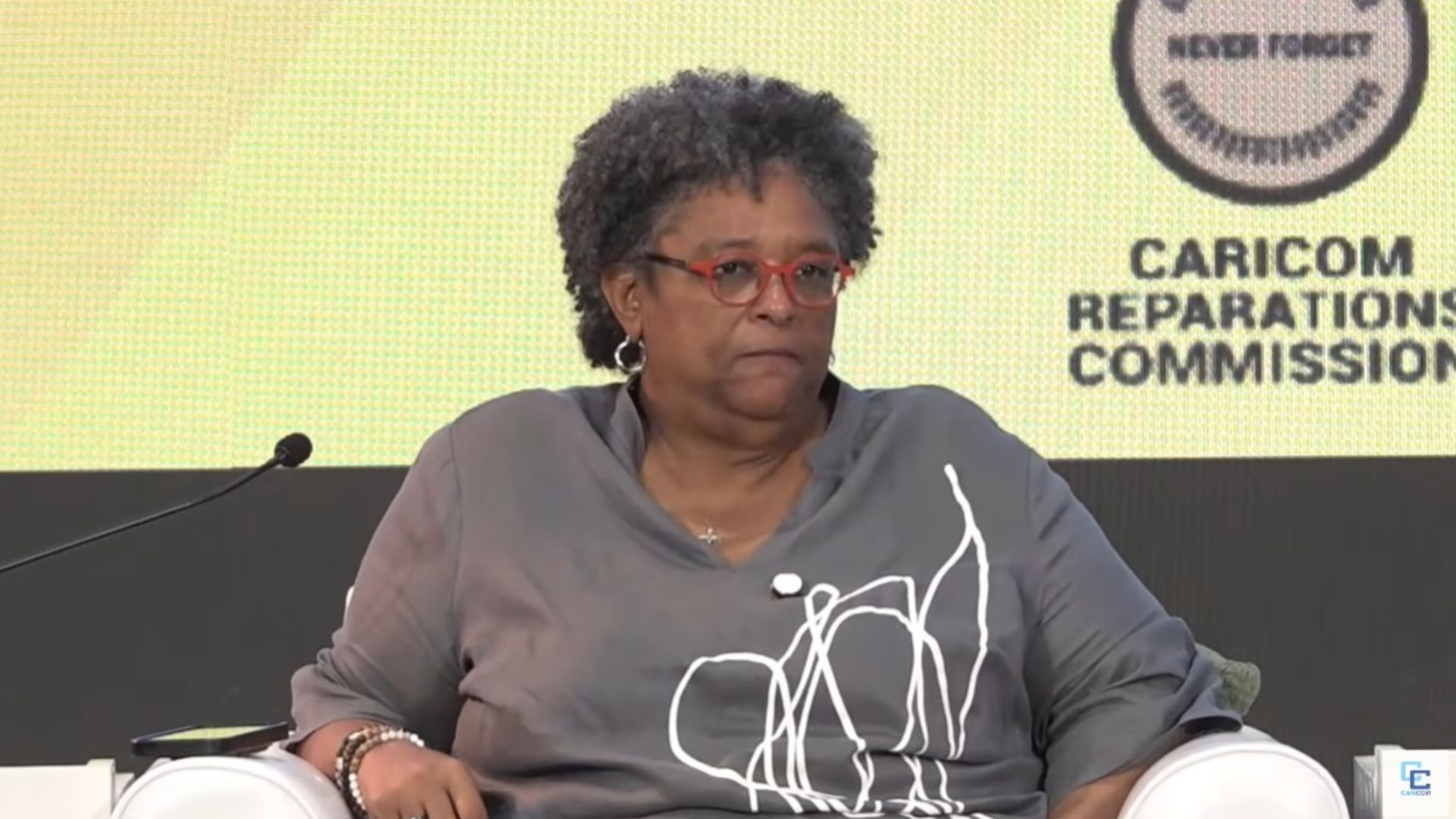
In one of the conference’s most anticipated panel sessions, Barbados Prime Minister Mia Mottley opened up about the intergenerational harms that continue to shape Caribbean societies centuries after abolition, explaining why the region remains unwavering in its demand for reparatory justice.
“The damage is deep psychologically, economically, it is real,” Mottley emphasized during her remarks.
She noted that Caribbean nations still grapple with the lingering societal and structural consequences of a colonial system built on violent extraction and dehumanization, impacts that persist across nearly every sphere of public life. For example, Mottley pointed to the persistent “eye-servant mentality” shaped by the era of enslavement, where workers only exerted effort when directly monitored by an overseer — a cultural norm that continues to shape labor attitudes across the region today. She also cited ongoing inequities in land access in Barbados and persistent achievement gaps in Jamaican education as tangible, modern outcomes of historical exploitation.
Addressing widespread criticism and pushback from former colonial powers that the reparations movement seeks financial ruin for modern nations, Mottley clarified that the movement’s core goal is redress, not retaliation. “We have no desire to bankrupt anybody, but we have a desire for justice,” she said.
Her comments came as the reparations issue has returned to the top of the global human rights agenda, with growing discussion of viable legal and diplomatic pathways Caribbean nations can pursue to secure binding reparations.
Sir Hilary Beckles, Chairman of the CARICOM Reparations Commission, used his address at the conference to stress the dual urgency of expanding public understanding of the movement’s goals and sustaining the current political momentum to advance a cohesive, long-term strategy. Beckles argued that the Caribbean region remains defined by its colonial legacy in ways that are often overlooked in global discourse.
“…We are still the most colonised part of the world. All across our archipelago we still have colonies,” he stated.
While Beckles acknowledged that low-level division and doubt still persist within the broader global reparations movement, he stressed that the current wave of international support creates an unprecedented opening to advance concrete progress. “There is still some division, but we have to move with this energy source that is now before us and to… roll out the strategy; managing this moment is now the imperative.”
This renewed push for action builds directly on the groundwork laid by the UN’s March 2024 resolution. Spearheaded by Ghana, the resolution passed with overwhelming global support, earning 123 votes in favor, just three opposing votes, and 52 abstentions. It formally calls for the development of structured reparations frameworks and prioritizes investment in historical research, public education, intergenerational healing, and formal legal justice.
Conference Chairman Rodney Grant laid out the case for a new, action-focused approach in opening remarks ahead of the conference’s official start. “We need an action-oriented outcome document that is built around the CARICOM ten-point plan, in fact, the revised CARICOM ten-point plan that speaks about the period of enlightenment,” he explained.
That revised 10-point strategic plan is the centerpiece of the conference’s mandate. CARICOM organizers note the gathering was designed to deliver clear, practical guidance for implementing the plan, and to turn recent political and global momentum into tangible progress through legal and institutional channels.
A core priority of the conference was also expanding the movement beyond formal government and official reparations commission channels. Regional leaders issued a collective call for greater grassroots public participation, urging ordinary people across the region and global diaspora to add their voices to the campaign. Leaders emphasized that the next phase of the movement cannot rely solely on regional governments or established reparations bodies — broad popular support is critical to demonstrating the urgency of the demand for reparatory justice.