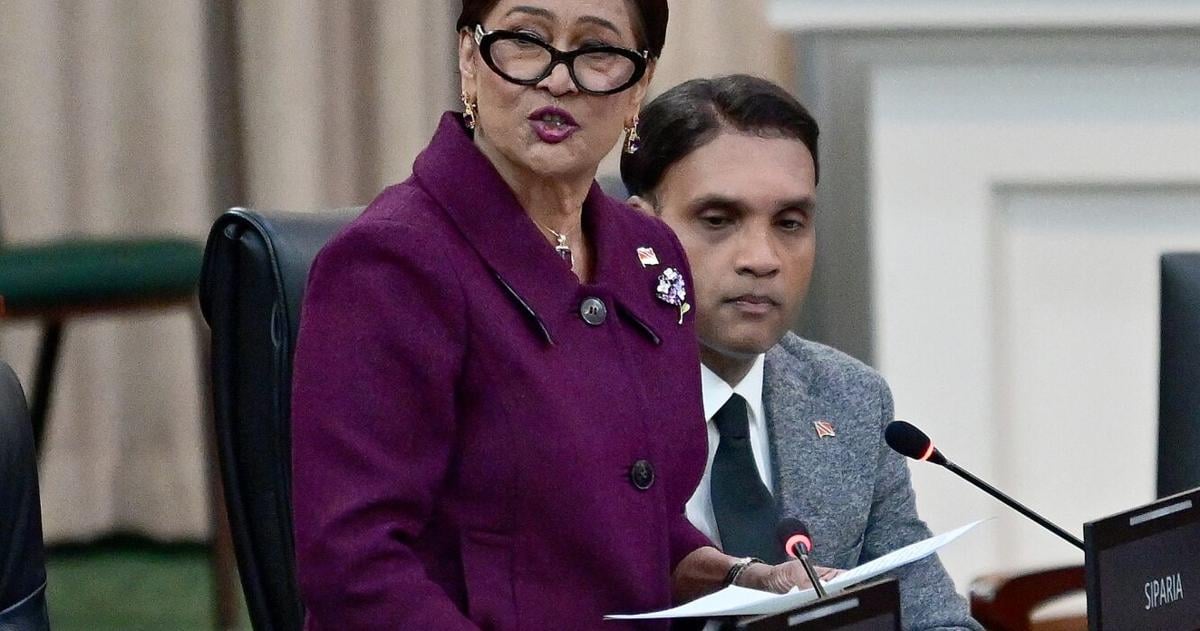
With just hours remaining before a nationwide state of emergency (SoE) was set to expire, Trinidad and Tobago Prime Minister Kamla Persad-Bissessar introduced a sweeping new anti-crime bill to parliament on Wednesday, locking in a permanent framework for targeted crackdowns on gangs, illegal firearms, and drug trafficking networks.
Unveiled as the Special Operations Bill (SOB) 2026, the new legislation draws core goals from the earlier Zones of Special Operations (ZOSO) Bill, but includes critical structural changes that ease its path to passage. Unlike the ZOSO Bill, which required a three-fifths supermajority vote to approve, the SOB can pass into law with the governing party’s simple majority, eliminating the need for cross-aisle support to advance the government’s crime-fighting agenda.
In a forceful address to lawmakers gathered at Port of Spain’s Red House, Persad-Bissessar emphasized that the end of the current state of emergency would not mark a retreat in the government’s war on violent organized crime. She warned criminal actors, their financial backers, and enabling associates that “there will be no sanctuary” for them as the transition to the new permanent framework takes effect. “The full lawful power of the State is coming for you,” she declared, drawing thunderous desk-thumping support from governing party legislators.
The core purpose of the SOB is to preserve the security gains made under the outgoing state of emergency without extending the broad temporary emergency powers. Under the legislation, designated policing districts will be established to enable sustained, targeted special operations, backed by the Trinidad and Tobago Defence Force when necessary. The Commissioner of Police will appoint a special operations lead for each district, while the Chief of Defence Staff will assign a military liaison for any deployments.
In districts where violent gang activity, illicit weapons trafficking, and widespread drug trade create threats that exceed the capacity of standard policing, authorities will be authorized to temporarily cordon off areas, impose curfews, regulate entry and exit, and exercise enhanced search, seizure, arrest, and detention powers – all of which will remain subject to judicial oversight, the Prime Minister clarified. She stressed that these measures are tailored to target criminal networks, not penalize law-abiding residents: “When gangs impose illegal curfews, extort businesses, recruit children, and drive families from their homes, they attempt to replace the authority of the State with the authority of the criminal gun. This bill gives protective services the lawful power to break that control, restore public safety, and return these areas to the people who live there.”
To counter criticism of uneven application of justice that plagued previous administrations, Persad-Bissessar explicitly rejected what she called a “two-tiered justice system” that allowed well-connected criminals to avoid accountability under the former People’s National Movement (PNM) government. “Criminals operating from upscale Westmoorings, St Clair or Federation Park will be treated in the same manner as those operating from Laventille, Arima or Siparia, or from anywhere else,” she said. “Money will no longer buy immunity, status will not prevent investigation, and political connections will not provide protection.”
The Prime Minister also moved to address longstanding civil society concerns over excessive use of force and abuse of power by embedding strict human rights safeguards into the text of the bill. All officers deployed to special operations, including military personnel, are required to complete training in human rights, lawful use of force, community engagement, and conflict de-escalation. Within cordoned operation areas, all officers must use body-worn cameras, register all deployed weapons, and formally document all resident complaints. Detainees will be guaranteed access to medical care and visitation rights, and all enhanced law enforcement powers remain subject to ongoing judicial review. The bill also mandates formal joint cooperation protocols between police and defence forces, as well as independent standard operating procedures for each service.
To ensure parliamentary transparency, the legislation requires monthly operational reports to be submitted to the Prime Minister and the relevant cabinet ministers overseeing police and national security. An annual public report must also be tabled before the full parliament, creating a formal mechanism for legislative oversight of ongoing special operations. Persad-Bissessar noted that these accountability measures directly address criticisms raised against earlier anti-crime legislation, balancing robust operational power for security services with clear protections for civilian rights.
She also issued a direct challenge to the opposition PNM, saying the party can no longer hide behind procedural objections that derailed the earlier ZOSO Bill. The new legislation, she argued, centers the rights of law-abiding communities that have borne the brunt of gang violence: grieving parents who have lost children to violent crime, families terrorized in their own homes, small business owners facing daily extortion demands, and young people targeted for gang recruitment.
As the current state of expiration came to an end on Thursday, Persad-Bissessar closed her address by repeating her stark warning to criminal networks: the expiration of temporary emergency powers is not a signal of weakened resolve. “The State of Emergency may end, but there will be no sanctuary for you,” she said. “We will find you, dismantle your networks, seize your drugs, guns and criminal proceeds, and bring you before the courts. Your money, status and political connections will not save you. The full lawful power of the State is coming for you.”
Parliament is scheduled to open debate on the Special Operations Bill 2026 tomorrow.