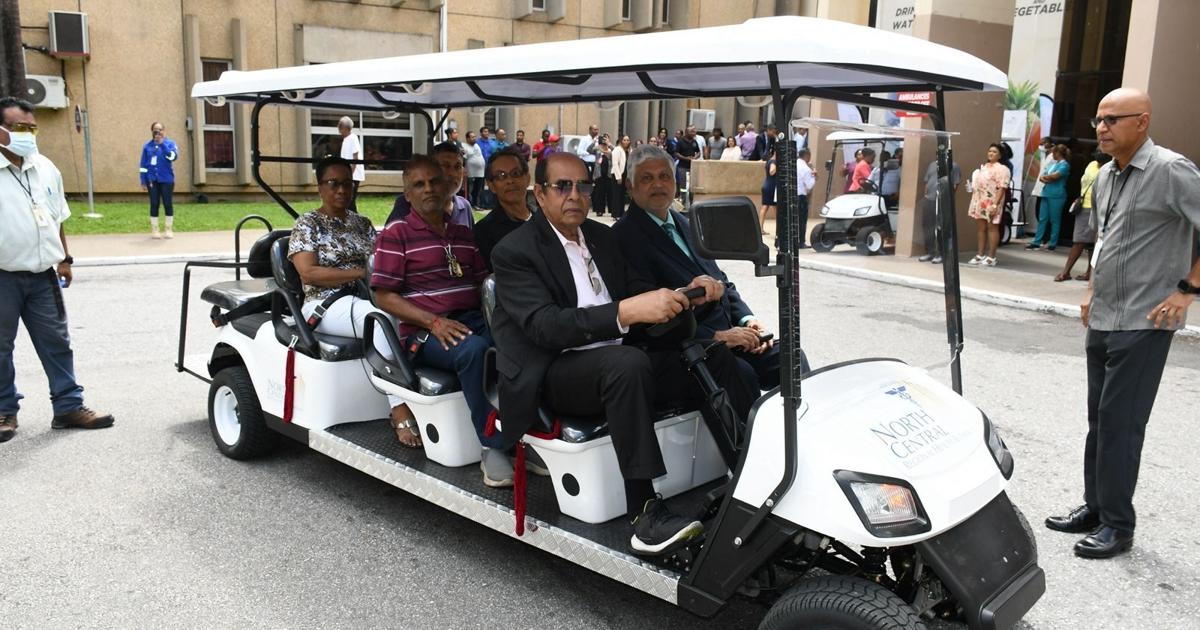
In a patient-centric upgrade aimed at easing navigation across the sprawling Eric Williams Medical Sciences Complex (EWMSC) in Mt Hope, the North Central Regional Health Authority (NCRHA) launched two new eight-seater golf carts yesterday to offer complimentary mobility assistance to patients and their families.
According to an official press release from the regional health governing body, the shuttles will be permanently stationed at key high-traffic locations: the complex’s main entrance and its cluster of outpatient clinic areas. Their core function will be to transport users between the facility’s public car park and clinical zones, eliminating the need for visitors to walk long distances across the large campus.
The initiative was designed to target vulnerable groups that face the greatest challenges navigating the extensive medical compound. Officials noted that elderly patients, individuals with permanent or temporary limited mobility, people living with mobility impairments, and any other members of the public who struggle with long walks will benefit most from the new service.
Currently, the shuttle service is scheduled to operate daily from 6 a.m. to 10 p.m., covering the majority of the complex’s operating hours for outpatient appointments, inpatient visits, and other public access periods.
NCRHA Chairman Dr Tim Gopeesingh lauded the new project during the launch, emphasizing that high-quality patient care extends far beyond clinical treatments and procedures. “For us, patient care is not only about the clinical services we provide. It also means ensuring that patients and their families are comfortable and able to move around our facilities with ease,” he explained, framing the shuttle service as a small but meaningful investment in improving the overall patient experience at one of Trinidad and Tobago’s major public medical facilities.
Health system observers note that investments in patient comfort infrastructure like this often address longstanding unmet needs at large medical campuses, where mobility barriers can add unnecessary stress to already vulnerable patients and their caregivers ahead of appointments or medical visits.