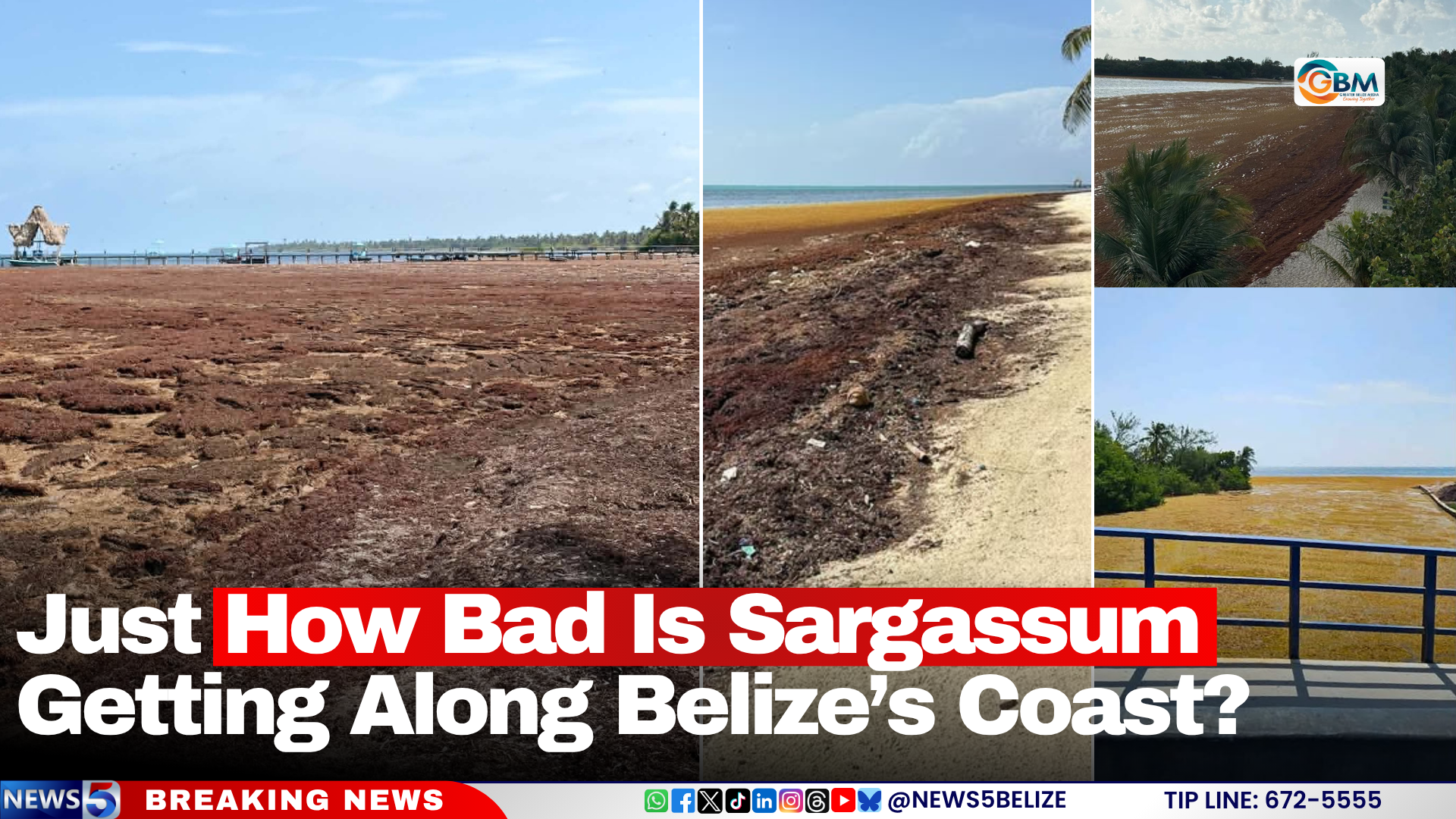
September 17, 2026 — A historic, unrelenting surge of sargassum seaweed is overwhelming Belize’s coastal areas, leaving local communities, tourism operators, and government leaders scrambling to address a crisis that has grown far beyond usual seasonal patterns this year.
For long-time Ambergris Caye resident Rebecca Coutant, the 2026 sargassum bloom is the worst she has witnessed in her time living along the island’s shore. In a typical year, shifting September tides and active storm season naturally clear accumulated seaweed from Belize’s beaches, opening up shoreline access for residents and visitors alike. But 2026 has defied all expectations: large volumes of sargassum continue to wash ashore daily, with no sign of the natural clearing that usually comes by mid-autumn.
Coutant explained that even daily, intensive clean-up efforts by large coastal hotels have failed to stop the seaweed from piling up. In unmaintained areas, the accumulated sargassum forms thick mounds stretching 10 to 20 feet out from the shore, making once-accessible beaches completely unusable. Many local residents now travel long distances across the island to find clear stretches of water for swimming, turning a routine recreational activity into a major inconvenience.
Beyond disrupting daily life for locals, the unmanaged bloom has emerged as a major threat to Belize’s core tourism industry. Reynaldo A. Malik Jr., president of the Belize Hotel Association, argues that the burden of addressing the crisis cannot fall exclusively on private businesses. Undeveloped public stretches of coastline, which are the responsibility of national and local government authorities, act as ongoing sources of accumulated sargassum that spread to maintained areas. Malik stressed that a collaborative cross-sector plan is non-negotiable, noting that he has yet to see a comprehensive, actionable strategy that addresses the full scale of the problem. “It really does need a partnership,” he said.
Belize’s Prime Minister John Briceño publicly acknowledged the severity of the crisis during his recent State of the Nation Address, confirming that the sargassum invasion has already driven a measurable drop in tourist arrivals, particularly in high-demand coastal destinations including San Pedro, Caye Caulker, Hopkins and Placencia.
In response to the growing pressure, the Belize Tourism Board (BTB) has developed a national rescue plan with backing from the central government. The initiative will leverage existing BTB resources, paired with grants and low-interest loans from international financial institutions, to purchase specialized clean-up and interception equipment tailored to Belize’s unique coastal geography.
One local private enterprise has already developed a promising pre-shore interception system that could be scaled up as part of the national plan. Placencia-based marine technology firm Sea Solution Ltd. has designed a modular barrier system that stops sargassum from reaching shore before it can accumulate on beaches. Company owner and designer Edgar Carballo explained that the floating barriers can be repositioned to adapt to local current patterns, wind conditions, and coastal geography, making them flexible for use across different Belizean shorelines.
Each 200-meter barrier section extends 3.5 feet below the water’s surface and can hold up to 74 tons of floating sargassum. For the Placencia region alone, Carballo estimates that six to seven barrier units would be sufficient to intercept roughly 90 percent of incoming sargassum, without disrupting access to local shipping channels or harbor entrances.
For local residents like Coutant, expectations for an immediate, perfect fix are low. What coastal communities want most is tangible commitment from national leaders: clear action and ongoing attention to a crisis that is upending daily life and threatening the nation’s most important economic sector. “We don’t want a magic solution,” Coutant said. “We would love a magic solution, but we know there’s not a magic solution out there. But we want to feel like our government hears us and wants to help out.”