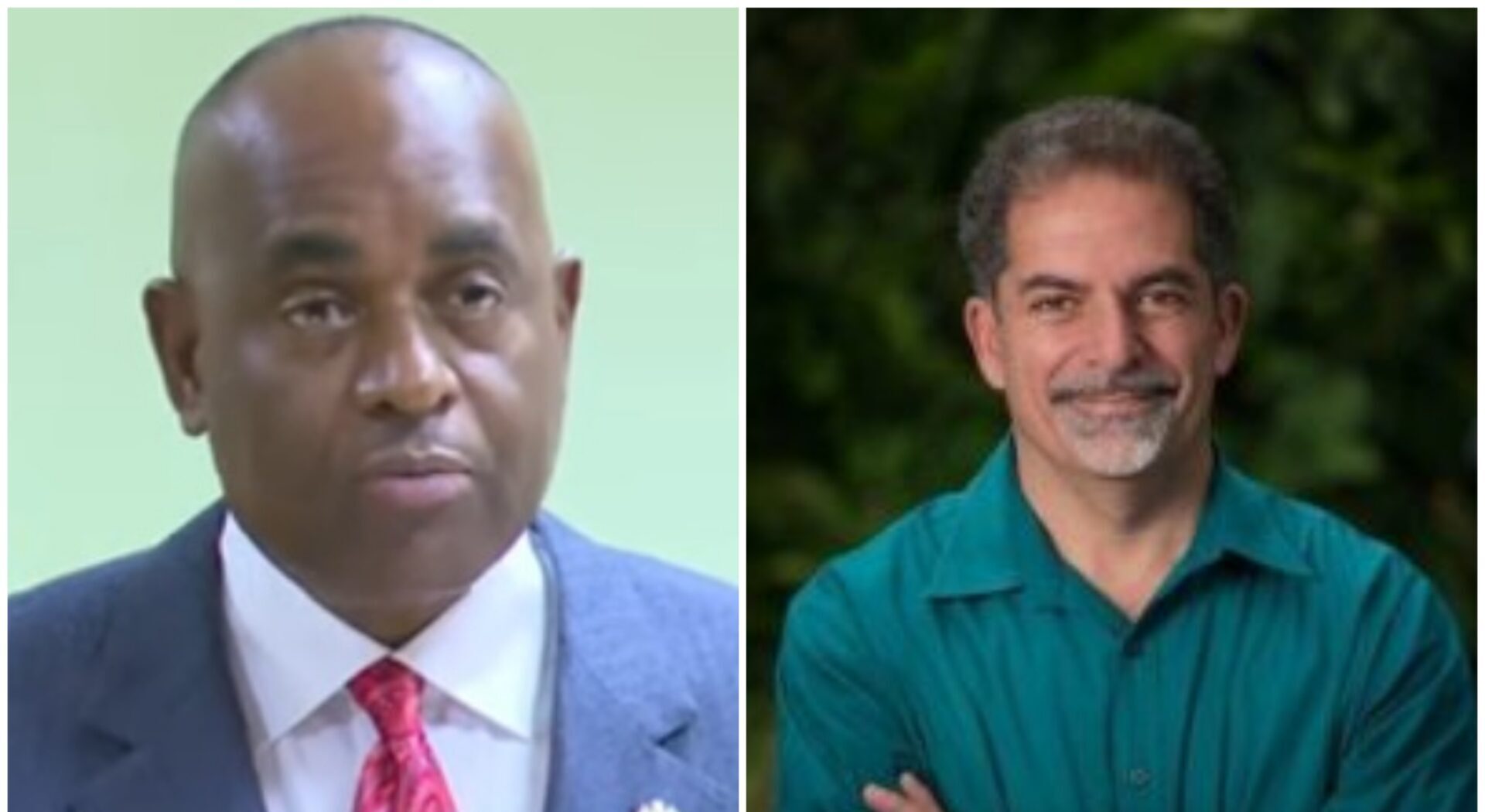
In a pointed open letter dated September 17, 2026, Dominican private sector leader Gregor Nassief has pushed back against misleading claims made by Prime Minister Roosevelt Skerrit during a September 9 press conference, laying out years of unaddressed misconduct in the country’s Citizenship by Investment (CBI) program, flaws in ongoing electoral reform, and what he calls a culture of intimidation that undermines Dominican democracy.
Nassief began by clarifying a core misrepresentation: he never claimed Skerrit had failed to respond to his repeated private correspondence about CBI irregularities. Instead, he argues that seven years of documented evidence of illegal pricing discounting has been met with empty promises and zero meaningful enforcement. The pattern of inaction, he says, stretches back to 2019, when he first submitted evidence that CBI citizenship was being sold well below the government-mandated price. By 2021, Skerrit acknowledged the government was aware of non-compliance, and by 2023, he pledged to crack down on discounting “with full force.” A 2023 stakeholder meeting convened after the United Kingdom revoked Dominica’s visa-free access for its citizens confirmed the severity of the problem, with all attendees agreeing illegal discounting had to stop immediately — and that enforcement only required action from the government’s own CBI Unit. Still, no changes followed.
Surveys Nassief conducted in 2024 and 2026 found illegal discounting in 80% and 100% of transactions surveyed respectively, with average discounts exceeding 50% of the regulated price. The CBI Unit’s own internal estimates, he notes, put current illegal transactions at 95% of all CBI activity. After half a decade of government inaction, Nassief reached out independently to Financial Intelligence Unit (FIU) director McKelson Ferrol in 2024, sharing full evidence and holding a formal meeting nearly two years ago. Skerrit later acknowledged the issue should be investigated by the FIU, but no results have ever been made public. Nassief stresses that no prolonged investigation is required to enforce existing pricing rules: the government could end illegal discounting within 48 hours if it chose to act. He leaves a pressing question unanswered by the prime minister: why has illegal discounting been allowed to continue for seven years, despite its massive cost to the Dominican national treasury?
To illustrate the financial damage, Nassief uses a simple analogy: illegal CBI discounting works like a scheme where licensed geothermal exporters illegally sell energy at half the regulated price, diverting billions in revenue that would otherwise flow to the public treasury into the hands of third parties. He estimates that over seven years, tens of billions in potential public revenue has been redirected through these illegal schemes.
Turning to electoral reform, Nassief refutes Skerrit’s claim that he has discouraged voter participation and registration. He explains his public criticism of the flawed reform process came after he was turned away when attempting to register to vote in January 2026, and that his letters have consistently called for full citizen participation. Comparing the electoral process to a sporting match, he argues that pointing out an uneven, unready playing field and an untrusted referee is not a call to abandon the game — it is a demand for a fair contest.
He challenges Skerrit’s claim that parliament passed electoral reform legislation with full confirmation that the Electoral Commission was ready to implement the new rules, asking whether the government shared final draft legislation with the commission in time for review, and whether the commission officially confirmed it was prepared to roll out new continuous registration and voter ID systems before parliament approved the bills. He also questions the prime minister’s claim that the recent Roseau North by-election could have proceeded without last-minute emergency legislative amendments, noting the changes were explicitly designed to address risks that eligible voters would be excluded from voter lists or turned away for lack of ID. Nassief says the electoral reform process has failed to deliver on the 2025 promise of renewed trust between Dominican citizens and public institutions, and calls for a reasonable delay to the upcoming general election to fix outstanding flaws: allowing sufficient time for voter registration, application processing, ID card issuance, accurate list publication, and targeted legislative amendments before the electoral register is frozen.
Nassief also addresses Skerrit’s attempts to frame his criticism as driven by personal financial interest, correcting the record on three policy issues: minimum wage hikes, the Alien Landholding Tax, and a loan from the AID Bank. He confirms he has repeatedly publicly supported minimum wage increases in both 2021 and 2025, and only criticized the abrupt implementation: the government gave the private sector just three days’ notice of the 2025 rate hike, despite the prime minister’s own Minimum Wage Advisory Board recommending more than six months’ notice to allow businesses to plan. During the 2021 COVID-19 pandemic, he similarly supported a wage hike but warned that implementing an unplanned increase while hospitality businesses faced massive losses and zero cash reserves would unnecessarily threaten jobs. He points to a stark contrast: while small hospitality employers struggled to keep staff on payroll during the pandemic, Skerrit moved into an official residence that costs Dominican taxpayers more than EC$600,000 annually in rent and related expenses.
On the Alien Landholding Tax, Nassief clarifies that his call for relief was not for his own Secret Bay resort development alone, but for all investors in government-approved projects, arguing the tax makes Dominica’s non-CBI vacation property market the least competitive in the Caribbean, and eliminating it would create a critical buffer against volatility in the CBI market. Regarding the AID Bank loan, he refutes Skerrit’s claim that Secret Bay took 50% of the total tourism facility, showing the development borrowed only 13% initially, repaid the full balance after Hurricane Maria, and later borrowed 17% of the facility, with an outstanding balance of just EC$1.5 million as of August 2026. He challenges the prime minister, who violated banking confidentiality to disclose Nassief’s loan details, to publish the borrowing details of all other recipients of the facility. He also corrects several minor factual errors cited by Skerrit: he is 59, not 60, and Secret Bay has 27 villas, not 46.
Nassief also calls out Skerrit’s defense of deploying security officers to monitor a private, invitation-only civic event held at the privately owned Fort Young Hotel in August 2026. Skerrit called the deployment “normal,” but Nassief argues that monitoring a lawful private meeting violates constitutional protections for freedom of assembly and expression, and asks what national security threat justified the surveillance, who authorized it, and under what law. He pushes back against Skerrit’s claim that open criticism is allowed freely in Dominica, noting that most Dominican citizens who depend on the government for jobs, contracts, housing, or public services stay silent out of well-founded fear of official retaliation.
He also raises urgent questions about the proposed $75 million cruise port agreement, which Skerrit claims will be finalized in weeks. Nassief asks whether there will be any public disclosure of the terms before the government signs a binding agreement, whether a public tender process was held, whether tourism stakeholders were consulted, what the length of the concession is, whether independent environmental, social, and value-for-money assessments will be completed, and who the beneficial owners of the contracted company are.
Reframing Skerrit’s framing of his criticism as contradictory or self-serving, Nassief says he remains grateful for past government support for his Secret Bay development, supports the CBI program as a whole, backs higher minimum wages, and encourages voter participation — he just demands better management, fair process, and transparency. He outlines five core demands: immediately end illegal CBI discounting, establish an independent commission of inquiry with an external forensic audit of 10 years of CBI program activity, fix all remaining electoral flaws before the upcoming general election, explain the deployment of security services to monitor the private meeting, and publish all terms of the proposed cruise port agreement before signing.
Nassief acknowledges he has held discussions with independent candidates and multiple political parties to share his concerns about the state of Dominica’s democracy and economy, and to propose alternative policy paths. He says seven years of unheeded warnings and ignored constructive criticism have left silence no longer a responsible option. “I would prefer to focus on investing, building businesses and creating employment. But the success of any business depends on the quality of the country in which we work and live. Fair elections, independent institutions, transparent public finance and equal application of the law are not and never should be political luxuries. They are the foundation of confidence in our country,” he wrote.
He called for an end to the culture of fear and intimidation, noting that “Loyalty to a person or party must never come before loyalty to Dominica. Disagreement should never make a Dominican afraid to enter a room or speak their mind.” He closed by challenging Skerrit to a public, moderated discussion of all national issues before the media, writing “Let us put Dominica first. Our people deserve more, and together we can build a better future.” The letter includes a note highlighting key questions in bold, urging the Dominican press to raise these issues at the prime minister’s next press conference.