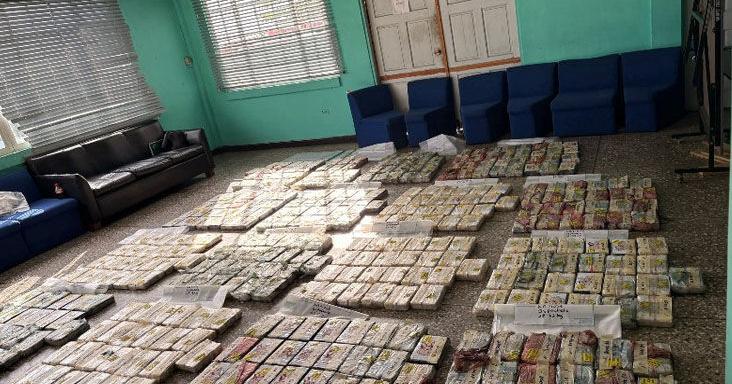
One year after the United National Congress (UNC) administration took office in Trinidad and Tobago, Prime Minister Kamla Persad-Bissessar has announced a landmark milestone in the country’s war on illegal narcotics: security forces have intercepted contraband drugs with a combined local street value of approximately $1 billion. The announcement comes on the heels of a major high-profile cocaine bust carried out by the Trinidad and Tobago Coast Guard earlier this week, a seizure that underscores the government’s ongoing push to disrupt transnational and domestic drug trafficking networks.
On Monday, Coast Guard operatives intercepted a shipment carrying 440.2 kilograms of cocaine, valued at an estimated $204.5 million on local streets, and took four men into custody following the operation. Speaking to reporters from the Trinidad Express on Wednesday, Persad-Bissessar, who also leads the country’s National Security Council, framed this latest bust as clear evidence that the country’s security apparatus is delivering measurable progress against the illegal drug trade.
Going beyond the announcement of aggregate seizure numbers, the Prime Minister pulled back the curtain on the structure of the narcotics trade in the small Caribbean nation, arguing that large-scale drug shipments cannot be funded or operated by low-level couriers or small-time criminal operators. She emphasized that well-connected, wealthy business leaders are the true masterminds behind most large-scale trafficking activity in Trinidad and Tobago. “Trinidad is a small place. Everyone knows it’s wealthy so-called business people who are behind drug trafficking. No poor person or small operator can traffic a billion dollars’ worth of drugs,” she stated.
This marks a continuation of the administration’s long-stated pledge to target every tier of drug trafficking networks, not just low-level street dealers and street gangs that handle the final stages of distribution. Persad-Bissessar has made dismantling the “big fish” financiers and criminal kingpins that operate behind the scenes a core priority of her government’s national security agenda.
When asked whether investigators would move up the criminal chain to apprehend the organisers and funders behind the latest cocaine seizure, the Prime Minister declined to prejudge the ongoing investigation, noting that local police and partner international law enforcement agencies are conducting a full, thorough inquiry. While she would not speculate on procedural outcomes, she made clear her expectation that the probe will result in arrests of higher-level players in the network. She also alleged that major trafficking operations are actively enabled by corrupt actors within local financial institutions, who facilitate the movement of United States currency — the primary currency used by international drug cartels, which do not transact in the local Trinidad and Tobago dollar.
Persad-Bissessar confirmed that a number of local businesses tied to narcotics activity are already under active surveillance by both local and international law enforcement. While members of the public have not seen high-profile arrests of these elite figures to date, she says behind-the-scenes action is already underway to disrupt the cross-border movement and criminal business operations of trafficking-linked individuals. When pressed on whether investigators would trace the financial trail through bank accounts, corporate holdings, real estate and other assets tied to the latest shipment, the Prime Minister said law enforcement would follow all formal investigative protocols and procedures.
International collaboration is a central pillar of the government’s campaign against organised drug crime, Persad-Bissessar confirmed. Over the past 18 months, key international partners including the United States and the United Kingdom have implemented a series of punitive measures against suspected trafficking figures, including visa revocations, restrictions and entry refusals, and the Prime Minister says she expects this cooperative support to continue. When asked if cross-border cooperation includes intelligence sharing, maritime surveillance, vessel tracking, financial investigations, personnel training and joint operational work, she confirmed the partnership includes all of these measures and additional coordinated initiatives. She declined to comment on whether foreign intelligence supported the latest cocaine interception, as well as questions about the cocaine’s origin, intended destination, and whether Trinidad and Tobago is being used as a transshipment point or final market, noting that these details remain part of confidential ongoing investigations.
The latest large seizure has reignited public debate over the country’s ability to secure its extensive territorial waters from sophisticated transnational trafficking operations. Acknowledging that no border security system is perfect and that some illicit shipments are likely to evade detection, Persad-Bissessar reaffirmed that security forces have made consistent, tangible progress in interceptions. When asked whether the government plans to allocate additional resources — including new coastal vessels, advanced surveillance technology, radar systems, drones, aircraft and other equipment — to boost the Coast Guard and police’s maritime interdiction capabilities, she confirmed additional resources are being deployed but declined to share specific details for operational security reasons.
The Prime Minister also tied recent gains in intelligence gathering to the national State of Emergency (SoE), which is scheduled to expire on September 17. She explained that the emergency public security measures, paired with major upgrades to information technology hardware and software at the Strategic Services Agency (SSA), have significantly boosted the country’s national intelligence gathering capacity. With emergency powers set to lapse, Persad-Bissessar says the government stands ready to reimpose emergency measures or take other extraordinary action if national security conditions deteriorate. She noted that the government has already delivered tangible progress, with overall crime rates and particularly murder rates falling across the country, but added that “if there is a reversion to an increase in crime the government has no problem taking every action available to us.”
Throughout her remarks, the Prime Minister reiterated a clear, uncompromising message: no amount of wealth, social status, or elite business connections will shield actors involved in the illegal drug trade from prosecution and disruption under her administration.