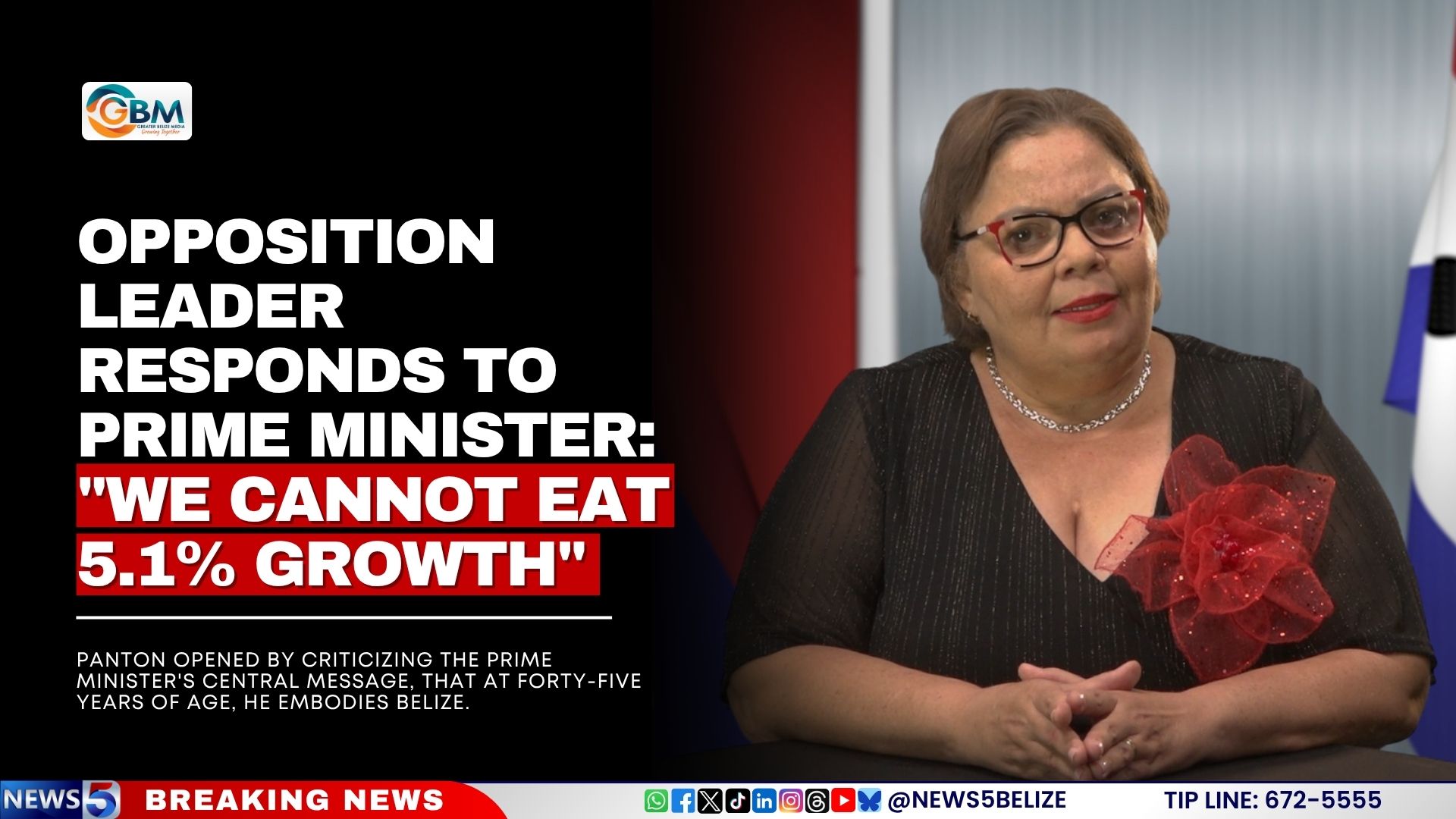
In a direct response to Prime Minister John Briceño’s 2026 State of the Nation Address delivered on September 16, opposition leader Tracy Panton has launched a pointed critique of the incumbent government’s policy framing, arguing that official economic indicators do not align with the daily struggles of ordinary Belizeans. Panton’s address pushed back against Briceño’s opening claim that, at 45 years old, he embodies the nation of Belize, re-centering the identity of the country around working people rather than political leadership.
“He told us to look at him, that at forty-five, he is Belize. Mr Prime Minister, with respect, you are not Belize. Belize is the cane farmer in Orange Walk, the fisherman in Sarteneja, the market vendor trying to make a living, and the mother in Belize City trying to stretch a dollar that simply cannot be anymore,” Panton stated in her opening remarks.
At the core of Panton’s critique is the disconnect between the government’s headline economic data and household financial pressures. Briceño highlighted a 5.1% national economic growth rate, 98% employment, and a stable Belizean dollar as markers of a successful economy — metrics Panton says mean nothing to families struggling to cover basic costs.
“The Prime Minister says the economy is growing at five point one per cent. He says employment is at ninety-eight per cent. He says Belize has a strong dollar. I have a very simple question: Are we feeling it? When you go to the grocery store, are we feeling the five point one per cent growth? When you fill your vehicle with fuel approaching sixteen dollars a gallon, are we feeling it? When we pay our electricity bill, when we pay rent, when we try to put food on the table, an economy cannot simply look good on paper. It has to work for the people,” Panton argued.
Panton also pushed back against government celebration of Belize’s recently reaffirmed B-/B credit rating, noting that the ranking remains deep in speculative grade and offers no tangible relief to struggling households. “We cannot eat five point one per cent growth. We cannot put a credit rating in our gas tanks, and we cannot tell struggling families that the economy is doing wonderfully when our money buys less and less,” she added.
Beyond economic metrics, Panton called out the government’s failure to address the ongoing national electricity crisis. While Briceño offered explanations for spiking utility costs, Panton emphasized that Belizeans do not need excuses — they need immediate action to bring down prices.
She further highlighted that the government’s temporary fix for lost electricity supply from Mexico’s national utility CFE, which cut Belize’s supply to zero earlier this year, only highlights long-term policy failure. The government has filled the gap with a six-month diesel-powered arrangement, while promised solar and battery storage projects first announced in 2023 are not scheduled to come online until 2027. While Panton acknowledged the partial relief of removing GST from residential electricity bills under $200, she noted the policy does nothing to resolve the underlying crisis of unreliable and unaffordable energy that plagues the country.
Turning to national security, Panton addressed the recent September 10 Sarstoon River sovereignty incident, praising the courage of civilian Belizeans who participated in the event but raising critical concerns about the government’s failure to protect national territory. “I salute every Belizean that was present. Their courage was real. Their patriotism was real. But we must not confuse courage with security. What happened on the Sarstoon should trouble us. Belizeans were challenged while travelling in territory that belongs to us. Brave citizens found themselves on the frontline of a sovereignty issue. That cannot become normal,” she said.
Panton called for full resourcing, modern equipment, and clear political backing for the Belize Defence Force, stressing that the nation should never rely solely on civilian courage to defend its sovereignty.
A large portion of Panton’s address focused on issues entirely omitted from the Prime Minister’s State of the Nation address, starting with demands for greater accountability and anti-corruption action. “Where was the serious discussion about corruption and accountability? Where was the response to the questions being raised about unexplained wealth and conduct at senior levels of the public service? While nurses struggle and patients search for medications, Belizeans have every right to demand accountability from those entrusted with public resources. We deserve answers,” she stated.
Panton also highlighted other unaddressed everyday concerns: new village trade taxes that place added burden on small entrepreneurs and street vendors, a persistent school transportation crisis that leaves parents scrambling to get children to class even as the government delays delivery of promised new buses, and plummeting morale among under-resourced police officers. “These are not small matters. They are the everyday realities of Belizeans. And a State of the Nation Address should confront them. Because sometimes what a government chooses not to talk about tells us just as much as what it does,” she noted.
Closing her address, Panton laid out an alternative progressive vision for Belize that centers working people, rejecting the Prime Minister’s framing that he equals the nation. She called for a country where economic growth translates to tangible household gains, public procurement and contracting are fully transparent, corruption allegations are investigated regardless of who is involved, energy is reliable and affordable, the military has the resources to defend national sovereignty, and young Belizeans can build prosperous lives at home.
“I believe we can build a Belize where economic growth reaches the kitchen table, where public money is treated with respect because every dollar earned is earned on the backs of the Belizean people, and where contracts and procurement are transparent. Where allegations of corruption are investigated and wrongdoing has consequences regardless of who is involved. Where families can afford electricity and the government has a real energy security plan. Where our soldiers have the resources they need to defend our sovereignty, and where a young Belizean can work hard, build a home, raise a family, and believe that their best future is right here at home,” Panton said.
She concluded by reaffirming that Belize belongs not to the government or any single political party, but to all its people, who must always be the nation’s first priority. “Mr Prime Minister, this morning you told Belizeans to look at you, that at forty-five, you are Belize. I see it differently. Belize is not one man. Belize is all of us. Our country faces serious challenges. I refuse to believe that those challenges are greater than our people. We can do better. We must do better together. We will do better. Belize does not belong to a government. It does not belong to a political party. Belize belongs to its people. It is the people who must always come first.”