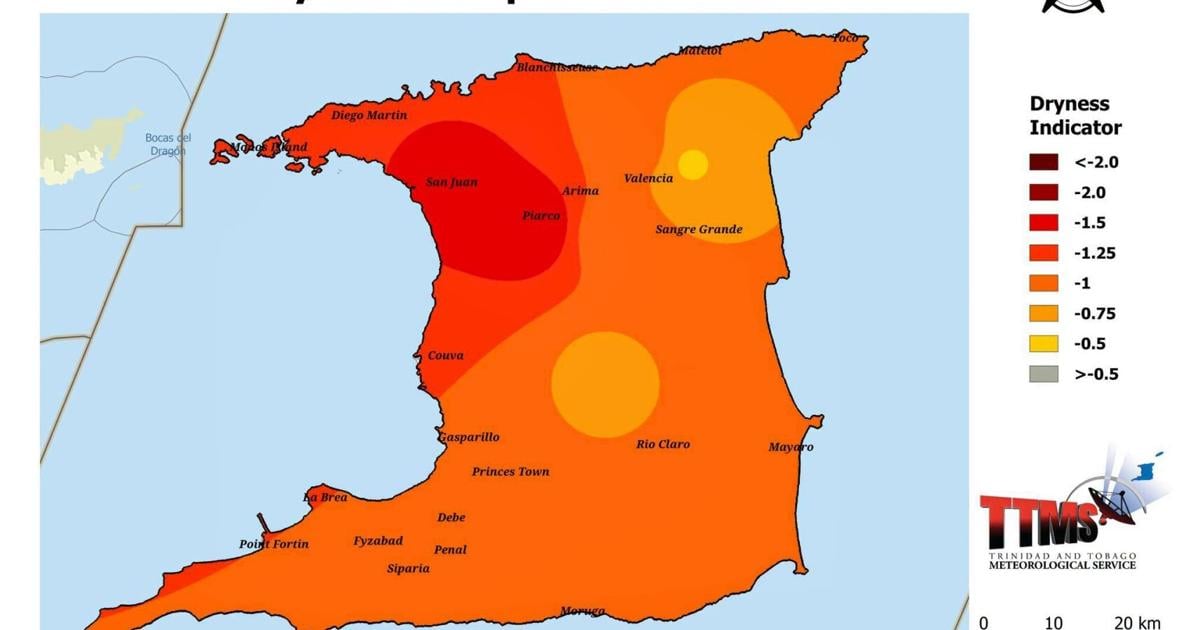
As the 2026 Atlantic hurricane season reaches its historically active peak, the twin-island nation of Trinidad and Tobago is facing an unexpected and growing climate threat: escalating dry conditions that are projected to worsen into 2027, according to an updated official outlook released by the Trinidad and Tobago Meteorological Service (TTMS) this week. Right in the heart of what is typically a wetter hurricane period, the country is already grappling with extreme heat stress, with recent maximum temperatures hitting 33°C in Trinidad and 32°C in Tobago. When adjusted for heat index – the perceived temperature that accounts for humidity – those values rose to 36°C and 35°C respectively, with forecasters projecting continued hot, mostly sunny conditions in the immediate short term. The current drought projection is built on analysis of the three-month Standardized Precipitation Index (SPI) covering July through September 2026, which shows an uneven but widespread pattern of below-average rainfall across both islands. In July, rainfall totals were near normal across most of Trinidad and sections of Tobago, but the Crown Point monitoring station in Tobago recorded just 72% of its typical monthly precipitation, at 115.8mm. Piarco, Trinidad’s main monitoring site, logged 215mm of rain, 94% of its long-term average. Over the full May-to-July period, extreme dryness was confirmed at Crown Point, south-western Tobago and Valencia, with slightly drier-than-normal conditions across central and north-eastern Tobago and north-eastern Trinidad. South-western Trinidad has already slipped into a moderately dry spell, with early drought development already underway. Nationwide, the number of consecutive dry days has risen steadily between June and July 2026, while the frequency of heavy rainfall events of 10mm or more has dropped across both islands. Looking ahead to September, the TTMS has issued an initial drought watch for most of Trinidad, with the highest risk of agricultural drought developing across the lower Caroni River basin from Piarco westward. Moderately dry conditions are expected in south-western Tobago, while central and north-eastern Tobago, north-eastern Trinidad, and the upper Caroni River basin will remain locked in persistent dry conditions through the end of the month. The trend of worsening dryness is expected to accelerate through October. By the end of that month, the TTMS projects that official drought warning conditions will take effect across all of Tobago and north-eastern Trinidad. The upper Caroni River basin will remain moderately dry, while the drought watch will expand from the lower Caroni westward into north-western Trinidad. That pattern is expected to hold through the end of November, with Tobago remaining under drought warning, drought watches in effect across the entire Caroni River basin extending into north-western Trinidad, and moderately dry conditions across northern Trinidad. Overall, short-term drought is projected across Tobago, north-eastern Trinidad, and the lower Caroni River basin between October and November 2026. Beyond the immediate three-month outlook, long-term projections raise even greater red flags. By December 2026 or January 2027, the TTMS warns that a long-term drought watch may need to be enacted, driven by a developing moderate-to-strong El Niño pattern forecast for late 2026. El Niño events across the region typically suppress wet season rainfall, push temperatures higher, and increase evaporation rates across northern South America and the Lesser Antilles, a pattern that could extend drier-than-normal conditions through the 2027 dry season. The growing drought poses major, immediate risks to two critical sectors of the nation’s economy: agriculture and public water supplies. For agricultural producers, irregular rainfall, extended hot spells, and falling soil moisture have combined to create elevated risks for both standing crops and livestock. Water resources are already under pressure, with reduced recharge rates for dams, natural streams, and underground aquifers cutting into the volume of available water for public distribution systems. In response to the developing crisis, the TTMS has issued a series of advisories for government agencies, businesses, and residents. Water and energy authorities are urged to roll out sustained water conservation measures immediately to protect reserves. The general public is asked to adopt careful water storage and usage habits to reduce unnecessary waste. For farmers, forecasters recommend close monitoring of on-farm water use, investment in improved irrigation and on-site water storage, regular weeding to cut down on water competition between weeds and crops, and increased surveillance for pest populations that thrive in drier-than-normal conditions. The TTMS is urging all relevant government and private sector stakeholders to use the updated drought outlook to update contingency plans, strengthen drought management protocols, and expand early warning systems to respond to the worsening conditions ahead.