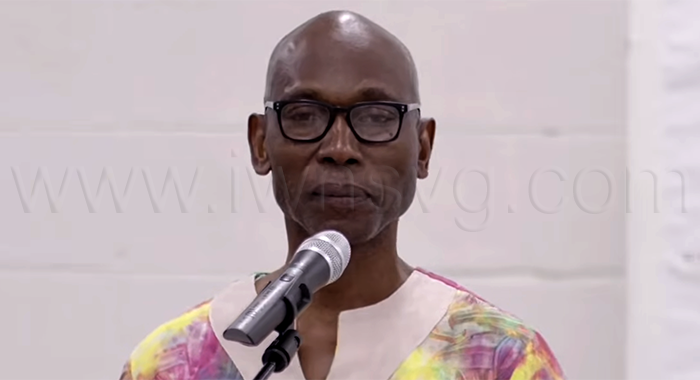
At the 2026 Oscar Allen Memorial Emancipation Lecture hosted by the UWI Global Campus in Kingstown, prominent lawyer, social commentator and former Speaker of St. Vincent and the Grenadines’ House of Assembly Jomo Thomas delivered a searing critique of the Caribbean’s self-framing as a post-colonial, emancipated region. Thomas argued that across the bloc, the Caribbean remains intellectually and structurally bound to its colonial legacy, with institutional failures perpetuating this unresolved connection to empire.
The annual lecture, which this year carried the theme “We want to be wise: Education, identity, and liberation in the modern post-colonial Caribbean,” was headlined by educator and climate resilience expert Andrew Simmons, who opened the event by formally calling for Oscar Allen — a late beloved Vincentian community organizer — to be granted national hero status for his lifelong work uplifting poor and marginalized communities. Thomas, speaking as a featured respondent, used the occasion to reflect on Allen’s legacy and tie it to broader ongoing struggles for decolonization across the region.
In a blunt address to an audience of state officials, diplomats, academics and grassroots activists, Thomas rejected the core premise that the Caribbean has achieved a meaningful break from colonial rule. As key evidence of this unfulfilled emancipation, he highlighted gaps in regional education policy: while English and mathematics are mandatory core subjects across all CARICOM member states, Caribbean history is not required coursework in any country of the bloc. This erasure of the region’s own story from formal learning, Thomas argued, exposes the fiction of post-colonial status. “We live a lie to ourselves when we say we are emancipated,” he stated, echoing Allen’s own famous mantra: “Emancipation ain’t reach yet. Emancipation still coming.”
Thomas also shared a personal journey with Allen’s legacy, admitting he was not always an admirer of the organizer’s quiet, understated approach. Early in his career, Thomas viewed Allen as too abstract, too soft-spoken, and not fiery enough for grassroots political work. That perspective shifted entirely when the two worked together alongside the People’s Movement for Change, where Thomas came to recognize what he calls Allen’s “simple profundity.” Though Allen spoke in gentle, approachable language, close listening revealed deep, transformative truths about power and liberation in the Caribbean. One quote from Allen that stuck with Thomas through decades of public life is the organizer’s reminder: “Brothers and sisters, the people are always watching.” Thomas illustrated this truth with a small personal example: when he changed his daily running route, local residents quickly noticed and asked if he had given up running, proving that ordinary citizens constantly hold public figures accountable, even when leaders assume no one is paying attention.
Tying Allen’s legacy to a broader global tradition of critical intellectual work, Thomas drew on insights from leading thinkers across generations. He cited Albert Einstein’s famous argument that “imagination is more important than knowledge,” explaining that knowledge only catalogues what is already understood, while imagination opens new pathways and transformative possibilities for liberation. This, Thomas noted, is exactly the expansive thinking Allen championed through his lifelong advocacy for intentional, critical reading. Thomas recalled a poem he wrote decades ago titled “Dreaming About Dreams,” whose closing line — “I don’t want to dream dreams that are just a dream; I want to dream dreams that we can live” — became a favorite refrain for Allen, who would greet Thomas with the line “the dreamer, dream real dreams” at every meeting.
Turning to the core political responsibility of intellectuals and activists, Thomas referenced the iconic 1968 essay widely associated with Noam Chomsky that frames the core role of the intellectual as telling unvarnished truth to power. He echoed this with a quote from South African senior counsel Muzi Sikhakhane, author of *The Odyssey of Liberation*: “We must tell the truth until it kills us.” Paraphrasing Sikhakhane, Thomas added, “A people who is not truly liberated cannot be said to be free,” noting that Allen would have fully embraced this stance. “Allen would have died of truth … would have died for the truth,” Thomas said.
To illustrate Allen’s belief that reading is a fundamentally emancipatory act, Thomas turned to the little-remembered story of Elma Francois, a Trinidad-based Vincentian labor organizer and activist who is honored as a national heroine in Trinidad and Tobago but remains largely unknown in her native St. Vincent and the Grenadines. After Francois successfully defended herself against a treason charge in Trinidad, she was asked how she secured her acquittal. Her famous reply, Thomas recounted, was: “I read. People must read. But more importantly, they must not read stupidness.” For Thomas, this line is a perfect epitaph for Allen, who was a lifelong lover of books and constantly urged his colleagues and comrades to deepen their political and historical understanding through serious, critical study rather than empty intellectual frivolity.
While Thomas did not directly address Simmons’ call for formal national hero status for Allen, his remarks highlighted the deep ethical and intellectual stakes of how communities remember legacy of movement leaders like Allen. He closed his address by returning to a biblical verse Allen often cited: “act justly, love mercy, walk humbly.” Thomas added a personal twist that he said reflects Allen’s own values: while the verse calls for walking humbly with God, Thomas does not believe Allen ever centered a divine figure in his work. Instead, Allen centered people — and he “walked humbly, anxiously, and loved people.” That, Thomas argued, is how the great Oscar Allen should be remembered.