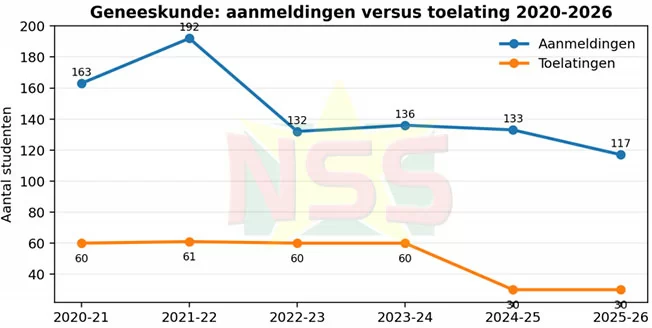
On September 7, as Suriname’s Faculty of Medical Sciences (FMeW) welcomed its latest cohort of just 30 medical students, a landmark new study has laid bare the steep unintended consequences of the country’s annual intake cap for medical training. The analysis, compiled by a cross-functional team of leading medical education and healthcare experts, warns that holding student numbers at the current capped level drastically inflates the cost of training each new general practitioner, while unplanned expansion without infrastructure upgrades risks eroding training quality.
The study was developed by FMeW Dean Fitzgerald Gopie, Vincent Lumsden (chair of the Suriname Specialists Registration Committee), and former Suriname Zorgfonds (SZF) director Rick Kromodihardjo, covering every stage of medical workforce planning from undergraduate admission to specialist training and national healthcare demand. Gopie led analysis of undergraduate metrics including intake rates, graduation outcomes, dropout rates, clinical clerkship placements and faculty quality, while Lumsden focused on postgraduate specialist training, registration requirements, trainee physician capacity and future specialist workforce projections. Kromodihardjo connected these training metrics to national healthcare needs, funding frameworks, labor market dynamics, regional distribution of medical professionals and long-term workforce planning.
FMeW’s cost analysis draws on data from the 2020-2025 period, when the faculty admitted an average of just over 50 students annually. In that period, the median estimated systemic training cost per graduating general practitioner came out to roughly 4.6 million Surinamese dollars (SRD). With annual intake now capped at a permanent 30 students, fixed operational costs for the faculty and clinical training programs remain largely unchanged. As a result, the median estimated cost per graduating doctor will jump to as much as 7.7 million SRD, the analysis finds.
The research team also modeled an alternative growth scenario: if the faculty scales intake in a controlled way to 60 students per year, the median cost per graduate would drop to approximately 3.9 million SRD. However, this cost reduction comes with a non-negotiable condition: training capacity – including numbers of teaching staff, lab facilities, clinical clerkship positions and quality monitoring infrastructure – must expand in lockstep with higher intake. The study thus warns against two problematic extremes: permanently low intake that makes each medical degree prohibitively expensive, and unregulated expansion that amplifies bottlenecks later in the training pipeline.
A key conceptual distinction the FMeW draws in the study is between two separate intake policy frameworks: Numerus Fixus and Numerus Clausus. Numerus Fixus sets an annual intake target based on the total number of physicians Suriname needs to meet national healthcare demand. Numerus Clausus, by contrast, sets a limit based on how many students the university can responsibly train given existing constraints on staff, facilities and clinical placement capacity. The study argues that these two figures must be calculated separately each year before being aligned, rather than automatically equating national workforce demand with current available training capacity.
Between the 2020-2021 and 2025-2026 academic years, a total of 873 candidates applied to the FMeW medical program, and 301 were admitted. In recent years, the formal annual intake cap has been cut to 30 students, creating a pressing policy challenge that the study aims to address. FMeW officials emphasize that current intake restrictions are not arbitrary: the entire training chain faces objective capacity limits, from available clinical clerkship positions and faculty supervision to lab space, historical graduation rates and overall clinical infrastructure. At the same time, the faculty warns that capping admission is not a standalone solution to the country’s future physician supply challenges.
One of the most critical bottlenecks currently sits further along the training pathway, not at admission. The study records that FMeW only has between 30 and 40 active clinical clerkship positions available, yet there are already 79 current clerkship students and an additional 24 students waiting for placements. More cohorts of students are progressing toward the clinical phase of training every year. The research team explains that admitting more students without expanding clinical capacity would only shift the bottleneck, leading to longer wait times for clerkships and increased pressure that undermines training quality.
The study’s core policy recommendation calls for a coordinated, holistic approach to medical workforce planning in Suriname. Rather than only deciding on annual admission numbers, the country must first clarify how many physicians it actually needs to meet population healthcare needs, and calculate what targeted investments are required to train that workforce responsibly. Researchers advise that policymakers re-evaluate the alignment between Numerus Fixus (demand-based targets) and Numerus Clausus (capacity-based limits) every year, and tie any increase in admission quotas directly to additional investment in teaching staff, clinical training placements, supervision and quality assurance systems.