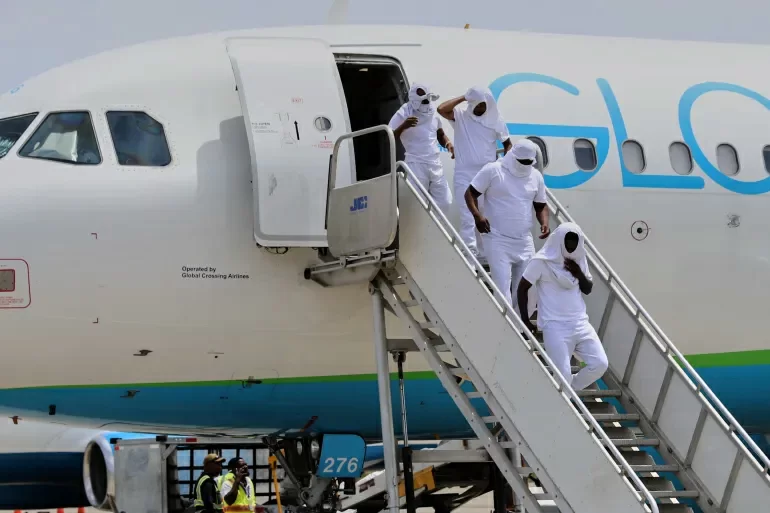
In a move that underscores the Trump administration’s aggressive expansion of controversial third-country deportation policies, the South American nation of Guyana has received six Cuban and Afghan nationals deported from the United States following months of bilateral negotiations, Guyana’s Foreign Minister Robert Persaud has confirmed.
The small group of deportees arrived in Guyana on Saturday, marking the first implementation of the newly struck agreement between Washington and Georgetown. Persaud explicitly clarified that none of the six individuals currently held in Guyana carry a criminal record, and added that no additional deportation requests from the U.S. government are pending at this time. The one-year bilateral deal does not grant permanent residency status to any of the deportees, leaving their long-term housing and legal status unresolved.
Third-country deportation is an immigration enforcement practice that sends foreign nationals detained in the U.S. to a third nation that is neither their country of origin nor the U.S. itself. Deported individuals subjected to this policy routinely face a cascade of challenges: unfamiliarity with the host country’s social norms, severe language barriers, and no legal guarantee of permanent settlement rights. Human rights advocates have repeatedly flagged these gaps as core failures of the policy.
The Trump administration has prioritized expanding this practice dramatically in recent years, securing more than 30 third-country deportation agreements with nations across the globe, 15 of which are located in the Americas. The policy is framed as a core fulfillment of former President Trump’s campaign promise to carry out what he called “the largest criminal deportation program in American history.” However, the fact that the six migrants sent to Guyana have no criminal records aligns with longstanding criticism that the policy casts a far wider net than advertised, sweeping up non-criminal migrants in enforcement actions.
Global human rights groups including Amnesty International have openly condemned third-country deportations, arguing the practice acts as a punitive pressure tactic designed to force migrants to abandon their pending asylum and immigration claims in the U.S. Beyond the harm to individual migrants, advocates also raise serious concerns about conditions in many receiving countries, many of which grapple with widespread poverty, political instability, and systemic human rights violations that leave vulnerable migrants in precarious, dangerous situations.
For the six newly arrived deportees in Guyana, short-term support is being provided by the United Nations’ International Organization for Migration (IOM) through its Assisted Voluntary Return Programme. The IOM will provide basic aid while the migrants’ immigration cases are processed, with two potential long-term outcomes: eventual voluntary return to their countries of origin, or resettlement in a third country willing to accept them.
This latest round of deportations to Guyana fits into the Trump administration’s broader restrictive immigration agenda. Beyond expanding third-country removals, the administration has moved to limit overall immigration levels, revoke legal status for tens of thousands of migrants already residing in the U.S., and cut visa access for roughly 200,000 pending asylum seekers.