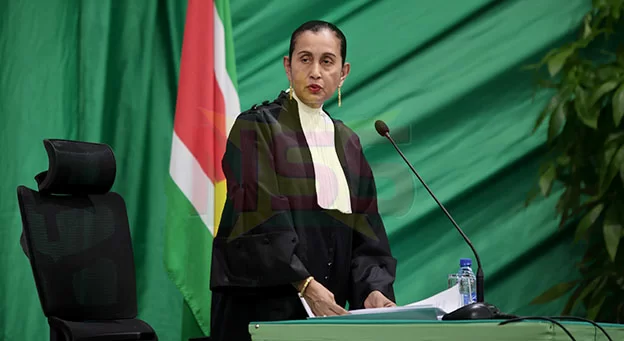
On October 24 at 16:23, a formal swearing-in ceremony for 15 new alternate members of the High Court of Justice was held, a historic milestone for the Surinamese judicial system as it marks the first time such a large cohort of new judicial officers has been inducted in a single batch. During her keynote address at the event, Prosecutor General (PG) Garcia Paragsingh laid out a clear set of non-negotiable core principles that the newly appointed judges must anchor their entire careers on: unwavering integrity, full judicial independence, and sustained professional expertise.
Paragsingh stressed that the oath of office the new judges took is far more than a procedural formality required to complete their installation. It is a public, binding promise made directly to the Surinamese citizenry, who place their most fundamental rights, personal freedoms, and collective trust in the rule of law in the hands of the judiciary. She reminded the new judicial officers that every ruling they issue carries profound, often life-altering consequences for the people appearing before their courts, so their work must never be guided by personal bias, external pressure, or shortcuts. Delivering true justice requires not just thorough knowledge of existing legal statutes, but also meticulous attention to case details, consistent respect for every individual’s inherent human dignity, and the fair, uniform application of the law across all cases regardless of a defendant’s or claimant’s background.
Against a backdrop of rapidly evolving societal norms, frequent updates to national legislation, and increasingly complex cross-cutting legal disputes that were rarely seen in past decades, Paragsingh emphasized that continuous professional development is not an optional perk for judges, but a core component of their professional responsibility. She urged the cohort to maintain regular, critical self-reflection on their own rulings and courtroom conduct, and to stay open to new legal insights, emerging best practices in judicial administration, and community perspectives to avoid stagnation in their work.
Expanding on the broader ecosystem of a functional rule of law, the PG noted that a robust, trusted judicial system cannot be sustained by judges alone. Effective justice delivery is a collective effort that relies on seamless, mutually respectful collaboration across the entire criminal justice chain, including the Public Prosecution Service (OM), law enforcement agencies, the legal advocacy bar, and correctional services. Crucially, Paragsingh clarified that this cross-agency partnership must be rooted in mutual trust, but must never compromise the constitutionally protected independence of the judiciary, nor the independent mandate of the Public Prosecution Service to pursue fair, evidence-based prosecutions. When every stakeholder executes their distinct duties with full integrity while keeping the shared goal of equitable justice top of mind, the entire national justice system becomes more resilient and responsive to public needs, she noted.
During her address, Paragsingh also highlighted ongoing staffing gaps within the Public Prosecution Service, noting that a new cohort of trainee prosecution officers will soon complete their formal certification programs. She expressed optimism that these new staff will be onboarded swiftly in the near future, as expanding the OM’s personnel capacity and specialized expertise will directly reduce case backlogs, speed up the processing of criminal matters, and raise the overall quality of prosecutorial work across the country. She called on relevant administrative bodies to expedite all required procedural steps to facilitate the smooth, timely entry of these new prosecution officers into the workforce.