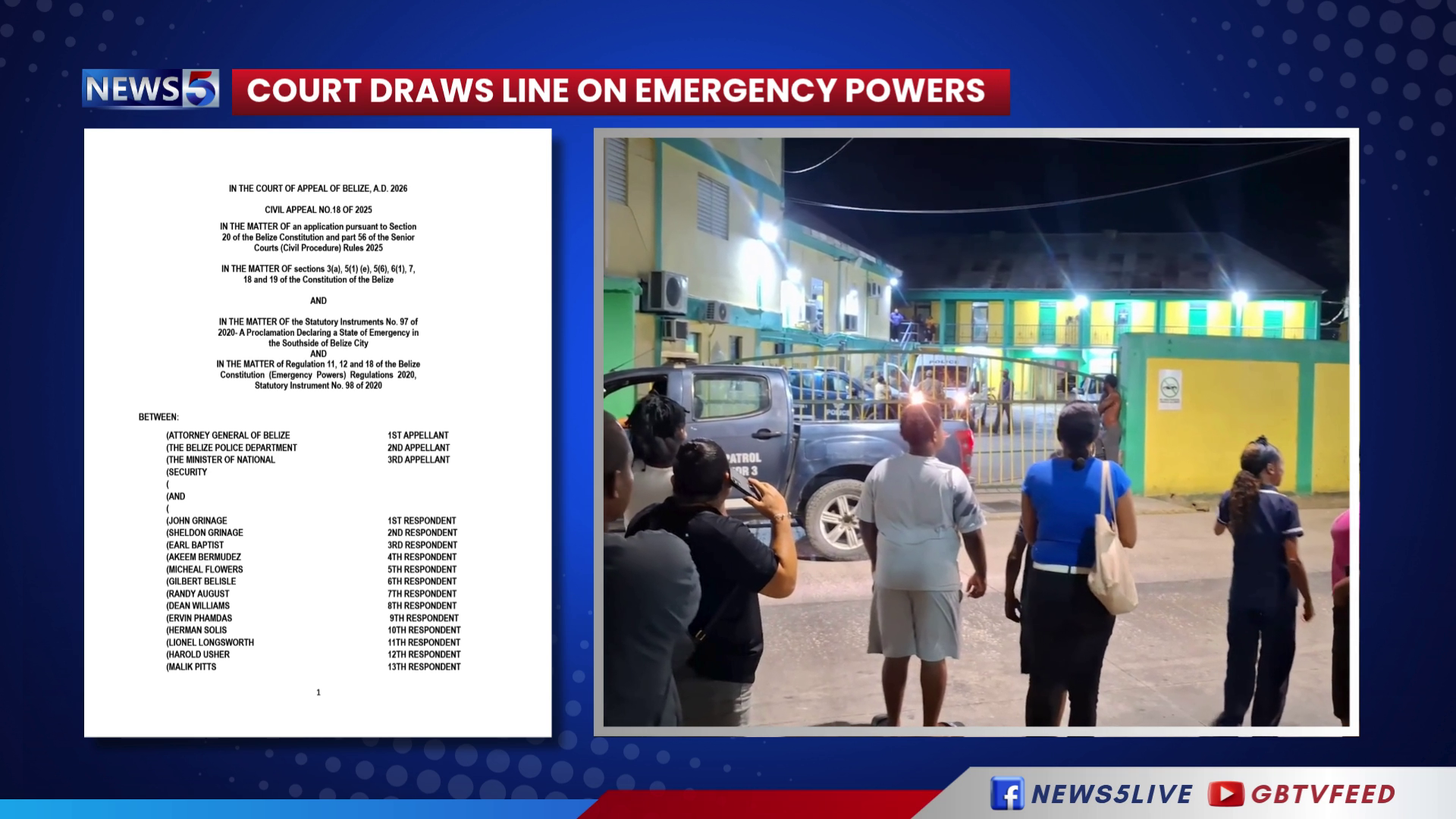
In a landmark ruling handed down on September 3, 2026, the Court of Appeal of Belize has formally invalidated two states of emergency declared for Southside Belize City back in 2020, determining that the national government failed to meet the constitutional threshold of evidence required to justify implementing these extraordinary executive measures.
The judicial panel laid out a clear legal precedent in its judgment: elevated levels of ordinary crime and violence, no matter how severe, do not automatically grant the executive branch the right to enact a state of emergency. For such extreme measures to pass constitutional muster, the government must prove that the threat at hand is so widespread and unmanageable that it cannot be addressed through the framework of the nation’s standard criminal justice system. After reviewing all evidence presented in the case, the judges concluded that the government did not meet this burden of proof for the 2020 declarations.
Beyond striking down the emergency declarations themselves, the court also found that the hundreds of arrests and detentions carried out under the authority of these measures directly violated the fundamental constitutional rights of the people detained. The ruling documented multiple procedural failures: detainees were given only vague, non-specific justifications for their detention, frequently cited only as suspected “gang activities”, and authorities never established an independent tribunal to review the legality of each detention, a requirement under Belize’s constitution.
As a remedy for the rights violations, the court ordered significant financial compensation for five petitioners who brought the case before the judiciary. Each of the claimants — Shane Harris, Laquan Shemar Flowers, Dejon Joseph, Dimetris Gordon and Nukie Barrow — will receive $15,000 in compensatory damages, alongside an additional $7,000 in vindicatory damages to address the harm caused by the unconstitutional detention.
Legal observers note that this judgment carries far-reaching implications for governance and civil liberties in Belize. It explicitly reaffirms that states of emergency are intended only for the most extreme, exceptional circumstances, and cannot be repurposed as a routine tool for combating common crime. The ruling also strengthens foundational constitutional protections by clarifying that safeguards against arbitrary arrest and detention remain fully in effect even during periods of declared public emergency, cementing the principle that no emergency can override the fundamental rights enshrined in the nation’s constitution.