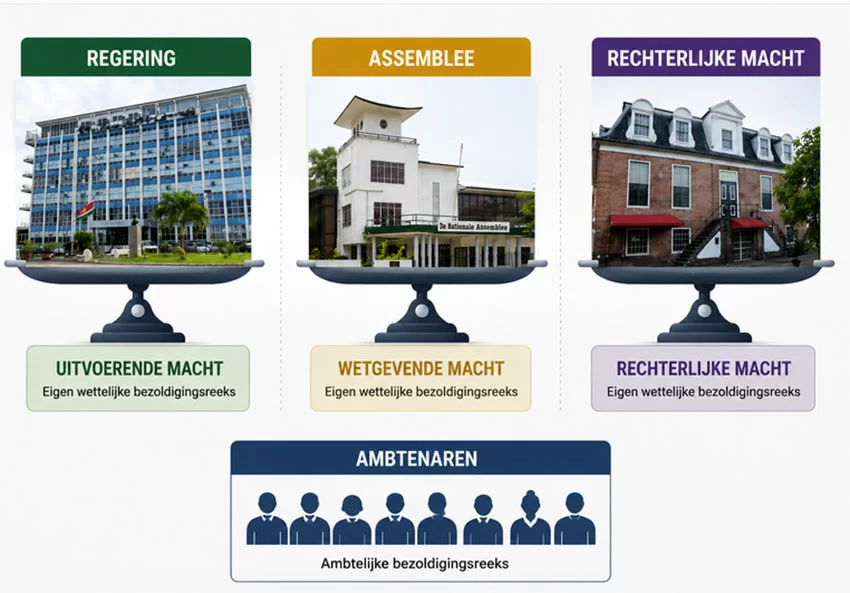
A planned 15 percent pay raise for public civil servants has sparked a pressing national debate over outdated salary linkage rules that automatically pass this increase to the country’s top political, legislative and judicial officials. With the judiciary and President Jennifer Simons having already agreed to decouple judicial salaries from the civil service adjustment, observers are now calling for this reform to extend across all three branches of government, framing the moment as a rare opportunity to scrap an outdated compensation system that no longer serves the public interest.
The commitment by the judiciary to opt out of the automatic 15 percent increase will be enshrined in national law, a meaningful step toward reform—but there is no logical justification for limiting this change to judicial roles alone, argues commentator Wilfred Leeuwin. The same principle of independent salary-setting should apply to all three branches of state power, he contends.
Under the current system, all top state officials’ pay is tied to the civil service compensation structure, which uses the salary of a departmental director—the highest-ranking civil servant—as the baseline reference. A cabinet minister’s salary is set at twice that of a departmental director, with all other political officeholders’ pay linked to the civil service scale through similar fixed proportional formulas. Judicial salaries are in turn tied to the president’s pay, which itself is linked to the civil service baseline, with rules stating judicial members cannot earn more than the president. While this structure creates a formal hierarchy on paper, in practice additional allowances, benefits and separate schemes already push the total income of senior judicial officials above the president’s salary, eroding the original logic of the system.
Critics argue it is long past time to move beyond narrow conversations about pay amounts and examine the broken system underlying salary decisions. Why should a pay adjustment approved for rank-and-file civil servants automatically translate to higher earnings for people holding political or constitutional offices? When the government approves a 15 percent raise for civil servants, the justifications behind that decision—eroded purchasing power from high inflation, a need to retain public sector staff, or improved compensation for daily work—apply specifically to civil service employment terms. Ministers, members of parliament, and judges are not civil servants, and each holds a distinct constitutional position with separate responsibilities. There is no inherent reason their pay should rise automatically alongside civil service salaries.
This push for decoupling does not mean that top state officials should never receive salary adjustments, advocates stress. On the contrary, the president, vice president, cabinet ministers, legislators, and judicial officers carry heavy public responsibilities and are entitled to fair, competitive compensation. For the judiciary in particular, financial security is a core guarantee of judicial independence, a foundational principle of democratic governance. But fair compensation is fundamentally different from automatic, unconsidered linkage to civil service pay changes.
The path forward, the argument goes, is to create a separate, legally enshrined compensation framework for each of the three branches of government. This new system would clearly outline in advance the financial relationship between different constitutional roles, establish explicit criteria for salary adjustments, and set out clear timelines for when changes can take effect. This would eliminate the current ripple effect that pushes a civil service pay raise through every level of the state apparatus automatically. Any new legal framework must also respect the constitutional separation of powers, rather than relying on simplistic fixed proportional multiples between different roles. Instead, salaries should be set based on objective criteria for each office: the scope of responsibility, the workload and complexity of the role, requirements for independence, necessary professional expertise, and the state’s overall fiscal capacity.
A key flaw of the current system is that political officeholders ultimately retain direct or indirect influence over the size of their own compensation, a conflict of interest that is difficult to defend to the public. To address this, an independent salary commission should be established to issue periodic, public recommendations on the pay of top state officials, with all criteria and deliberations made fully transparent to the public. When a salary increase is approved for legislators, ministers or other political officeholders, the adjustment does not need to take effect immediately for sitting officials. Law can explicitly stipulate that changes only go into effect after the current term of office, eliminating any perception that politicians are voting to enrich themselves while in office.
The rules for judicial compensation require a separate approach, given the need to protect judicial independence from political discretion. A distinct legal framework is needed to guarantee predictability and protect judicial pay from political manipulation. Still, the core starting principle holds for all three branches: automatic linkage to civil service salaries must be eliminated. This is a far more defensible arrangement for public trust.
Rank-and-file civil servants are receiving the 15 percent raise to offset soaring costs of daily essentials, including food, electricity, transportation and housing, all of which have seen steep price increases. A percentage-based pay increase also has vastly different absolute impacts: it delivers far more relief in absolute terms to low earners than it does to the highest-paid officials in government. This makes it even more important to avoid a system where an adjustment for lower- and middle-income public workers automatically delivers an identical percentage increase to the very top of the state pay scale. The executive branch and national assembly should follow the judiciary’s lead and extend the decoupling reform.
The current moment is a critical opportunity to design a new, transparent legal compensation framework for the highest offices across the legislative, executive and judicial branches. The new system should clearly state how much each official earns, what criteria that pay is based on, who can propose adjustments, and under what conditions changes go into effect. A pay raise for civil servants should benefit the workers it was intended for. Top state officials are entitled to fair compensation, but that pay should reflect the responsibilities of their office and be set through a transparent, accountable legal process—not simply flow automatically from a 15 percent raise approved for rank-and-file public servants.