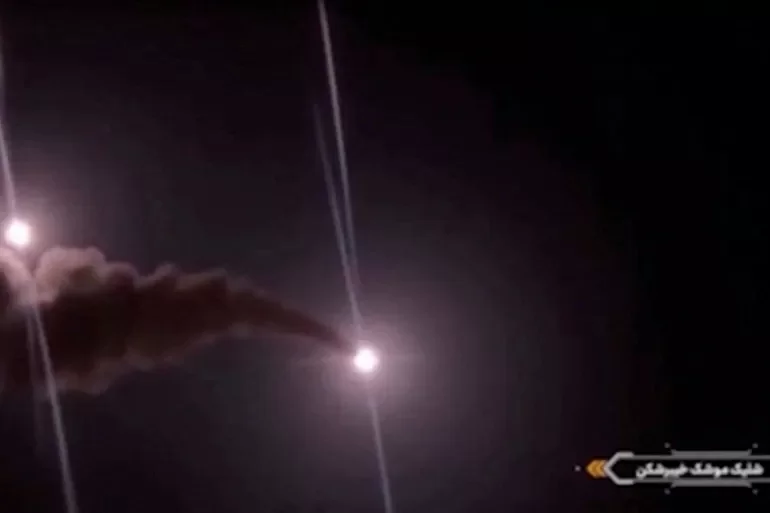
As tensions between Iran, the United States, and Israel continue to spiral upward in the Middle East, one Iranian weapon has emerged as a defining symbol of Tehran’s military deterrence and striking capacity: the Kheibar Shekan, officially translated as the “Castle Breaker” ballistic missile. Unveiled in 2022 by Iran’s elite Islamic Revolutionary Guard Corps (IRGC), this medium-range weapon has quickly become one of the most closely watched assets in the escalating regional standoff.
The Castle Breaker brings unique tactical advantages that set it apart from many of Iran’s older missile systems. With an operational range of approximately 1,450 kilometers, it is capable of striking deep into the region, putting all U.S. military bases in the Middle East and key Israeli targets within its strike envelope. It carries a substantial warhead, weighing between 440 and 590 kilograms, enough to inflict severe damage on fortified military installations. What makes the system particularly strategically valuable is its solid-fuel propulsion design. Unlike older liquid-fuel missiles that require hours of pre-launch fueling, solid-fuel rockets can be prepared for launch in a fraction of the time. This drastically reduces warning time for adversaries, making it far harder for the U.S. or Israel to detect and neutralize the missile before it is launched, and allowing Iran to respond rapidly to any enemy offensive.
In recent months, as cross-border strikes between Iran and U.S.-aligned forces have become more frequent, Tehran has already deployed the Castle Breaker in live combat operations. After a series of U.S. and Israeli strikes on Iranian positions, including a surprise attack on the strategic island of Larak in the Strait of Hormuz, Iran launched Castle Breaker missiles at U.S. military facilities in Jordan in a deliberate act of retaliation. These strikes have served as a public demonstration of both the missile’s capabilities and Iran’s willingness to use its full arsenal to respond to aggression.
The Kheibar Shekan is far from the only asset in Iran’s expanded missile inventory, however. Tehran has built one of the largest missile forces in the Middle East over the past two decades, with a full spectrum of strike capabilities ranging from short-range rockets for near-border targets to long-range ballistic missiles capable of reaching targets 2,000 kilometers or more. Iran also maintains a sizable fleet of cruise missiles, with some variants boasting a range of up to 2,500 kilometers, adding another layer of complexity to any adversary’s defensive planning.
The latest round of escalations has further destabilized the already fragile security balance in the Middle East. Following new U.S. strikes on Iranian targets on August 31, Tehran responded with a coordinated barrage of missile and drone attacks targeting U.S. military bases across Jordan, Bahrain, Kuwait, and Iraq. The rising violence has already spilled over to harm civilian populations: a recent Iranian bombardment on the city of Kuhestak hit a wedding venue, leaving multiple civilian dead in a tragic reminder of the human cost of the escalating confrontation.
Tensions have also re-intensified around the Strait of Hormuz, the world’s most critical chokepoint for global oil trade. In peacetime, more than 25% of the world’s total oil production passes through the narrow strait, and the recent surge in hostilities has already pushed global oil prices higher as markets price in the risk of disrupted shipping. Control over this strategic waterway remains a core geopolitical priority for both Iran and the United States, making it a central flashpoint in the ongoing standoff.
Compounding military tensions, the United States continues to ramp up economic pressure on Tehran, targeting the financial interests of the Iranian regime across the globe. This dual campaign of military pressure and economic sanctions has pushed tensions to their highest level in years, raising widespread concerns that the ongoing tit-for-tat cycle of strikes could spiral into a full-scale regional conflict that threatens global energy security and stability.