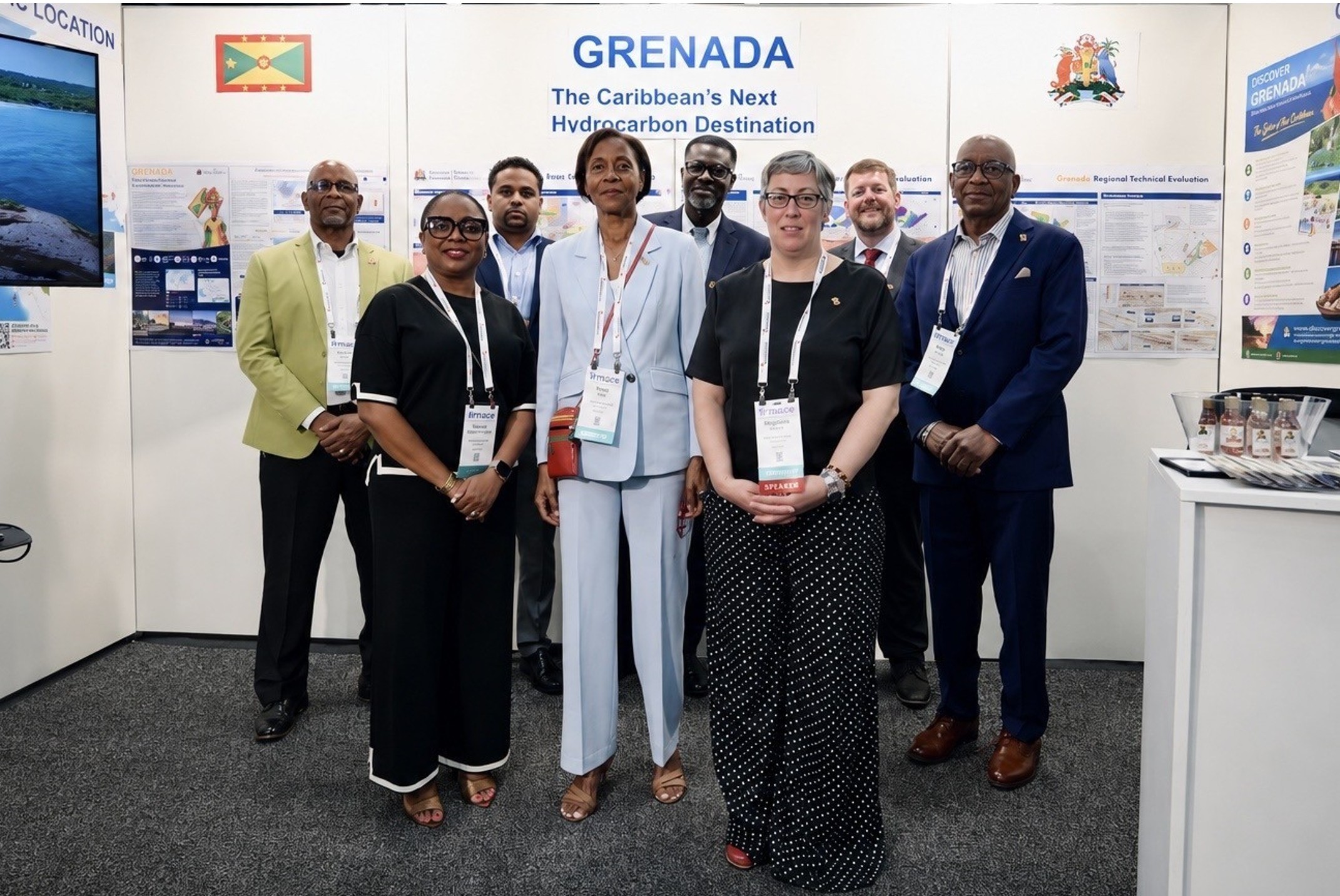
Grenada’s Hydrocarbons Technical Working Group has wrapped up a successful mission at the 2026 International Meeting for Applied Geosciences and Energy (IMAGE), held in Houston, Texas — one of the world’s most influential industry gatherings for energy geoscience professionals.
During the conference, the Caribbean nation’s delegation leveraged the high-profile platform to host a targeted investor roadshow, reaching out to leading international oil and gas companies to highlight the country’s largely untapped offshore hydrocarbon potential and drum up support for its first-ever licensing round, scheduled to launch in 2027. At Grenada’s dedicated exhibition booth, team members held one-on-one discussions with prospective investors, industry partners, and leading geoscientists, walking attendees through newly completed technical assessments and walking them through the scope of the country’s untapped energy resources.
The IMAGE 2026 participation delivered five key strategic wins for Grenada’s energy development ambitions. First, it granted the small island nation unmatched direct access to a global audience of major upstream operators and energy investors, putting its untapped offshore potential in front of the industry’s key decision-makers at a single premier event. Second, the delegation’s on-site engagement generated significant technical and commercial interest from attendees, who validated Grenada’s updated subsurface geological models, regional prospectivity analyses, and comparative geological studies through in-depth expert discussions. Third, the conference appearance successfully built pre-launch buzz for the upcoming 2027 licensing round, which will put seven offshore areas up for bidding: six fully defined exploration blocks and one open acreage area. Fourth, the event created a valuable space for technical knowledge exchange, with Grenada’s team sharing its latest evaluations of high-resolution 2D seismic basin data with global experts, highlighting confirmed active hydrocarbon indicators and global geological analogues that demonstrate the commercial viability of the country’s resources.
For industry attendees, the conference appearance clarified key details about what Grenada is bringing to the table for the 2027 round. The total offshore acreage on offer covers approximately 28,600 square kilometers across the geological Grenada Basin and Tobago Trough, with water depths ranging from 180 meters to 3,000 meters, spread across the six defined blocks and one open exploration area.
Geographically, Grenada’s offshore blocks are strategically located adjacent to already prolific producing basins controlled by major regional energy producers including Trinidad & Tobago, Venezuela, Guyana, and Suriname. Despite this favorable geological position, the area remains drastically underexplored: to date, only one exploratory well has been drilled in Grenada’s offshore territory, leaving up to 12 kilometers of sedimentary geological section untested for commercial hydrocarbon reserves.
The technical data presented for the first time at IMAGE 2026 draws on a robust, newly compiled seismic database that combines two major multi-client 2D seismic surveys: 6,979 kilometers of CAMDI 2D seismic data collected by Geoex MCG, and approximately 710 kilometers of CARIBE SPAN 2D seismic data acquired by industry leader TGS.
Advanced interpretations of this new seismic data have confirmed multiple promising prospective play types across geological intervals from the Upper Eocene to Upper Pliocene eras. These include high-potential structures such as deepwater turbidite channels, fan complexes, large transpressional anticlines, and structural closures. Clear Direct Hydrocarbon Indicators (DHIs), including distinctive bright seismic amplitudes and gas chimneys, confirm the presence of an active hydrocarbon system in the basin.
To contextualize the resource potential, Grenada’s technical team conducted global analogue benchmarking against 937 producing hydrocarbon fields with matching geological settings around the world. The analysis confirms that individual accumulations in Grenada’s basins could hold up to 3.2 billion barrels of oil equivalent of in-place resources, marking a major potential upside for successful explorers.
This report was issued via the Office of the Prime Minister of Grenada. NOW Grenada does not take responsibility for the content or opinions shared by contributing authors.