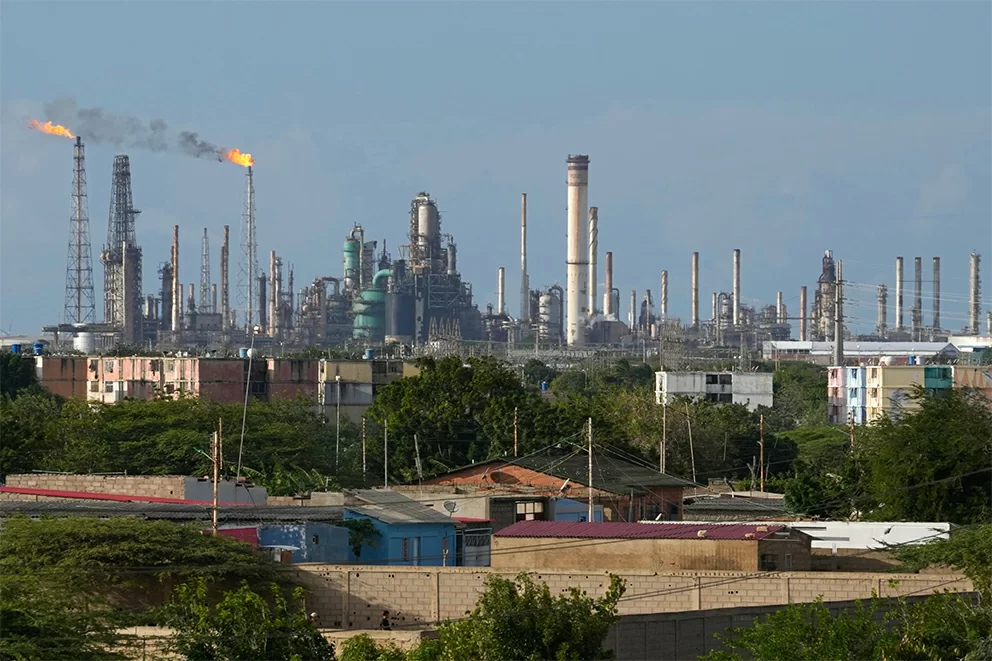
A landmark 100-year oil concession agreement between the Trump administration and Venezuela’s interim government has ignited fierce cross-factional criticism, pitting opponents from both the Venezuelan opposition and the legacy Chavismo movement against the deal just days after it was announced.
U.S. President Donald Trump revealed Friday evening that a U.S.-led consortium has secured development rights to 17 Venezuelan oil fields holding a combined 65 billion barrels of crude — equal to more than one-fifth of the South American nation’s total proven oil reserves. Trump framed the pact as “the largest oil agreement in world history,” while Venezuelan interim president Delcy Rodríguez projected that the deal would bring more than $100 billion in new investment into Venezuela’s ailing energy sector.
Despite the bold claims from both sides, official transparency around the agreement has been severely lacking. No detailed information has been released on how the deal will be implemented, where the bulk of the investment capital will originate, or what role PDVSA, Venezuela’s U.S.-sanctioned state-owned oil giant, will play in the project moving forward.
The agreement has split opposition voices, even among those who broadly support renewed foreign investment to revive Venezuela’s collapsed oil industry. Juan Pablo Guanipá, a prominent opposition figure, acknowledged that foreign capital is critical to reversing decades of operational decline caused by mismanagement, and noted the deal holds potential to jumpstart stagnant energy activity. At the same time, he warned that the arrangement remains inherently fragile as long as the same political actors responsible for the collapse of PDVSA and broader Venezuelan economic decline remain in control of investment flows.
Henrique Capriles, leader of a moderate opposition bloc, zeroed in on the lack of clarity and long-standing accusations of government corruption, demanding that the deal be fully grounded in constitutional legal frameworks. “What concrete benefits will this deal actually deliver to ordinary Venezuelans?” Capriles questioned, a sentiment echoed by many across the country. Hundreds of protesters gathered in the streets of Caracas this week to voice opposition to the U.S. stake in Venezuelan oil reserves, with many labeling the deal a violation of national sovereignty.
The political context for the agreement is deeply unstable. Earlier this month, Venezuela’s interim government and opposition factions opened talks on new national elections, following the deeply disputed 2024 presidential vote that saw Nicolás Maduro declare victory despite independent evidence of an opposition win. Maduro and his wife were arrested by U.S. forces on January 3 and are currently detained in New York awaiting trial on drug trafficking charges. The Trump administration has thrown its support behind Rodríguez, who has recently pushed through legislation opening Venezuela’s oil and mining sectors to full foreign investment.
Opposition leaders have raised a key red flag: many fear Washington will step back from its demands for urgent new elections, as the U.S. now has a direct geopolitical and economic stake in keeping Rodríguez’s interim government in power to implement the oil deal.
Criticism has also come from hardline remnants of the Chavismo movement, which ruled Venezuela from 1999 until Maduro’s arrest earlier this year. Rafael Ramírez, a former PDVSA president and Venezuelan energy minister, called the agreement “the greatest theft in our nation’s history,” warning that the deal will reduce PDVSA to nothing more than a third-party contract administrator. Left-wing activists joined protests in Caracas against what they called U.S. “occupation” of Venezuela’s strategic energy sector, while former ruling party members have labeled the deal a violation of the Venezuelan constitution and “the greatest act of oil betrayal” in the nation’s modern history.
Years of systemic mismanagement and crippling U.S. sanctions have gutted Venezuela’s once-thriving oil industry. Production has plummeted from a peak of around 3 million barrels per day to just 1.12 million barrels per day — less than one-tenth of current U.S. daily crude output.
While some industry voices have expressed cautious optimism, independent analysts warn that near-term production gains will be modest. Enrique Novoa, head of the Venezuelan Petroleum Chamber, said that even though local industry groups have not seen full details of the agreement, any support for the struggling energy sector is being viewed with cautious positivity. However, Francisco Monaldi, a leading oil expert at Rice University, projected that the deal will deliver only minimal production growth in the next two years: an increase of less than 200,000 barrels per day in 2024, and only slightly higher gains in 2025.