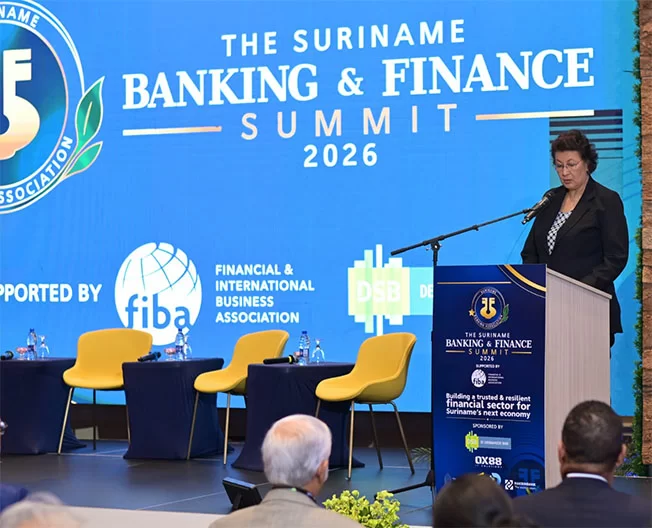
On Saturday, the inaugural edition of the one-day Suriname Banking and Finance Summit 2026 opened at the Royal Ballroom of Paramaribo’s Hotel Torarica, bringing together senior government officials and banking leaders from across the country and abroad. Opening the event, which carries the central theme “Building a Trusted & Resilient Financial Sector for Suriname’s Next Economy”, President Jennifer Simons laid out a clear vision for the country’s financial sector: it must do more than just maintain stability and reliability, it should actively drive inclusive economic growth, expand job creation, and broaden access to critical financial services for all Surinamese.
Simons opened her address by highlighting the unprecedented economic opportunities that have opened up for Suriname in recent years, opportunities she said would have been unimaginable just a generation ago. The rapid development of the country’s nascent oil and gas sector has unlocked new growth pathways and created fresh market access for Surinamese goods, local businesses, and national talent. Yet she stressed that opportunities alone are not enough to build a prosperous nation. “Opportunities alone do not build a country. Trust does that,” the president emphasized, per official statements from the Communication Service of Suriname. For Suriname, she argued, trust is the most valuable currency the nation holds.
The summit’s core theme aligns directly with the current administration’s long-term policy direction, Simons noted. “Our ambition goes far beyond just economic recovery. We are working to build an economy that produces more, exports more, and generates sustainable, long-term employment for our people,” she explained. To turn this ambition into reality, the country needs a financial sector that is not only trusted and resilient, but also prepared to help unlock the full potential of Suriname’s emerging economic opportunities.
On the global regulatory front, Simons highlighted that findings from Suriname’s National Risk Analysis (NRA) and the FATF-aligned Mutual Evaluation Report (MER) call for targeted action and demonstrable progress. To strengthen anti-money laundering (AML) and counter-terrorist financing efforts, the government established a presidential AML Task Force to boost cross-agency coordination and deliver the required regulatory improvements. For a small open economy like Suriname, maintaining international confidence and critical correspondent banking relationships is of paramount importance, Simons stressed, particularly ahead of the 2027 FATF mutual evaluation that will assess the country’s regulatory framework.
Recognizing that banks and investors require consistent macroeconomic stability, legal certainty and policy predictability to operate, the Simons administration is working under the leadership of the Ministry of Finance and Planning to strengthen public budget management, improve revenue collection, and implement responsible sovereign debt governance. “We are focused on modernizing the Tax and Customs Administration, ensuring more efficient use of public funds, and strengthening national financial planning,” the president said. In full collaboration with the independent Central Bank of Suriname, the government is working to build a more stable macroeconomic environment that better manages inflation, exchange rate volatility and systemic financial uncertainty. To prepare for future oil and gas revenue, the administration is also moving forward with operationalizing the country’s Savings and Stabilization Fund, which will prevent volatility from commodity price swings and preserve resource wealth for future generations.
Simons noted that Suriname cannot develop every economic sector simultaneously, so the government has set clear strategic priorities focused on high-growth industries: agriculture and agro-processing, tourism, sustainable forestry, logistics, and technology. The oil and gas sector, she emphasized, should not operate as an isolated enclave, but should act as a catalyst to drive growth and development across these other priority sectors. To enable this growth, the government is advancing modern investment legislation, with a target to finalize the new framework by 2027.
In her address, the president laid out three core priorities for the domestic banking sector to advance the country’s economic goals. First, banks must continue to uphold their critical role as gatekeepers of financial integrity, ensuring the country meets international AML and regulatory standards. Second, the sector must expand its financing support to the productive priority sectors that will drive long-term inclusive growth, while also working to develop a deeper and more robust domestic capital market. Third, the banking sector must work to make financial services more accessible and modern, so that a larger share of the Surinamese population can fully participate in the formal economy.
Simons stressed that building Suriname’s economic future cannot rely on conferences and policy announcements alone. Concrete collaboration and on-the-ground implementation are essential to deliver results. To this end, she invited the Suriname Bankers Association (SBV) to participate actively in national consultations, and work alongside the Ministry of Finance and Planning, the Central Bank of Suriname, and regional development institutions to co-design a concrete national financing agenda. This agenda will be aligned with the country’s core economic priorities, and will include clear accountability frameworks, realistic timelines, and measurable performance targets. Through this collaborative approach, Simons said, the financial sector can become a core partner in turning Suriname’s new economic opportunities into tangible, shared progress for all of Surinamese society.