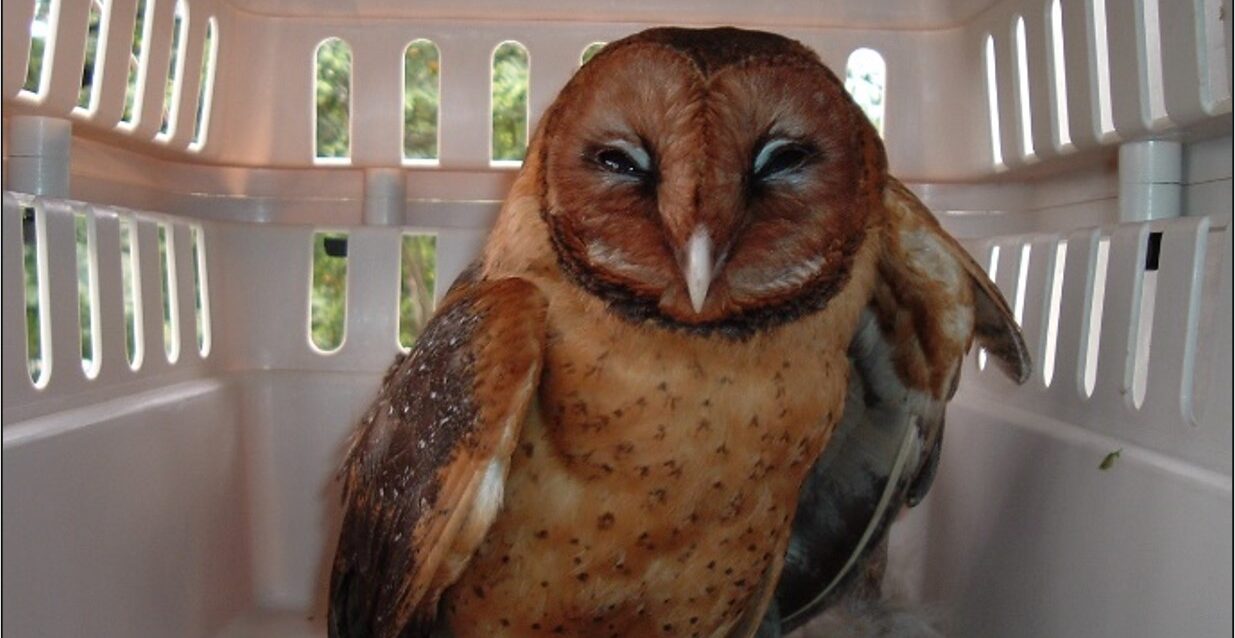
For generations of residents across the Caribbean island of Dominica, the local barn owl has been a familiar, if often nocturnal, presence. Many islanders have spotted the stealthy raptor roosting in local church buildings, caught a glimpse of its silent flight overhead, or woken to its distinctive screech after dark. Known by two traditional local names, the species is called *chawan* by Kwéyòl speakers, while communities in the Marigot and Wesley regions that speak Kòkòy refer to it as *jombie bòd*, or jumbie bird. As a permanent resident breeder, the owl lives and reproduces exclusively on the island year-round.\n\nAs a nocturnal apex predator, the Dominica barn owl hunts under cover of darkness, with an unusually broad diet that supports the island’s natural ecological balance. Its prey includes a wide range of species: small mammals such as rats and bats, large insects, lizards, and multiple bird species including seasonal migratory visitors. A decades-old field expedition to study the owl’s feeding habits offers clear evidence of this diverse diet. In the late 1990s, three researchers – retired Dominican forestry officer and lifelong bird enthusiast Bertrand ‘Dr. Birdy’ Jno. Baptiste, a French ornithologist based in Guadeloupe, and the original author of this report – climbed a rickety wooden ladder to access a long-standing owl nest inside the iconic steeple of the now-demolished Portsmouth Roman Catholic Church. By dissecting several regurgitated owl pellets collected from the nesting site, the team uncovered the preserved skeletons of bats, rats, large insects and multiple bird species, matching the expected dietary profile of the resident adult, which observed the group silently from its perch above throughout the research work.\n\nUntil recent taxonomic updates, the Dominica owl was classified as part of the widely distributed common barn owl species, *Tyto alba* – long labeled the most geographically widespread owl species on the planet. With a natural range spanning Africa, Asia, Australia, Europe and the Caribbean, and introduced populations on Oceanic islands brought in for rodent control, the species showed marked physical variation across different regions. Unlike common barn owls found across most of the world, which have a distinct white facial disc bordered by an orange ring and lighter overall plumage, owls native to the Lesser Antilles have dark brown feathers and a fully dark facial disc. These consistent physical differences led taxonomists to reclassify the Lesser Antilles population as a separate standalone species, renamed the Lesser Antilles barn owl with the scientific name *Tyto insularis*, restricted only to the Windward Islands of Grenada, St. Vincent, the Grenadines and Dominica.\n\nFurther detailed analysis of the Lesser Antilles barn owl population uncovered even more distinct differences between island groups. Researchers confirmed that the Dominica population has unique physical traits that set it apart from barn owls on the other Lesser Antillean islands. As a result, the Dominican population has now been reclassified as a unique endemic subspecies, with the new scientific designation *Tyto insularis nigrescens*, while populations on Grenada, St. Vincent and the Grenadines retain the classification *Tyto insularis insularis*.\n\nThis new classification adds *Chawan*, as the owl is locally known, to Dominica’s growing list of endemic bird species – animals found nowhere else on Earth other than the Nature Isle. It now joins the island’s iconic endemic Sisserou Parrot (*Amazona imperialis*), the Jaco Parrot (*Amazona arausiaca*), and the Kalinago Wren (*Troglodytes martinicensis*) as a unique biological treasure found only within Dominica’s borders.\n\nBeyond its new taxonomic status, there are several fascinating and little-known facts about this unique endemic raptor. Unlike many wild raptors that prefer undisturbed old-growth forest, some of Dominica’s barn owls favor man-made structures like church steeples and abandoned warehouses as roosting and nesting sites, bringing them into close proximity with local communities. The owls also occasionally compete with larger native bird species for prime nesting real estate: several years ago, one pair of owls took over a pre-existing tree cavity nest built by parrots in Mone Diablotin National Park’s rainforest, with the resident owl even resting outside the entrance to enjoy daylight views on occasion.\n\nLike all owls, the Dominican subspecies has a number of extraordinary biological traits. Newly hatched barn owl chicks are covered in pure white down, which is gradually replaced by signature dark brown plumage as they mature. All owls, including the Dominica barn owl, can rotate their heads nearly 270 degrees – three-quarters of a full rotation – an incredible anatomical adaptation that lets them survey their surroundings without moving their bodies.\n\nFor many local communities, the owl also carries deep cultural and superstitious meaning. A long-held local belief holds that if an owl’s screech is heard in a village or town, it signals the impending passing of an elderly resident in the area, tying the raptor closely to local folklore and traditions that have persisted for generations.