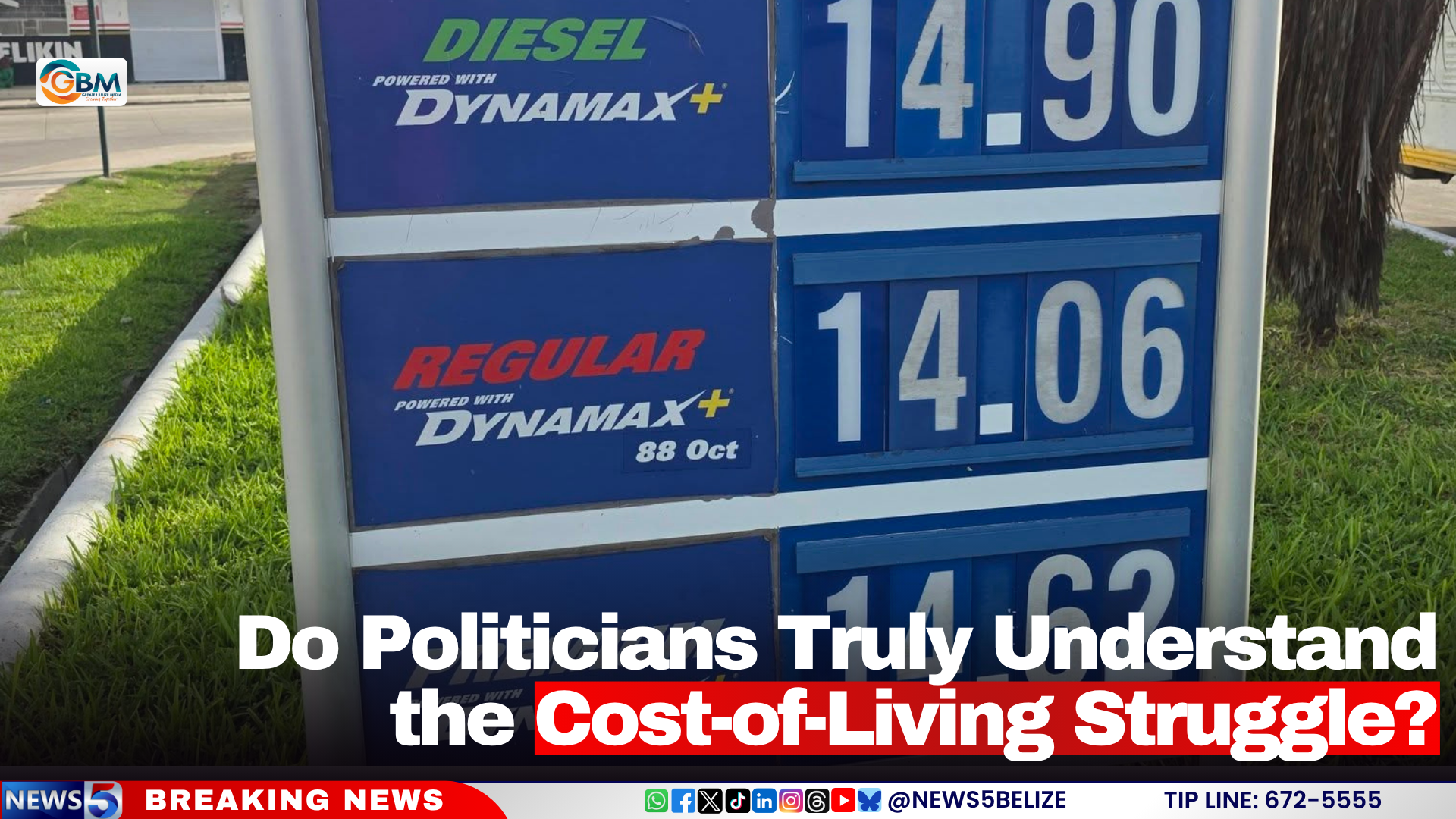
As steep hikes in the prices of fuel, electricity and core household goods stretch ordinary families’ budgets across Belize to breaking point, a growing debate has erupted over whether the nation’s top political leaders and senior public officials can truly grasp the severity of the financial crunch hitting average citizens.
Glenfield Dennison, a Union Senator, has publicly argued that many high-ranking officials who receive taxpayer-funded fuel allowances and official vehicles are completely disconnected from the day-to-day transportation costs that weigh heavily on ordinary working people.
Dennison emphasized that for many officials, transportation costs are never a personal out-of-pocket expense, a privilege that removes them from the reality faced by most Belizeans. “Anybody who has their gas paid for, who gets a government vehicle, a vehicle from a statutory body, or a car provided by the utility company they serve as a director for — any of these people who never have to buy their own fuel can’t relate to what is happening on the streets right now,” Dennison stated. “I feel like once you can’t relate to buying your own gas, you can’t relate to the average Belizean, straight like that.”
The affordability crisis extends far beyond fuel prices, with electricity costs also pushing household expenses higher. Ella Waight, president of the National Trade Union Congress of Belize (NTUCB), noted that her organization has already submitted a detailed set of 12 policy recommendations to Prime Minister John Briceño’s government, targeted at easing the burden of rising living costs for workers, including measures to address sky-high fuel prices.
Weeks after submitting the proposals, however, Waight confirmed that the union has not received any official response from the administration. “We did not even get an acknowledgement that we can sit down and discuss these issues, these recommendations, nothing from government,” Waight said.
Waight stressed that the NTUCB seeks open, collaborative dialogue rather than adversarial confrontation with the government, arguing that organized labor representatives must have a seat at the table when crafting solutions to the country’s ongoing economic challenges. “We want to promote social dialogue,” she said. “So, we made a list. We sent in a list with some proposals, nothing, no response.”
Even with this disconnect on everyday costs, Waight pointed out one shared experience that cuts across class and political lines: widespread power outages that disrupt daily life for all Belizeans. “When the electricity goes off, the prime minister and Minister Musa and Minister Usher say, ‘shux, it’s hot in here. The AC come off,’ just like all of us, our fans come off,” she illustrated.
Both Dennison and Waight have called for urgent, targeted action from the government to address the mounting financial pressures facing ordinary Belizean households. While Dennison’s criticism centers on the elite’s disconnect from everyday living costs, Waight has reiterated the union’s call for the government to open formal talks with labor leaders and review the concrete policy proposals the NTUCB has put forward to ease the cost-of-living crisis.