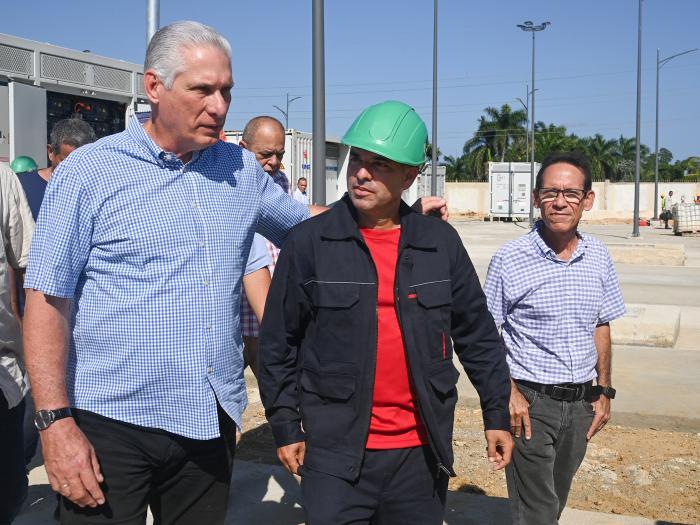
On August 28, 2026, Cuban President Miguel Díaz-Canel Bermúdez conducted an inspection tour of key infrastructure projects and state-owned enterprises across the Cuban capital, focusing on urgent solutions to the capital’s ongoing energy and water supply challenges that have been exacerbated by more than eight months of a U.S. blockade and oil embargo.
The first stop of the president’s tour was the Paso Seco water supply facility, a strategic infrastructure that serves the majority of southern and central Havana, a metropolitan area home to nearly 2 million residents. For months, prolonged and frequent power outages triggered by the country’s energy crisis have disrupted water pumping operations, creating a critical livelihood crisis for local residents. Following Díaz-Canel’s specific directive issued at the National Defense Council, large-scale maintenance and restoration work has been launched at the site, with cross-institutional teams from the National Institute of Hydraulic Resources, the National Electric Union, and the Revolutionary Armed Forces joining forces to repair deteriorated infrastructure including aging pumping equipment, damaged transmission lines, and faulty motors, while upgrading the facility’s backup power capacity.
Rubén Campos Olmo, Director General of the National Electric Union, told reporters that the project started from an extremely critical baseline, with a core goal of securing stable water supply for the capital. To mitigate the impact of National Electric System outages, additional backup motors will be deployed at Paso Seco and other key water sources across Havana to keep well pumps operational during system failures, maintaining pipeline pressure and consistent water delivery. While this temporary solution incurs additional fuel costs, long-term resilience plans call for the installation of solar panels at all key pumping and repumping stations across the city to reduce reliance on fossil fuels and the strained national grid. Campos Olmo confirmed that the backup motors are scheduled to be delivered and connected within 72 hours, ready for activation during any unexpected prolonged outages. During a meeting with task officials, Díaz-Canel emphasized the urgency of resolving power-related water shortages across all of Havana’s water systems, not just the Paso Seco site.
Next, the president visited the under-construction Havana 220 Battery Energy Storage System (BESS), located near the Technological University of Havana (Cujae). This is one of four new 50 MW battery storage facilities being rolled out across Cuba, which together will add 200 MW of total grid storage capacity to the national system. The remaining three facilities are located in Cotorro (Havana), Cueto (Holguín), and Bayamo (Granma) respectively.
Manuel Alejandro Soler Sánchez, lead electrical engineer for the Havana 220 project, explained that the lithium-ion based facility is designed as a grid-forming system with a primary function of stabilizing primary frequency for the National Electric System. During national grid disruptions, the BESS can provide startup power to generation facilities to help restore full system operations. It will also mitigate Automatic Frequency Trips, automatic protection mechanisms triggered by dangerous frequency drops that are a leading cause of widespread blackouts across the country. Additionally, the new storage network will enable greater utilization of Cuba’s growing solar photovoltaic capacity, compensating for output dips during cloudy conditions to keep overall power supply stable. According to the project timeline, all electrical installation and technical assembly will be completed by September 30, with final testing and commissioning wrapping up by October 30, when the facility will come online. This project is widely viewed as a landmark technological advancement for Cuba’s energy sector.
The final stop of the president’s tour was Servivip, a pioneering state-owned micro, small, and medium-sized enterprise (MSME) based in Havana’s Cotorro municipality. Founded in 2021 under Cuba’s new economic framework, the MSME falls under the country’s Higher Business Management Organization for Water and Sanitation, created to address gaps in residential hydraulic network services that the National Institute of Hydraulic Resources was unable to reach. From its original core mission of repairing household and community water networks, Servivip has expanded into a multi-service provider that handles more than 80% of Havana’s mobile water pipe supply, along with drain unclogging, wastewater evacuation, municipal garbage collection, and drinking water treatment. The enterprise has earned the distinction of National Vanguard for three consecutive years, becoming a widely recognized benchmark for successful state MSME management in Cuba. Currently, Servivip employs 88 workers, with an average salary that exceeds 48,000 Cuban pesos, well above the national average for the sector.
During a meeting with company leadership, director Víctor Janier Jara Jorge walked the president through the MSME’s five-year operational history, its strong economic performance, the benefits it has gained from Cuba’s recently approved economic and social reforms, as well as remaining structural obstacles that hinder its growth compared to other business management models. Díaz-Canel took note of the challenges raised to coordinate solutions for the MSME. The president also toured the company’s social responsibility projects, including a daytime care facility for isolated elderly residents that provides full daily care and meals, along with community outreach programs supporting the local school and maternal home. Díaz-Canel highlighted Servivip’s successful operating model, calling for the replication of its worker-led, creative management approach across other entities under the National Institute of Hydraulic Resources to resolve widespread service gaps.
Accompanying the president during the tour were senior Cuban officials including Political Bureau member and Minister of the Revolutionary Armed Forces, Army Corps General Álvaro López Miera; Deputy Prime Minister Inés María Chapman Waugh; and multiple members of the Council of Ministers.