Fifty years after Suriname gained full independence from the Netherlands, long-standing diplomatic rhetoric around the two nations’ “special, equal bond” is facing fresh scrutiny, as voices in Paramaribo highlight a striking gap between stated values and on-the-ground reality for ordinary citizens.
For decades, official meetings and state visits between the two governments have consistently leaned on warm diplomatic language: shared history, unique cultural ties, diaspora connection, friendship, mutual respect, equality and cooperation. There is no question these terms have roots in reality: centuries of shared history have woven the two nations closely together, with cross-ocean family ties, hundreds of thousands of Suriname-born people residing in the Netherlands, and overlapping cultural, linguistic and educational bonds that include both joyful memories and the heavy, painful legacy of colonial rule. But according to commentator Wilfred Leeuwin, one critical term is missing from this diplomatic lexicon: reciprocity.
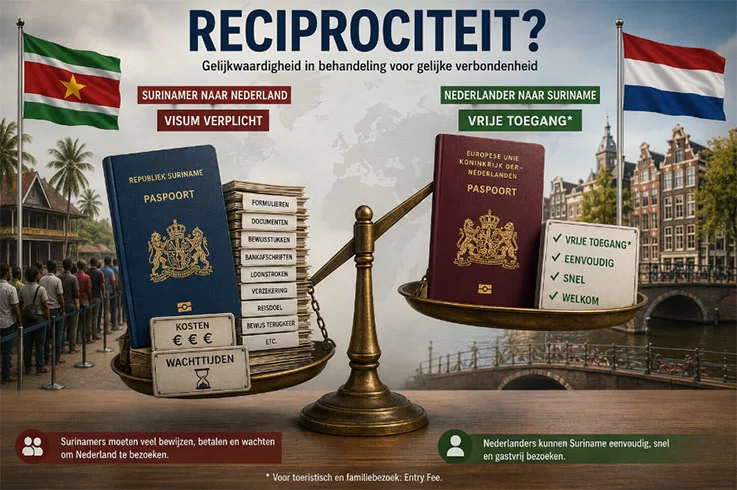
Equality, Leeuwin argues, is not defined by statements issued during state summits. It is felt by everyday citizens navigating cross-border travel. For a Surinamese resident seeking to visit family or take a short holiday in the Netherlands, a strict, burdensome visa requirement remains in place. Travelers must fill out extensive forms, gather supporting documentation, schedule in-person appointments, submit sensitive personal and financial information, pay processing fees, and wait for final approval on their application. All requests are processed in Paramaribo via third-party vendor VFS Global, under rules set by the Dutch government that require in-person attendance, fingerprint collection and detailed questioning about travel plans. For many Surinamese, the frustration extends far beyond the visa requirement itself: it stems from the cumbersome process and the often dismissive treatment applicants receive during the procedure.
This week, new Dutch ambassador to Suriname Marjolein Busstra acknowledged in her debut radio interview with ABC that Surinamese citizens widely view the process as unnecessarily burdensome, noting that high costs, long wait times, extensive documentation requirements, and demands for private financial data create significant barriers. She also pledged to take complaints about poor treatment by VFS Global seriously. But Busstra repeated a familiar explanation for the status quo: the Netherlands cannot unilaterally eliminate the visa requirement, as it is bound by European Union rules as a member of the Schengen Area. While this argument holds formal legal weight, Leeuwin argues it is socially and politically insufficient. If the Netherlands cannot deliver on this basic measure of equal treatment, it ought to stop claiming it shares a deeply special, warm and equal relationship with Suriname – a claim that was repeated just recently when Busstra presented her credentials to the Surinamese government, with officials saying the two nations would deepen their “close, equal bonds.” Equality, Leeuwin insists, must be visible in tangible practice, not just diplomatic statements.
The contrast in policy becomes even starker when looking at travel in the opposite direction. For Dutch citizens traveling to Suriname for tourism or family visits, no comparable visa process exists. In 2022, Suriname unilaterally eliminated visa requirements for citizens of dozens of countries, including the Netherlands, allowing short-term visits with just a simple entry fee payment (different rules remain in place for work and long-term study placements). This creates a jarring imbalance: the citizen of the former colonial power can enter Suriname with relative ease, while the citizen of the former colony must jump through dozens of bureaucratic hoops to travel in the opposite direction. This imbalance opens a larger, uncomfortable question: how much of the old colonial power dynamic remains embedded in how the two nations interact, 50 years after Suriname’s independence?
This is not an accusation that the Netherlands still governs Suriname as a colony. Suriname has been an independent republic since November 25, 1975, and it carries full responsibility for its own policy successes and failures. But political independence does not automatically equal psychological equality, a warning first sounded by late Surinamese president Ronald Venetiaan 28 years ago. On the 20th anniversary of independence in 1995, Venetiaan cautioned that positive ties with the Netherlands must not devolve into Dutch dominance, and clear boundaries were needed to prevent Dutch influence from becoming counterproductive. Most notably, he observed that while the formal colonial era had ended, the colonial mindset still persisted among the former colonizing power.
Three decades later, Venetiaan’s warning carries new urgency, Leeuwin argues. A colonial mindset does not need to manifest through formal governors, occupying troops or a colonial flag flying over government buildings. It can be felt in an imbalanced dynamic where one side sets the rules, imposes conditions and exercises control, while the other is expected to explain itself, prove its eligibility and conform to the terms set by the more powerful partner. That is the feeling shared by many Surinamese, and the issue goes far beyond visa rules alone.
Look at other areas of bilateral cooperation: internships, development projects, research exchanges, knowledge sharing and technical assistance. Dutch students, experts, consultants and organizations face few barriers to entering Suriname to conduct research, gain field experience or implement projects. This collaboration is valuable, and Suriname benefits from access to global knowledge and partnership. But Leeuwin argues that the critical reverse question is rarely asked: how easy is it for Surinamese citizens to access the same opportunities in the Netherlands? How reciprocal are internship exchanges? How reciprocal is joint knowledge sharing? How many Surinamese experts are invited to lead work in the Netherlands? How often do Surinamese institutions help set the agenda for bilateral projects? Who gets to define what Suriname needs? Who sets the terms of cooperation? Who controls funding? Who provides the core expertise? The issue is not that all these interactions are imbalanced, but that 50 years after independence, Suriname is mature enough to ask these questions openly.
Suriname must also take responsibility for advancing its own interests, Leeuwin argues. It cannot simply blame four centuries of colonialism for every challenge and avoid taking action. If the Netherlands claims changing the visa requirement requires approval from European institutions, the Surinamese government should map out all available diplomatic pathways and pursue them aggressively – not just hold one cursory meeting, issue a gentle statement during a bilateral visit, or appoint yet another unproductive study committee. If full visa-free travel is not immediately achievable, Suriname should negotiate concrete, immediate easing of restrictions. The government should also be transparent with the public about what steps have been taken, what the Netherlands can do unilaterally, what requires approval from Brussels, and where the current barriers lie. Suriname’s own policy must also shift: why has the country unilaterally offered travel concessions to Dutch citizens without first negotiating reciprocal measures in return? Why is it often seen as improper for Suriname to set clear conditions for foreign partners, when it is accepted as normal for other countries to set those conditions for Surinamese citizens?
Reciprocity does not mean Suriname should retaliate by imposing the same burdensome bureaucratic barriers on Dutch travelers tomorrow – that would be counterproductive and childish. Instead, reciprocity means two sovereign nations take each other seriously enough to build a relationship where rights, opportunities, obligations and benefits are as balanced as possible. This requires Suriname to practice self-respect, Leeuwin argues: there is nothing wrong with the Netherlands defending its own national interests, that is what all sovereign states do. But it is equally essential for Suriname to defend its own interests consistently and forcefully.
Some of this imbalance, Leeuwin notes, stems from a less discussed part of colonial legacy: the mindset that remains among the formerly colonized, a habit of looking to the former colonizer for approval, funding, solutions and even validation. It is this mental slavery that must be overcome, echoing Bob Marley’s famous lyrics: “Emancipate yourselves from mental slavery, none but ourselves can free our minds.”
Suriname does not need to beg for favors because of its colonial history, and the Netherlands does not need to grant favors out of colonial guilt. What Suriname can and should demand is far simpler: equal treatment, because it is no longer a colony. Equality should not only be heard when an ambassador presents credentials, a minister makes a state visit, or both governments issue a joint statement calling relations “excellent.” It should be felt by ordinary citizens when they interact with the bilateral relationship: at the visa counter, when applying for an internship, when enrolling in study programs, when working on joint projects, and when accessing equal opportunities. It should shape how the two nations talk to each other as equals.
After more than 50 years of independence, it remains entirely appropriate for the Netherlands and Suriname to celebrate their unique shared relationship. History and people-to-people ties do make the bond special. But moving forward, every time the word “equality” is invoked by either side, it is time to ask one simple question: where is the reciprocity? No favors, no retaliation, no nostalgia for colonial rule, no perpetual anger at the former colonizer. Just two mature, sovereign nations, mutual respect for each other’s citizens, and equal rights and obligations on both sides. There is no better word for that than reciprocity.