For weeks, cross-border travel and trade between Suriname and Guyana have been thrown into chaos after the Canawaima ferry was forced out of operation by a safety ban. Now, top Surinamese transport officials say a provisional resumption of the critical service could be just days away, but political leaders are demanding far-reaching structural reforms rather than quick fixes to the long-troubled operation.
The Suriname Maritime Authority (MAS) imposed the operating ban on the Canawaima after a routine inspection uncovered serious gaps in mandatory safety equipment, including faulty or missing lifeboats, life buoys, life jackets, and emergency VHF communication radios. Further concerns were raised about the structural integrity of the vessel’s steel hull, which had not undergone dry dock maintenance since 2021.
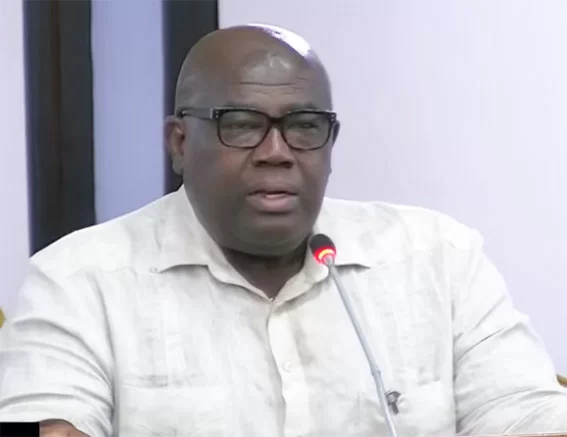
Speaking before the National Assembly on Tuesday evening, Transport, Communication and Tourism Minister Raymond Landveld reported that nearly all of the MAS’s mandatory safety corrections have now been completed. Hull thickness tests found that 99% of the sampled steel plating meets the required minimum standards, he said. Landveld has formally asked the MAS to lift the ban on a temporary basis, ahead of the vessel’s previously scheduled full dry dock maintenance set to begin August 31.
“Nearly all of the MAS’s requirements have been satisfied,” Landveld told lawmakers. “I expect that a clearance certificate allowing the ferry to resume operations will be issued in the very near term.” After the Canawaima enters dry dock, the Guyanese ferry Sandaka, which is currently also undergoing maintenance, will take over the route on an interim basis.
The shutdown has already caused widespread disruption, leaving hundreds of passengers stranded on both sides of the border, and cutting off critical supply links for local businesses and agricultural producers that rely on the ferry cross-border service. Lawmakers have also raised alarm over unregulated informal “backtrack” crossings that have surged since the shutdown, with reports of passengers including children crossing open water without life safety equipment.
Political leaders have made clear that resolving the immediate travel crisis is not enough. Opposition National Democratic Party leader Rabin Parmessar pushed Landveld to take immediate administrative action to overhaul the ferry service’s management, arguing that the failure to maintain basic safety equipment is the result of systemic mismanagement, not a one-off technical error.
“We hold you accountable right now, and that means you must intervene in the governance of this service,” Parmessar told the minister, doubling down on his demand for immediate action. National Party of Suriname leader Jerrel Pawiroredjo echoed that criticism, noting that both governance and regulatory oversight of the service have failed to meet basic standards, requiring root-and-branch reform. ruling party lawmaker Rawien Raghoenandan also emphasized the urgent human cost of the shutdown for stranded travelers.
Minister Landveld acknowledged that the crisis cannot be dismissed as a simple technical failure, admitting that systemic problems have built up at Canawaima over years of inadequate management. He conceded that the service has long operated on a day-to-day reactive basis, without long-term planning, regular performance reporting, or structured forecasting for maintenance and investment needs.
The 1998 bilateral management agreement that forms the basis of the Suriname-Guyana cross-border ferry partnership has never been updated or re-evaluated as required, Landveld confirmed. The service’s boards of commissioners have now been ordered to draft an updated agreement to reflect modern operational and safety standards, while a full audit of the Canawaima’s current business operations is already underway, with findings due by August 31.
Landveld emphasized that his immediate priority is to restore safe service as quickly as possible to end the current disruption for travelers and businesses. Once service is provisionally restored, he said, the government will move forward with structural changes to the service’s governance, management and operating models to prevent a repeat of the crippling shutdown that has disrupted cross-border ties between the two South American nations.