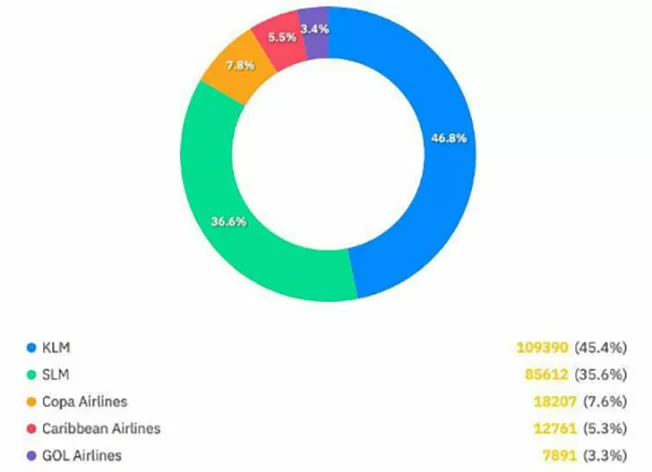
A new annual report from Suriname’s ICF Unit has mapped the competitive landscape of incoming air passenger traffic to the South American nation for 2025, naming Dutch flag carrier KLM as the market leader with the largest share of registered incoming travelers.
Data published in the 2025 Annual Incoming Statistics Report breaks down market share across major carriers serving Suriname: KLM holds a dominant 43.5% of all incoming air passengers, outpacing national carrier Surinam Airways (SLM) which commands 33.5% of the market. Regional players follow behind: Panama’s Copa Airlines accounts for 9% of traffic, Caribbean Airlines takes 5.4%, and Brazil’s GOL Airlines holds 2.9%. The remaining small share of incoming passengers is carried by a collection of smaller regional and niche airlines.
The ICF analysis attributes KLM’s enduring position as Suriname’s top international air transport provider to two key competitive advantages. First, the Amsterdam–Paramaribo route operated by KLM offers high flight frequency and proven operational reliability, factors that consistently draw traveler preference. Second, KLM’s hub at Amsterdam Schiphol Airport provides unrivaled access to a vast global network of connecting flights, making it a convenient choice for passengers traveling to Suriname from points across Europe, North America, and beyond.
By contrast, the report outlines multiple ongoing challenges holding back Surinam Airways’ market growth. SLM faces constrained fleet capacity that limits the number of passengers it can carry, persistent uncertainty around its published flight schedules that erodes traveler trust, and limited infrastructure for through-checking baggage directly to final destinations for connecting flights. The analysis also notes that European aviation safety restrictions imposed on Surinamese airlines have created additional headwinds for SLM’s international operations.
Regional carriers play a critical niche role in connecting Suriname to neighboring markets: Copa links the country to Panama, Caribbean Airlines serves routes across the Caribbean basin, and GOL connects Suriname to Brazil. Smaller local operators including Gum Air and Fly All Ways also contribute meaningfully to regional passenger traffic, supporting intra-regional travel and tourism.
The ICF’s core conclusion highlights a key consumer trend in Suriname’s aviation market: travelers do not base their carrier choice primarily on airline nationality. Instead, the biggest drivers of passenger decision-making are operational reliability, access to convenient connecting routes, and broad operational capabilities. To strengthen the competitive position of Suriname’s domestic aviation sector, the report recommends three priority actions: strengthening national aviation oversight, bringing Surinamese carrier safety practices into full alignment with international standards, and expanding the network of regional air connections.