As the 2026-2027 academic year approaches, Suriname’s Ministry of Education, Science and Culture is racing against the clock to resolve a growing education crisis that has left thousands of students without guaranteed classroom spots, compounded by systemic shortages of learning spaces and qualified teaching staff. Education Minister Dirk Currie laid out the scale of the challenge and the government’s emergency response plan during an initial thematic session of the National Assembly (DNA) on Friday, with a full policy debate scheduled for Tuesday to allow lawmakers to scrutinize official data and debate solutions to the identified bottlenecks.
Currie emphasized that enrollment figures remain dynamic as the start of term nears, but current data paints a stark picture of unmet demand. For incoming first-grade students, 4,786 applications had been registered at the time of his presentation, while only 4,444 places were available. Updated population projections from the Central Bureau of Civil Affairs indicate that an additional 4,458 first-grade children will still need placement before the term begins. The gap is equally severe for students transitioning from grade 8 to grade 9: 2,592 students are seeking placement, against just 1,496 available spots, leaving 1,096 learners without allocated places.
To address this immediate gap, the ministry has implemented pre-registration and a centralized national enrollment tracking system to map available capacity across all regions. By August 30 at the latest, authorities will finalize placement plans for all students who have not yet secured a spot.
One of the most intractable long-term issues facing the sector is a persistent structural shortage of classroom space. Last academic year, 1,134 students were forced to attend classes on a modified schedule that included Saturday schooling to compensate for overcrowding. Currie stressed that urgent expansion of education capacity is critical to avoid repeating this disruptive arrangement. The worst shortages are concentrated in Paramaribo, Wanica, Saramacca and Brokopondo, while other regions have stable capacity or even spare spots to accommodate extra students. To minimize disruption, the minister has ruled out long-distance school transport for young children, though he noted the option remains on the table for older learners.
Authorities have identified more than 100 schools in need of infrastructure upgrades, with 61 institutions placed on an immediate priority list. Tendering for renovation work and temporary emergency classroom construction at 31 priority schools will launch before the end of August, Currie confirmed. Additional new classroom construction has already been completed with financial and logistical support from partners including national oil company Staatsolie, Chinese firm Dalian, and the Caribbean Development Bank.
Alongside the space crisis, a severe national teacher shortage is creating another major barrier to a smooth term start. To speed up hiring, the ministry is changing its recruitment strategy: instead of waiting for graduates to apply for open roles, it will now directly extend job offers to new graduates from teacher training institutes and the country’s Institute for Teacher Training (IOL).
Currie explained that the shortage stems from more than just low numbers of new graduates: high rates of long-term teacher absence have also left schools chronically understaffed. The ministry is currently exploring whether digital learning tools can help partially offset staffing gaps. Official data shows that graduation numbers from teacher training programs remain very low: just 87 IOL graduates earned lower teaching qualifications this year, alongside 25 with mid-level MO-A certifications and 8 with senior MO-B certifications, and graduation numbers at other pedagogical institutes are similarly small.
In Suriname’s interior regions, the teacher shortage is made worse by substandard housing for education staff. Many qualified teachers cannot be posted to rural schools because existing staff housing is uninhabitable, and efforts to rent private housing have been hampered by property owners’ reluctance to rent to the ministry, which has a well-documented history of late rental payments. Currie said he will work with local village councils to find collaborative solutions to this housing barrier.
In a rare moment of self-criticism, Currie acknowledged that his own ministry has failed at timely, clear communication with schools and the public, giving the department a “failing grade” for its performance in this area. Both the accuracy and timeliness of communication need urgent improvement, he said. To fix this, clear, unified guidelines for schools for the new academic year will be published and made publicly accessible by the end of October at the latest. The ministry is also developing a unified protocol for social media and mobile phone use in schools that will apply to all public and private institutions.
The minister also addressed widespread labor unrest that disrupted the previous academic year, noting that nearly all teacher strikes were tied to late payment of salaries, scale adjustments and bonuses. To resolve this, administrative payroll procedures will be overhauled to ensure teachers receive correct pay on time going forward.
As part of longer-term education reforms, Currie announced a pilot program that will devolve more autonomy to school leaders at 15 participating institutions. Under the pilot, principals will gain direct control over cleaning services, minor facility maintenance, school security and selected administrative tasks. All participating school leaders will complete targeted leadership training before the pilot launches.
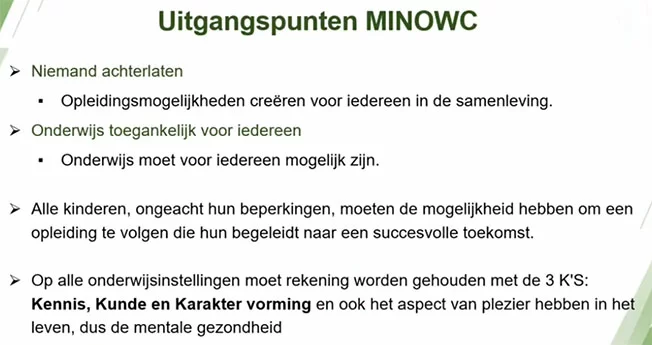
Currie reaffirmed that the core principle guiding the ministry’s policy remains that no child should be left behind, and education must remain fully accessible to children from low-income households who cannot cover associated costs. Beyond building academic knowledge and skills, the ministry will place greater emphasis on character development and youth mental well-being in the coming term.
The National Assembly intentionally split the thematic debate into two phases to allow lawmakers adequate time to review Currie’s back-to-school plan and supporting data. After Friday’s initial presentation, MPs will have time to study the materials before returning on Tuesday to submit questions, raise criticism and table policy proposals. Key topics for Tuesday’s debate include funding for the emergency plan, student placement processes, grade 10 programming, infrastructure renovations, curriculum updates and education access.
Closing Friday’s session, Vice President Gregory Rusland acknowledged that Suriname’s education system has faced years of challenges, and the government’s priority is now restructuring the system to ensure all children receive the education they are legally entitled to. Where urgent catch-up action is needed, the government will take all necessary steps to deliver a smooth start to the 2026-2027 academic year, Rusland confirmed.