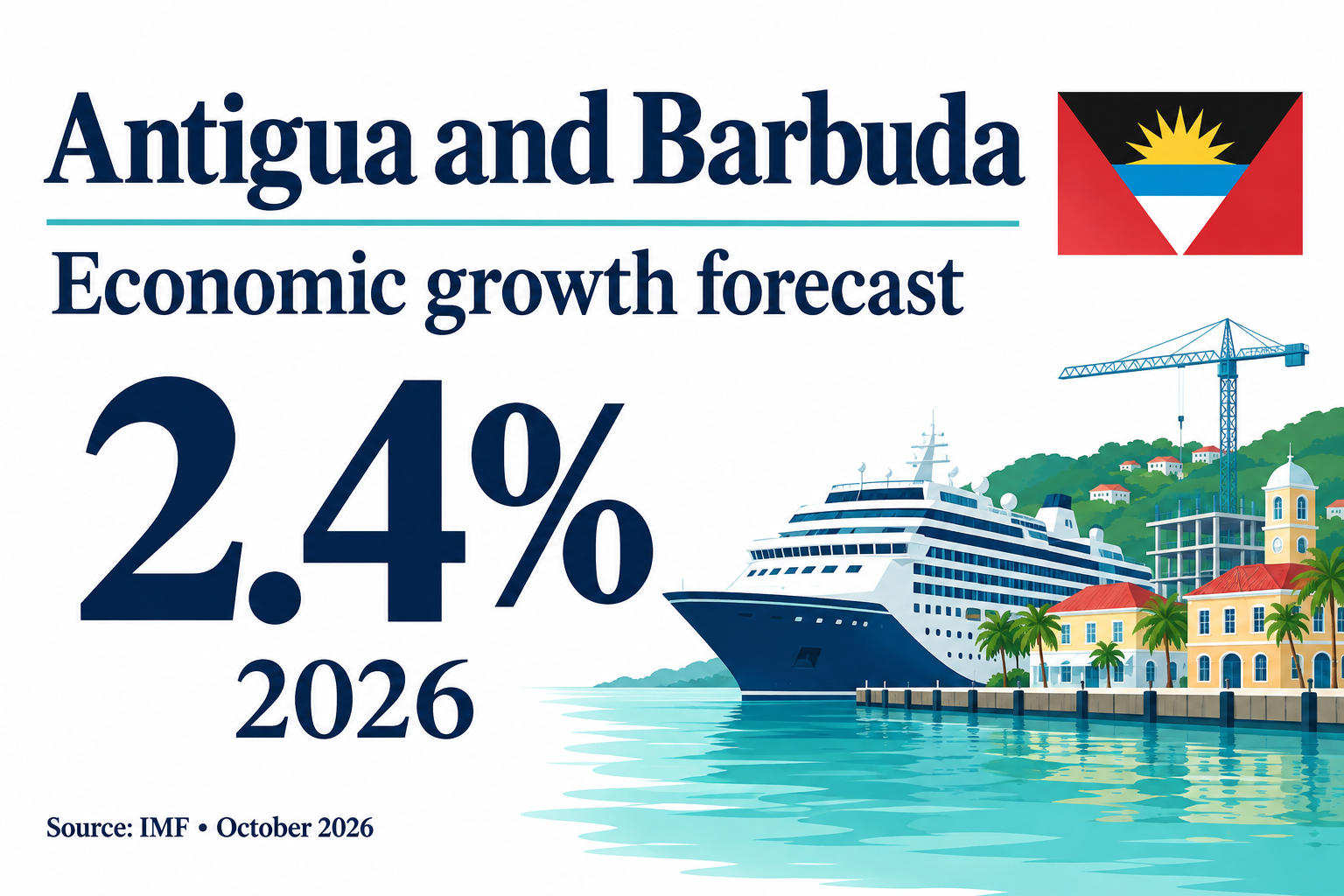
The International Monetary Fund (IMF) has released its October 2026 Regional Economic Outlook for the Western Hemisphere, forecasting a 2.4% annual growth rate for the twin-island nation of Antigua and Barbuda this year, down from the 3% expansion the country recorded in 2025. The report, titled “Turning Tailwinds into Lasting Gains,” also projects that Antigua and Barbuda’s growth will tick up slightly to 2.5% in both 2027 and 2028, outperforming the average 1.4% growth forecast for all tourism-dependent Caribbean economies in 2026.
While Antigua and Barbuda’s projected growth outpaces the regional average for tourism-dependent economies, several neighboring island nations are set to see faster expansions this year: Grenada tops the regional group with a 3.9% growth forecast, followed by Dominica at 3.1%, The Bahamas at 2.5%, Barbados at 1.8%, and St. Lucia at 1.2%.
In its analysis, the IMF notes that broad economic activity across the Western Hemisphere has remained surprisingly resilient in recent months, buoyed by a combination of strong consumer demand from the United States, elevated global commodity prices, looser financial conditions, booming regional tourism sectors, and steady inflows of remittances from overseas workers. These positive tailwinds have offset significant headwinds including persistent trade policy uncertainty, volatile global energy prices, and shifting global immigration patterns that have disrupted regional labor markets.
Despite this near-term resilience, the IMF sounded a note of caution about long-term regional economic stability. The organization warns that public debt levels remain far too high across most of the hemisphere, leaving governments with very limited fiscal buffer to respond to unexpected economic shocks, while medium-term growth projections for most countries remain below pre-pandemic averages.
For Antigua and Barbuda specifically, the report projects that inflation will rise to 4.5% by the end of 2026, up from 3.1% at the end of 2025, as sustained high global energy and food prices push back the timeline for inflation to return to central bank target levels. The IMF clarifies that slower inflation growth only means prices are rising at a reduced pace, not that overall price levels will decline. Inflation in Antigua and Barbuda is expected to ease back to 2.3% in 2027 and hit the 2% target in 2028, per the forecast.
On fiscal metrics, Antigua and Barbuda is projected to continue reducing its gross debt-to-GDP ratio, which the IMF estimates will fall from 70.2% in 2025 to 66.8% in 2026, then drop further to 65.8% in 2027 and 64.7% in 2028. One key imbalance the report highlights is the country’s widening external current account deficit, which is set to expand from 11.6% of GDP in 2025 to 12.7% in 2026, before gradually narrowing in the following two years.
Across all tourism-dependent Caribbean economies, aggregate growth is projected to rise to 2.3% in 2027 before easing slightly to 2% in 2028. The IMF used the release of the report to urge regional policymakers to take advantage of current favorable economic conditions to rebuild critical fiscal reserves, lock in long-term price stability, and roll out targeted social support for low-income and vulnerable households. The organization also called for structural reforms to boost domestic productivity, upgrade workforce skills, strengthen public institutions, and attract sustained foreign direct investment to drive long-term growth. Antigua and Barbuda’s specific projections are included in the report’s statistical annex, with no separate country deep dive included to break down the drivers behind the forecast numbers.