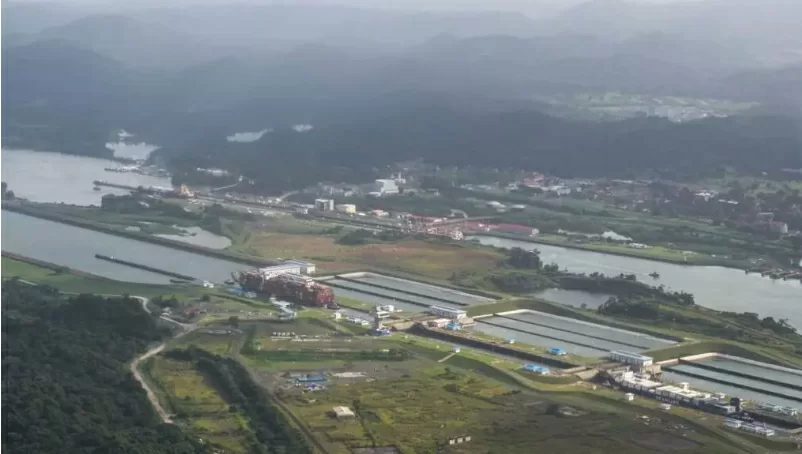
One of the world’s most critical maritime trade arteries is facing unprecedented strain from extreme drought, driven by one of the strongest El Niño events in recent decades. The Panama Canal Authority (ACP) announced in late August 2026 that it will implement deep cuts to the number of vessels allowed to transit the iconic interoceanic route starting September 3, responding to plummeting water reserves that are essential to the canal’s lock operations.
Currently, the waterway accommodates 32 vessels per day. Under the new restrictions, that number will first drop to 34 daily transits on September 3, before falling further to 32 daily passages by September 15. Additional water conservation measures have already been put in place, including a reduction in the maximum allowable draft for large vessels, to slow the depletion of stored water.
Unlike most major shipping routes, the 108-year-old Panama Canal, which connects the Atlantic and Pacific Oceans, relies entirely on rainwater collected in two artificial reservoirs—Gatún Lake and Alhajuela Lake—to operate its lock system. The locks, which raise and lower vessels between the different ocean levels, consume large volumes of water with every transit. This year, an extreme drought across Central America, amplified by El Niño, has brought far less rainfall than expected to the canal’s watershed.
El Niño, a cyclical climate phenomenon characterized by elevated sea surface temperatures in the central and eastern equatorial Pacific, reshapes global weather patterns, shifting wind currents, atmospheric pressure and rainfall distribution. For Central America, this shift consistently brings prolonged dry conditions and below-average precipitation. This year’s event has been particularly severe, pushing drought conditions across much of the region: just last week, Honduras declared drought emergencies for 80 percent of its national territory.
The impact of the canal’s new restrictions extends far beyond Panama’s borders. The waterway handles roughly 5 percent of total global maritime trade volume, and carries approximately 40 percent of all container cargo that enters or departs the United States, serving as a vital link connecting trade flows between the Americas, Asia and Europe. Any disruption to transit capacity has immediate ripple effects on global supply chains, shipping schedules and logistics costs.
This is not the first time drought has forced cuts to canal operations. Similar restrictions on daily transits and vessel draft were implemented in 2019 and 2023 during previous dry periods. But canal officials warn that the current crisis is more severe, as drought conditions are becoming increasingly frequent and intense due to long-term climate change, which has made rainfall patterns across Central America far less predictable.
ACP officials emphasized that the immediate cuts are a necessary measure to protect the long-term sustainability of the canal, rather than just a short-term response to the current dry spell. In the longer term, the authority is working on permanent solutions, including upgrades to water management infrastructure and targeted investments to reduce the canal’s vulnerability to future drought events. As El Niño conditions persist through the end of 2026, the canal faces a prolonged period of uncertainty as it works to maintain reliable operations for the global shipping industry.