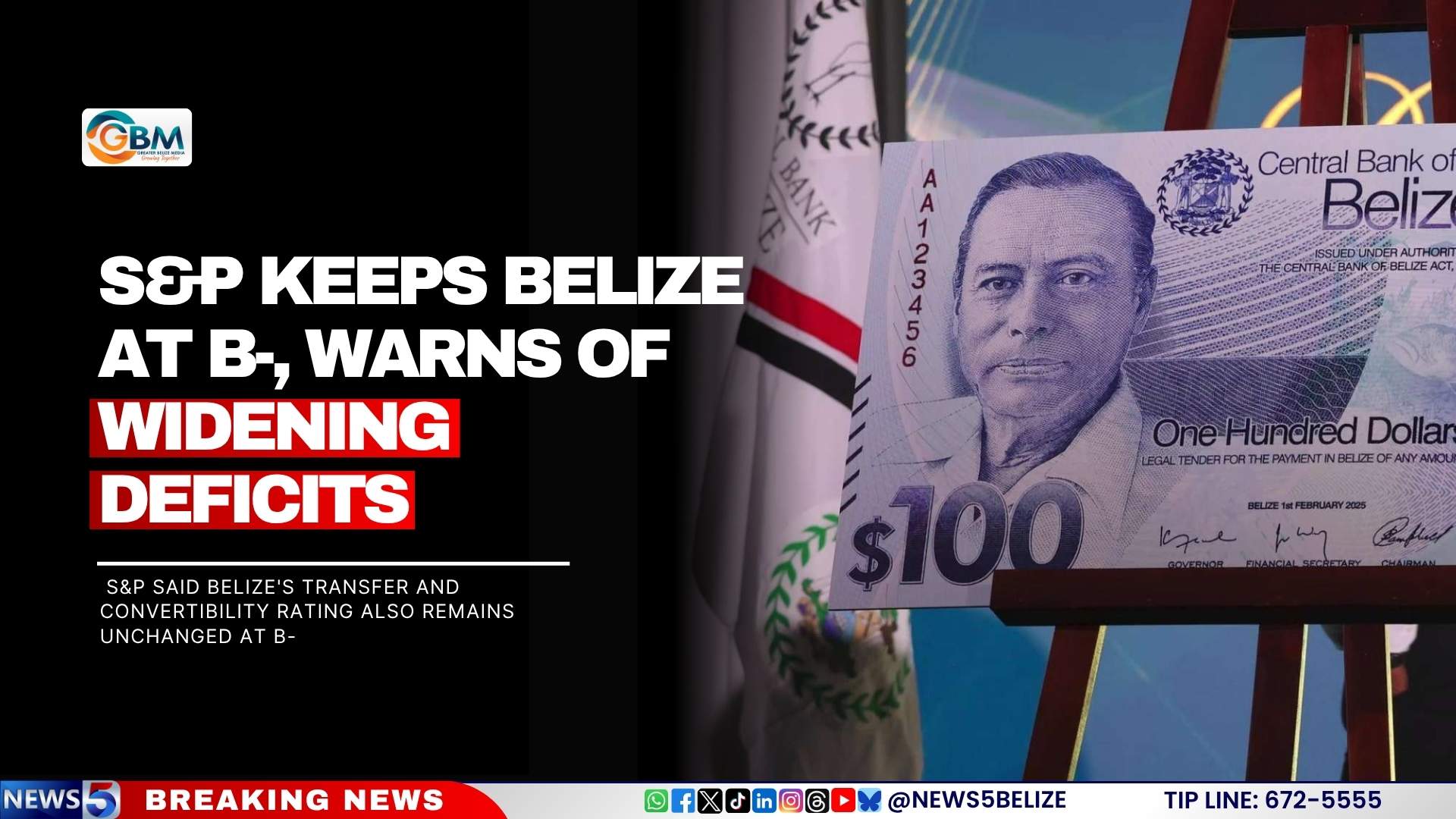
On August 19, 2026, S&P Global Ratings announced it would retain Belize’s B-/B sovereign credit rating with a stable outlook, while issuing warnings about expanding fiscal and current account deficits over the coming two years. The rating agency linked the expected deficit expansion to ongoing volatility in global crude oil markets, which has pushed up the Central American nation’s import costs.
Alongside the main sovereign rating, S&P confirmed that Belize’s transfer and convertibility assessment will also hold steady at B-. The stable outlook is rooted in the agency’s projection that Belize will see moderate economic growth aligned with its long-term potential, and that even with mounting pressure from elevated oil prices, the country’s twin deficits will remain manageable.
For 2026, S&P forecasts real GDP growth of 2.0 percent, a slowdown compared to previous years driven primarily by cooling expansion in two key sectors: business process outsourcing (BPO) and tourism. The tourism sector, a cornerstone of Belize’s economy, is expected to soften in 2026 as higher oil prices drive up travel costs and reduce the number of overnight tourist stays. Even so, S&P notes potential upside on the horizon: new air routes launched by BermudAir and Air Canada are expected to improve Belize’s connectivity to North American and European markets, which could boost visitor numbers in coming years.
The BPO sector, which employs roughly 9 percent of Belize’s total workforce, faces a separate long-term challenge. S&P warns that the rapid global adoption of artificial intelligence is likely to automate many routine business functions that are currently handled by Belizean outsourcing providers, reducing global demand for these services over time.
On the fiscal front, Belize delivered a nearly balanced budget in 2025, posting a tiny surplus equal to 0.03 percent of GDP. That positive result came from moderate revenue growth and cuts to capital spending. But S&P projects that trend will reverse sharply in 2026, with the general government posting a deficit equal to 2.5 percent of GDP. The shift is driven by multiple factors: rising imported energy costs, a recent cut to gasoline excise taxes, government-mandated electricity rate caps, and growing public sector payroll expenses. Already, payroll and pension costs make up 41 percent of total government spending, and an additional 4.0 percent wage increase is scheduled to take effect in October 2026.
Net general government debt rose to 66 percent of GDP in 2025, up from 64.5 percent in 2024. S&P attributes the increase largely to domestic borrowing taken on after the nationalization of the country’s energy assets. Over the period through 2029, the rating agency expects net government debt to average roughly 67 percent of GDP. S&P also highlighted growing debt servicing costs, noting that the stepped-up coupon structure on Belize’s $364 million Blue Bond will reach its maximum rate of 6.04 percent in 2026. This change will push total debt servicing costs above 10 percent of total government revenue for the entire forecast period.
Belize’s current account deficit expanded to 2.8 percent of GDP in 2025, and S&P projects it will widen further to 4.6 percent of GDP in 2026. The widening deficit is driven by a growing trade gap caused by more expensive fuel imports, continued reliance on electricity imports, and softening tourism revenue. Through 2029, the current account deficit is expected to average 2.8 percent of GDP, and S&P projects it will be primarily financed by foreign direct investment targeted at tourism, real estate, and infrastructure projects.
Looking ahead, S&P outlined two potential paths for Belize’s rating over the next 12 to 18 months. The agency could downgrade the rating if external or domestic economic shocks weaken fiscal performance or restrict Belize’s access to official financing. On the other hand, an upgrade would be possible if the government delivers concrete policy commitments to strengthen fiscal results and sustain steady economic growth, or if external vulnerabilities moderate alongside clear evidence of policy progress.