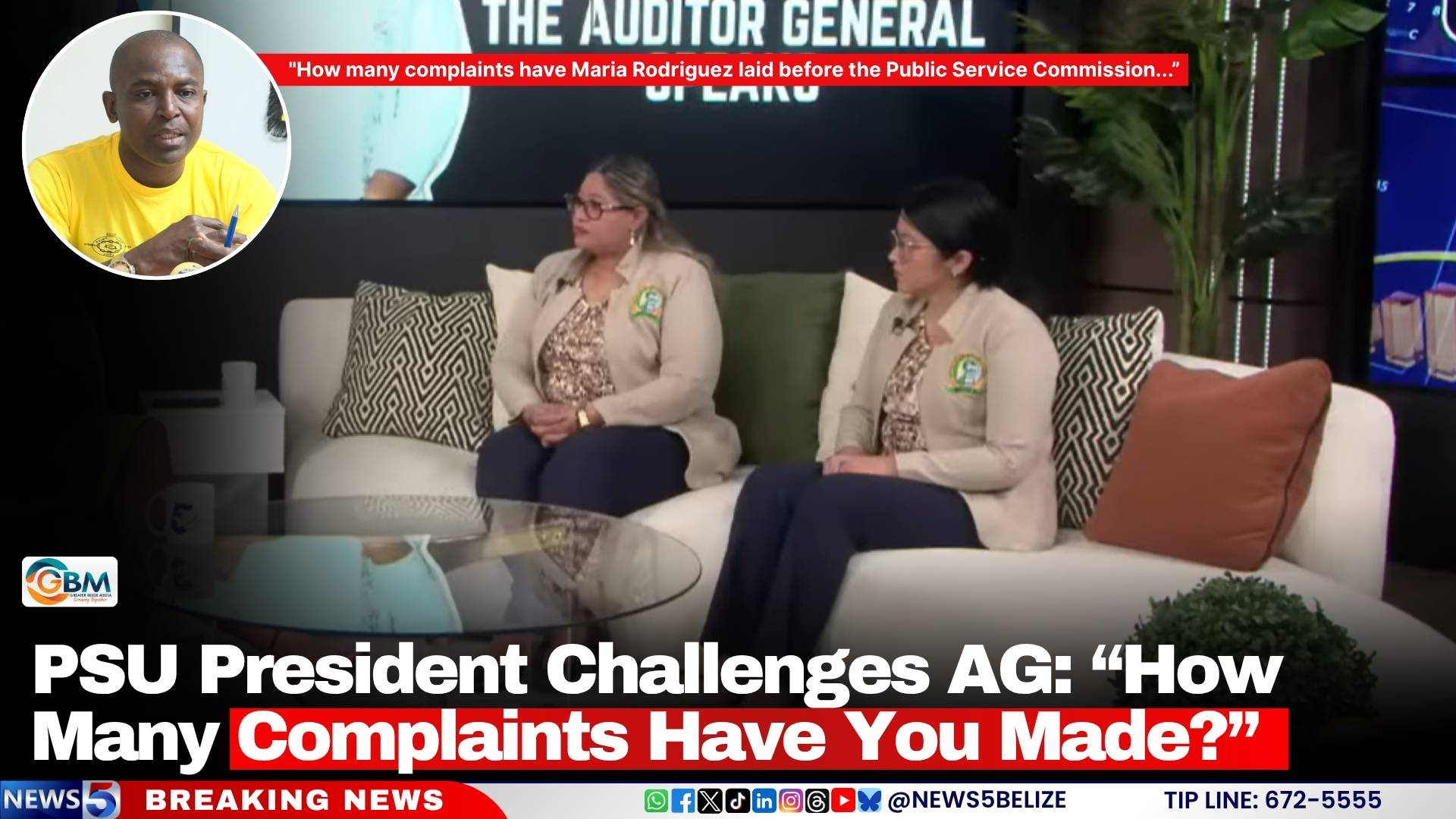
A public confrontation over government accountability has emerged in Belize, where the leader of the nation’s largest public sector union is pressing the country’s top auditor to answer for unexplored enforcement action against officials responsible for widespread mismanagement of official government records.
Dean Flowers, president of the Public Service Union (PSU), laid out the challenge during a press conference hosted Tuesday by the National Trade Union Congress of Belize. His comments came in direct response to recent public remarks from Auditor General Maria Rodriguez, who last Thursday appeared on the local current affairs program *Open Your Eyes* to detail the deep, systemic barriers her office faces in completing routine government audits.
During that interview, Rodriguez painted a stark picture of record-keeping failure across Belize’s government ministries. She explained that decades of accumulated physical documents have left agencies critically short on storage space, forcing years of official records to be packed away in unventilated, unconditioned storerooms that lack basic utilities like electricity. Without climate control, documents quickly develop mold, decay, and become permanently damaged or illegible long before auditors can access them for financial reviews. Rodriguez labeled the ongoing crisis a “systemic” failure that has contributed to a crippling backlog of uncompleted annual audit reports. As of August 2026, the most recent finalized audit report released by her office covers the 2017-2018 fiscal year, leaving nearly a decade of government spending unvetted.
Beyond storage-related damage, Rodriguez also noted that public officials have at times withheld original documents to obstruct audit work. Because photocopied records can easily be altered to misrepresent official transactions, her auditors require access to original primary documentation to verify spending. She confirmed that her team has encountered multiple cases where altered copies contradicted the content of original documents, creating further delays and uncertainty in the audit process.
In his response, Flowers questioned why Rodriguez has not exercised the full enforcement authority granted to her office under Belize’s Finance and Audit Reform Act (FARA) to hold errant public officials accountable for obstructing audits and destroying records. He specifically cited Section 13(4) of the legislation, which explicitly grants the Auditor General the power to file formal disciplinary and criminal complaints against public officers who violate record-keeping rules.
Under that provision, Rodriguez can file disciplinary complaints directly with the Public Service Commission, which has the authority to terminate employment for officers found guilty of misconduct. She also has the power to refer criminal cases to the Director of Public Prosecutions for formal charges under Belize’s Criminal Code.
Flowers is now demanding public transparency around how often the Auditor General has used this power. “How many complaints have Maria Rodriguez laid before the Public Service Commission for those public officers to be sent home?” Flowers asked reporters Tuesday. “How many complaints have Maria Rodriguez made to the Director of Public Prosecution under the Criminal Code or any other law, as the FARA says, for people to be charged and prosecuted?”
The exchange has reignited longstanding questions about institutional accountability in Belize, focusing attention on a core gap between identifying public sector wrongdoing and taking actionable enforcement against the officials responsible. For Flowers and the PSU, the crisis of missing and damaged records is not just an administrative oversight—it is a failure of enforcement that demands clear answers from the nation’s top auditor.