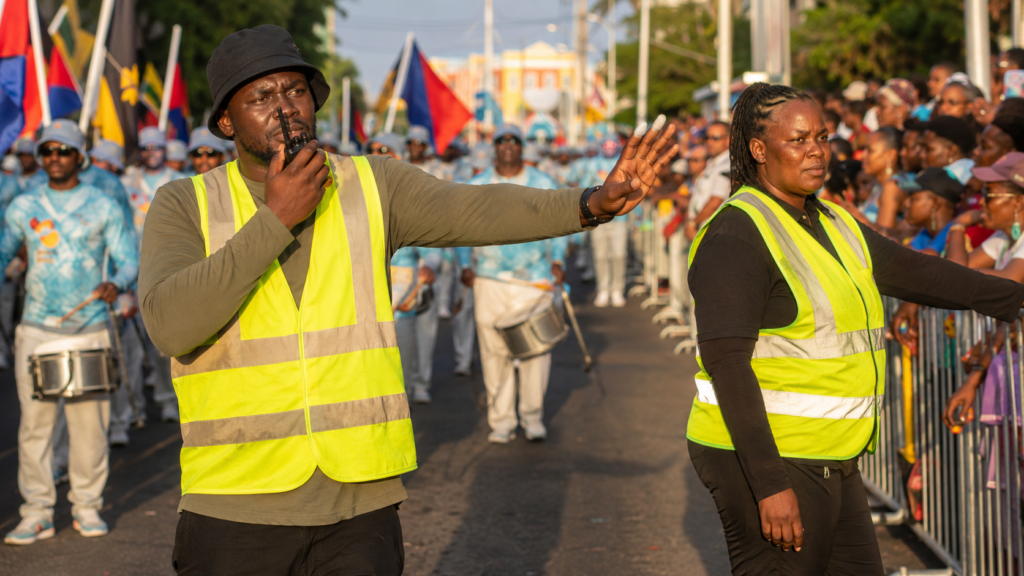
The confetti has settled and the calypso beats have faded after another hugely successful edition of Antigua’s annual Carnival, and now the traditional cycle of post-event gratitude is underway. Every year, well-earned public praise flows to the Antigua and Barbuda Festival Commission, the island nation’s police force and defense force, emergency response teams, media partners, local vendors, corporate sponsors, and the throngs of international visitors who turn out to celebrate the island’s cultural heritage. But one critical group remains conspicuously absent from most shout-outs: the unsung Parade Marshals, who work tirelessly behind the scenes to keep every event safe and running on schedule.
Long before the first costumed mas band steps onto the parade route, while most revelers are still preparing for the day’s celebrations, marshals are already on site. They spend hours coordinating band positions, liaising with event organizers, troubleshooting early logistical issues, mapping crowd control strategies, and prepping for any unexpected crises that might emerge. They stay at their posts from the first light of dawn until the final band crosses the finish line, long after most spectators have headed home for the night.
Contrary to common public misconception, the role of a parade marshal extends far beyond walking alongside bands or directing vehicle traffic. Tasked with preserving the flow and structural integrity of the entire procession, marshals collaborate constantly with police officers, emergency medical teams, band leaders, and other event stakeholders. They maintain constant situational awareness, making split-second real-time decisions to keep the parade moving safely and efficiently for participants and onlookers alike.
What remains widely unacknowledged, however, are the hardships and unfair treatment many marshals endure while carrying out their duties. It is not uncommon for marshals to face verbal abuse from spectators who resent being asked to move out of restricted areas, or who disagree with on-the-spot calls marshals must make to keep the event on track. In more extreme cases, they have been subjected to aggressive behavior and even physical confrontation, simply for doing the job they volunteered to do. Even more disheartening is the unfair blame they absorb for parade delays that are not their fault.
A core part of a marshal’s mandate is to keep the procession moving at a consistent, manageable pace. But there are repeated instances where mas camps, bands, or individual participants deliberately slow their pace or hold up the procession, creating large, disruptive gaps between parade sections. When marshals’ repeated instructions to keep moving are ignored, the resulting delays are often wrongfully blamed on the marshals who tried to prevent them. This double standard raises a fair question: how can marshals be expected to deliver a seamless parade when participants deliberately refuse to cooperate with official guidance?
Marshals cannot be in every section of the parade at once, nor can they physically force groups of participants to adhere to the required pace. Their authority is limited to communicating instructions, monitoring progress, reporting issues, and intervening when appropriate. A successful parade ultimately depends on the cooperation of every group involved: bands, mas camps, participants, spectators, and organizers. It is fundamentally unfair to place all blame for delays on marshals when disruptions stem from parties that refuse to follow established event protocols.
Even in the face of these constant challenges, marshals continue to show up year after year. They work for hours under the scorching Caribbean sun, they pull all-night shifts during multi-day events, they walk miles along the parade route, they de-escalate tense confrontations between uncooperative spectators and participants, and they often put themselves in harm’s way to protect other attendees when crises arise.
When the last band completes its route, when crowds disperse and the street cleanup begins, marshals are still hard at work. Their responsibilities do not end when the music stops; they remain on post until every final task is complete and the entire parade operation is wrapped up. The bitter irony of their role is that when they do their job perfectly, their work goes entirely unnoticed. If the parade runs smoothly, everyone simply enjoys the festivities without a second thought for the coordination that made it possible. If something goes wrong, however, marshals are often the first to face public criticism. To be clear, the marshals themselves acknowledge that there is always room for improvement, and teams work every year to refine training and processes for the next event.
Despite this, the public attitude toward parade marshals is long overdue for a shift. Public recognition for Carnival contributors should not be reserved only for those whose work is visible from the sidewalk. It must extend to the behind-the-scenes workers who keep the entire festival running safely and efficiently. Parade Marshals deserve widespread appreciation not just for the countless hours they dedicate to the event, but for the abuse they endure, the high-pressure situations they navigate, and the personal risks they take to deliver a successful celebration.
As Antigua and Barbuda celebrates the conclusion of another successful Carnival, it is time to ask why the people responsible for keeping parades safe, organized, and on schedule are so often left off the list of publicly thanked contributors. This piece, written by a former parade marshal who has experienced these challenges firsthand, is a tribute: to every marshal who reported for duty before sunrise, who stayed on post for endless hours, who managed difficult confrontations, who absorbed unfair criticism, who faced verbal or physical aggression, and never wavered in their commitment to getting the job done: thank you.
Your work matters. You are not just people in vests walking along a parade route; you are an essential cog in the machinery that makes Antigua Carnival the beloved celebration it is today. It is long past time that the nation recognizes Parade Marshals not as an afterthought, but as the indispensable, foundational part of Carnival that they truly are.