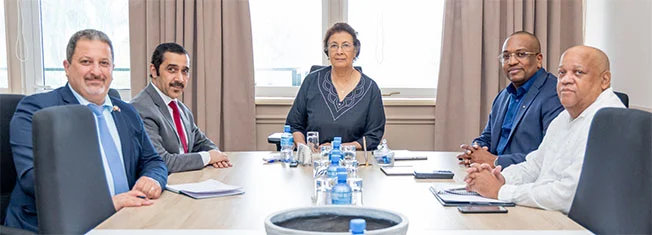
On November 21, Suriname’s Ministry of Foreign Affairs, International Trade and Cooperation (BIS) announced a new wave of deepening bilateral collaboration with Qatar, following a courtesy meeting between Surinamese President Jennifer Simons and Qatar’s non-resident Ambassador Ahmad Mohammed Al Shebani on the sidelines of Suriname’s annual Diplomatic Week.
Led by Surinamese BIS Minister Melvin Bouva, the two nations are currently finalizing four core bilateral agreements spanning visa-free travel, civil aviation, double taxation avoidance, and reciprocal investment promotion, with the goal of wrapping up all remaining pending documents by 2027. Two of the four pacts are already at an advanced stage of negotiation: the visa-free travel accord was formally signed by Minister Bouva and his Qatari counterpart in September 2025, while the civil aviation agreement is being prioritized to unlock expanded business travel routes and cross-border tourism flows between the two nations. The remaining two pacts covering tax regulatory alignment and mutual investment facilitation are still under active drafting, with ongoing consultations supported by Suriname’s Ambassador to Brazil Ike Antonius, after initial framework agreements were reached between Minister Bouva and Ambassador Al Shebani during a diplomatic gathering in Brazil earlier this year.
Beyond the four foundational agreements, both governments are laying the groundwork for a series of escalating high-level political consultations, starting with a ministerial bilateral dialogue between the two foreign affairs teams, followed by a full head-of-state summit to formalize shared cooperation targets. Minister Bouva emphasized that the core focus of the expanded partnership is economic collaboration, with Suriname seeking to leverage Qatari firms’ extensive industry expertise, operational experience, and robust capital pools to support its emerging offshore oil production sector. The partnership is not limited to energy, however: both nations are exploring mutually beneficial investment opportunities across infrastructure development, affordable residential construction, sustainable agriculture, tourism, and information and communications technology.
To support these cross-border investment flows, the Surinamese government is rolling out sweeping regulatory reforms to strengthen its domestic investment climate, with a draft national investment law set to be tabled before the National Assembly in the coming weeks, alongside proposed legislation to establish a dedicated national investment promotion agency. “Suriname is open for business,” Bouva stated publicly, noting that the country cannot meet all its large-scale development needs through domestic resources alone, making targeted international partnerships with strategic allies like Qatar a critical pillar of its long-term economic growth strategy.
Suriname en Qatar werken aan vier overeenkomsten voor nauwere samenwerking