A fresh standoff over judicial accountability and institutional independence has emerged in the Eastern Caribbean, with the Government of Antigua and Barbuda pushing back against regional judicial bodies’ criticism of Prime Minister Gaston Browne, while formally reaffirming its longstanding commitment to an independent judiciary and the separation of powers.
The controversy ignited in early August, when Browne delivered public remarks about sentencing practices during a National Security Council meeting. The comments came against a backdrop of mounting public anxiety across Antigua and Barbuda over persistent firearm-related violence and widespread public frustration that sentencing for serious criminal offenses has been disproportionately lenient. In response to these public concerns, the national parliament had already passed legislation in 2024 strengthening penalties for a range of firearms offenses, including introducing a maximum 15-year prison sentence for anyone convicted of unlawful firearm possession on indictment.
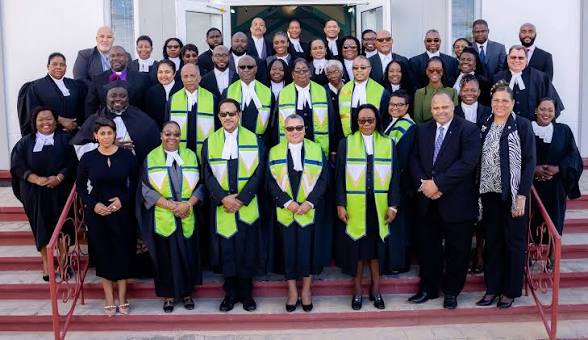
After Browne’s initial comments, the Commonwealth Magistrates’ and Judges’ Association (CMJA) issued a critical statement on August 14, and the Caribbean Heads of Judiciary followed with a joint statement expressing alarm that the Prime Minister’s remarks threatened core principles of judicial independence and separation of powers. Now, in an official letter addressed to CMJA Secretary General Dr. Karen Brewer, Antigua and Barbuda’s Minister for Foreign Affairs, Trade and Immigration, E.P. Chet Greene, has responded to that criticism, pushing the CMJA to review the full context of the incident rather than relying on partial information.
Greene emphasized in the correspondence that the Antigua and Barbuda government fully recognizes the CMJA’s legitimate mandate to protect judicial independence across the Commonwealth, and remains unwaveringly committed to the core tenets of separation of powers, security of tenure for judicial officers, the Commonwealth Charter, and the Latimer House Principles that govern relations between branches of government across Commonwealth nations.
Greene argued that the CMJA’s original August 14 statement failed to account for key subsequent developments that clarify the government’s position. These include Browne’s own public clarification of his remarks, formal correspondence between the Prime Minister and the Chief Justice of the Eastern Caribbean Supreme Court, and a formal response to the statement issued by the Caribbean Heads of Judiciary.
The government draws a clear legal and institutional distinction between legitimate public criticism of sentencing outcomes and improper executive interference with ongoing judicial decision-making. Officials stress that Browne’s remarks never sought to dictate the outcome of any specific pending case, reopen any matter that the courts have already concluded, or encourage any individual to disregard a formal court order. To date, the government adds, it has never defied a judicial ruling or court order of any kind.
A key point of clarification from Browne addresses fears of executive overreach against judicial officers: the Prime Minister explicitly confirmed that no judge would be removed, reassigned, deported, or targeted through unauthorized executive action. The government confirmed that all matters related to judicial tenure, assignment, and disciplinary action will be handled exclusively through processes outlined in the national constitution and existing law, and no extra-legal executive actions have been taken or are being planned against any judicial officer.
Browne has stood by his criticism of lenient sentencing practices, rejecting claims that this public criticism on its own amounts to an attack on judicial independence. The government notes that the Prime Minister’s clarification does not retreat from his concerns about sentencing outcomes, but rather sets clear constitutional boundaries for how those concerns will be pursued, aligning with the rule of law.
In his letter, Greene has formally requested that the CMJA publish the government’s full correspondence alongside the association’s original August 14 statement. This would allow CMJA members and the broader Commonwealth public access to what Antigua and Barbuda describes as the complete, unredacted record of events surrounding the controversy.
In closing, Greene reaffirmed that Antigua and Barbuda remains committed to upholding judicial independence, constitutional governance, public safety, and constructive collaboration between the three branches of state. He emphasized that these core principles are mutually reinforcing, and all deserve equal protection under the law.