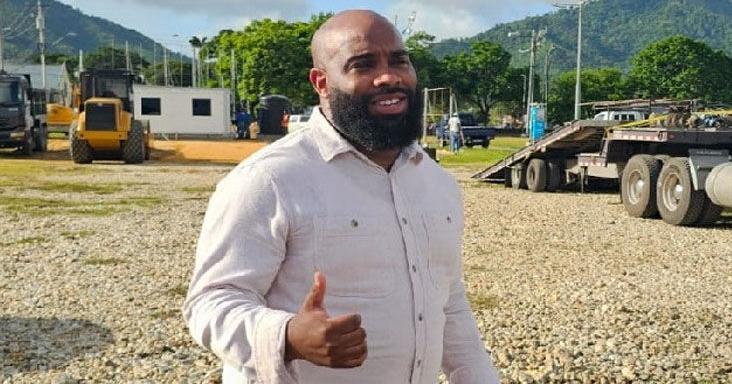
A standoff over an unconsulted joint army-police security post construction has escalated in Trinidad and Tobago, with the Tunapuna/Piarco Regional Corporation giving state authorities five days to respond to an official violation notice over the project at Eddie Hart Savannah in Tacarigua. Corporation chairman Josiah Austin laid out the details of the dispute during an on-site press conference on Wednesday, outlining a months-long breakdown in communication between local regional governance bodies and central state agencies.
The violation notice was formally delivered to the project’s contractor last Friday, Austin confirmed, after repeated attempts by the Corporation to arrange a sit-down with officials overseeing the construction fell through. The local governing body had originally requested a meeting with representatives from the Urban Development Corporation of Trinidad and Tobago (UDeCOTT) for 10 a.m. Wednesday, which was declined. A second request, offering flexibility to match authorities’ schedules, also failed to result in a scheduled dialogue. Austin emphasized that the corporation is only demanding basic, good-faith consultation on a project sited on land over which the Corporation holds jurisdiction.
While the corporation has received legal advice to pursue formal court action against the project, Austin said leaders are still weighing their options and hold out hope that a negotiated resolution can be reached to avoid litigation. Crucially, Austin stressed that the corporation does not oppose the creation of a new security post in the region entirely. Two other planned security posts in the area, at Grand Bazaar and Acono, have moved forward without any pushback from the local body, he noted. The conflict is rooted entirely in the lack of process and the specific complications of the Eddie Hart Savannah site.
“On this piece of land, which is vested under our Corporation, they moved ahead with construction with zero consultation and zero respect for our jurisdiction,” Austin said. “That is the core of this issue.”
Beyond the lack of advance discussion about the post itself, Austin raised urgent safety concerns about unannounced work carried out over the recent weekend on existing underground gas lines at the site. Senior industry officials informed him that construction workers arrived at the location early Saturday morning to map out existing National Gas Company (NGC) pipelines, then began excavation work that continued until 6 p.m. that evening. Crews dug between six and eight feet deep, carried out modifications to the lines, “blown out” the pipes to clear residual gas, then re-covered the excavation site. Austin questioned why neither the Corporation nor other relevant state agencies were notified before this high-risk work got underway, calling it a clear example of the dangers of skipping pre-construction consultation.
“My concern is that no consultation has taken place, not just with us, but with every other state agency that has infrastructure here,” he said. “Authorities only became responsive after we raised public concerns, rather than doing the right thing and talking to all stakeholders before breaking ground.”
Austin added that the Corporation already had a fully consulted, community-backed development plan for Eddie Hart Savannah that included a new police post, alongside major upgrades like a new public pavilion, expanded parking facilities, and improved recreational amenities. The planned police post in that master plan was sited at the southern end of the Savannah, selected after careful assessment of existing infrastructure including the grass running track, cricket nets, public restrooms, and planned future additions. That information would have been shared freely with state authorities if they had reached out for input, he said.
Austin’s criticism extends far beyond this single construction project, however. He used the press conference to highlight a growing pattern of central government undermining the authority of the country’s 14 regional corporations. Historically, regional corporations controlled hiring and project management for local development work, but Austin said that power has increasingly shifted to central government ministers and their departments, eroding local governance autonomy.
“This is a stance on behalf of all 14 regional corporations against what the central government is doing to our authority,” Austin said, adding that multiple other regional bodies have shared similar frustrations over lack of consultation on state-led projects in their jurisdictions.
Proper advance consultation would have avoided almost all of the current conflicts over the project, Austin argued. The site hosts a complex network of underground infrastructure, including NGC gas lines, WASA water lines, and buried cesspit lines that crisscross the entire area. Moving ahead without mapping and consultation has created unnecessary safety risks, he said.
“They just said they were coming here, and they showed up without talking to anyone. Senior local officers don’t know what’s happening, our corporation has no details, NGC only found out after work started, other agencies are in the dark. Who knows what other unexpected issues will pop up? At the end of the day, they went ahead without asking. They are acting like bullies in this situation. Now we will just have to wait and see how this gets resolved.”