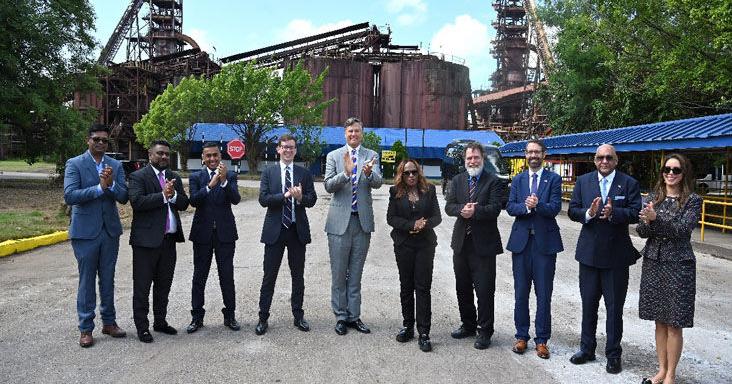
A shuttered steel manufacturing facility at Trinidad and Tobago’s Point Lisas is set to roar back to life, bringing back hundreds of lost jobs and unlocking billions in investment that signals a new era of economic cooperation between the United States and the Caribbean nation, U.S. Deputy Secretary of State Christopher Landau announced at a recent official ribbon-cutting ceremony.
First shuttered in 2016, the facility threw 644 skilled industrial workers out of employment when it ceased operations. Now, U.S.-based metals and industrial investment firm Pinnacle Steel and Vanadium Corporation is reviving the site through its local Trinidadian subsidiary, Ibis Steel Company of T&T Ltd. Over the first two years of the project, US$250 million in initial capital will be poured into refurbishments and upgrades, with total planned investment – including future expansion and facility modernization – set to hit US$750 million by the completion of all planned phases. Barring unforeseen delays in refurbishment work, regulatory approvals and local permitting, the plant is on track to deliver its first commercial output by the end of 2027.
At the ceremony held at the Pt Lisas Industrial Estate in Couva, Landau framed the project as a landmark mutual victory for both nations, far beyond the reopening of a single industrial site. “This is not just the metal that we’re seeing here; it’s the lives that are impacted,” Landau told attendees, referencing the 644 direct jobs that will be restored alongside dozens of indirect positions supporting the facility’s operations. “Those jobs are coming back… and that’s a win not only for Trinidad but also for the United States.”
Landau emphasized that the revival serves as a powerful example of how foreign private sector investment can reverse long-standing industrial decline and deliver tangible, widespread economic benefits to host communities. Comparing the restart to a biblical resurrection, he noted, “I think there is nothing more beautiful, frankly, than being able to see a plant like this that’s been shuttered come back to life. It’s like Lazarus arising from the dead again.”
For the United States, the investment addresses a pressing strategic and economic priority: securing stable, reliable access to critical industrial minerals that have become increasingly vital to national and economic security. For decades, the U.S. allowed its domestic mining and processing sectors to shrink, leaving the country dependent on foreign suppliers that may not align with American strategic interests. The Pt Lisas plant will process local ore and industrial residue into two high-demand materials: steel, used in everything from civilian skyscrapers to U.S. military battleships, and vanadium, a critical alloy that strengthens steel for industrial and defense applications. The project also repurposes century-old industrial waste tailings left from previous operations, turning a legacy environmental liability into an economic asset.
“We need these critical minerals. You need jobs. You have tailings and industrial residue that’s been left over from 100 years of industrialisation. This is a perfect example of what we’re talking about. That is great for Trinidad. It’s great for the United States,” Landau explained.
The investment also comes at a time when both the U.S. and Trinidad and Tobago governments are actively working to deepen bilateral economic ties. Landau noted that American businesses have grown increasingly hesitant to pursue cross-border investment opportunities in recent years, leading to frequent questions from global partners asking “where are the Americans?” The Pinnacle investment, he said, sends a clear signal that U.S. companies are returning to the Caribbean, and that the bilateral relationship is moving beyond rhetorical partnership to deliver tangible on-the-ground results.
Landau framed the Pt Lisas project as a symbol of a new, refocused chapter of U.S. engagement with the Caribbean region, crediting current Trinidadian Prime Minister Kamla Persad-Bissessar for opening new doors to cooperation that have not been available in six decades of prior relations. He stressed that the private sector remains the core driving force behind the project, noting that the restart would not have been possible without private investment leadership. Beyond economic and strategic gains, Landau said the revived plant will restore a sense of dignity and community pride to the Pt Lisas region, where workers lost their livelihoods nearly a decade ago.
“I really get choked up when I sit here, and I look out at these rusting steel mills to think, you know, this will again be a place where people can show their kids, ‘that’s where I work’. And I think that can be a source of great pride for the people of Point Lisas and all of Trinidad and Tobago, as well as for the people of the United States,” he said. Landau added that he hopes the project marks a new beginning for collaboration between the two nations, with many more mutually beneficial partnerships to come.