A bureaucratic misstep has led to a high-stakes legal dispute over a large shipment of unlicensed rice entering Suriname, after customs authorities ultimately seized the controversial consignment that was initially supposed to be seized by a different government agency.
The shipment, totaling 282 big bags of parboiled rice (over 385,000 kilograms), is imported by Guyanese entrepreneur Bhagwatpersad Ramadhin. Earlier announcements from Minister of Economic Affairs, Entrepreneurship and Technological Innovation Andrew Baasaron indicated that the Economic Control Service (ECD) would carry out the seizure operation. However, Starnieuws has confirmed that ECD inspectors never received required authorization from the Public Prosecution Service to execute the seizure. Instead, Suriname’s Customs service took action on Monday at 6:37 p.m., acting on orders from the Inspector of Import Duties and Excise, according to an official Customs report.
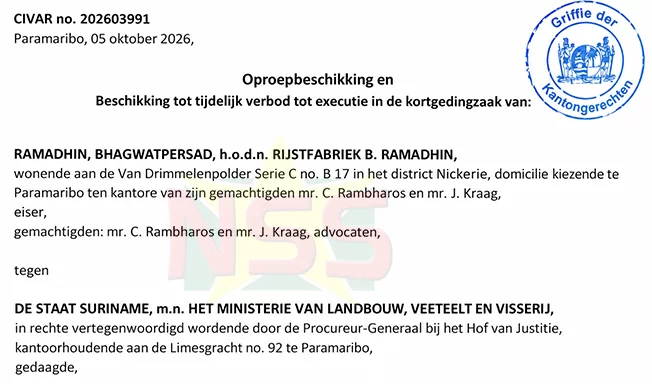
After seizure, the entire shipment was moved onto the vessel *Falk* and placed under constant armed supervision. The case was first brought before a judge on Tuesday, after Ramadhin filed a summary proceedings lawsuit against the Surinamese state. The importer is seeking court approval to have the rice inspected independently; if no phytosanitary safety risks are identified, he wants the shipment cleared for entry into Suriname’s domestic market. State representatives have pushed back against Ramadhin’s request, arguing that he failed to secure all legally required permits before bringing the rice across Suriname’s border.
Under current Surinamese trade regulation, rice is listed on the country’s “Negative List” of controlled imports, meaning no commercial shipment can enter without a pre-approved import license. As an agricultural plant product, rice is also subject to strict phytosanitary rules that require advance government approval for all imports. The official Customs report also sheds new light on how part of the shipment was accidentally released before the seizure.
The shipment was first declared to Customs on September 30. When officers attempted to verify the declaration and accompanying documentation in the automated ASYCUDA customs processing system, a widespread internet outage prevented access to the full set of submitted documents. According to the report, a representative for Ramadhin told Customs that all required paperwork, including approvals from the Ministry of Agriculture, Livestock and Fisheries and a valid phytosanitary certificate, had already been uploaded to the system by the importer’s customs broker. Since the shipment had also been processed and stamped by the Customs Exemptions Department, officers initially granted approval to release the entire cargo.
Shortly after the initial release, internet connectivity was restored, allowing Customs officers to conduct a full check of the system. To their surprise, the inspection confirmed that none of the required documentation was actually present in the system, as Ramadhin’s representative had claimed. Officers immediately halted further release of the cargo and ordered the portion of the rice that had already left the port to be returned to Customs custody, ahead of the full seizure.
Customs grounded its final seizure order in the 2020 Plant Protection Act, a national law that explicitly grants authorities the right to seize imported agricultural shipments when required documentation is missing. In court proceedings, the state has also reiterated that Ramadhin never submitted a request for advance phytosanitary import approval, and cannot produce a valid import license for the shipment, as required by law.
Prior to the seizure, Minister Baasaron had publicly stated that the ECD would lead the seizure operation, due to the shipment’s entry without required permits. He also announced an official probe into how Customs was able to accidentally release part of the cargo last month.
With the official Customs report now public, it is formally confirmed that Customs itself carried out the full seizure of the shipment. The judge has not yet issued a ruling on Ramadhin’s claims, and the legal proceedings are scheduled to resume on Thursday.