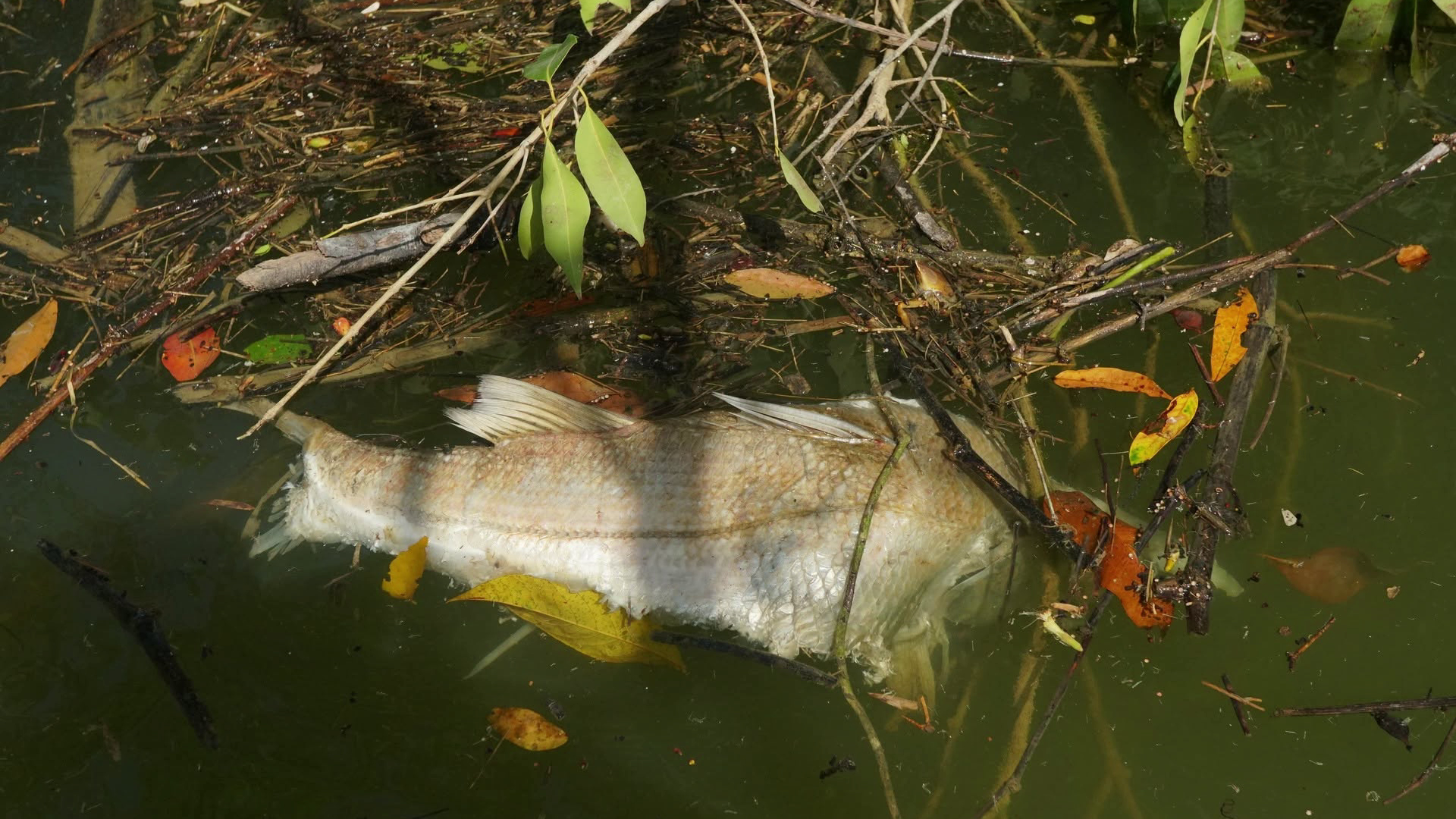
Nearly one week after hundreds of dead fish and multiple endangered reptiles were found washing up along a 17.5-mile stretch of the Belize River Valley, Belizean environmental authorities are expanding their probe into the massive die-off, with final lab results that could pinpoint the root cause expected as early as next week.
Preliminary on-site assessments have already confirmed dangerously depleted dissolved oxygen levels and other abnormal water chemistry across the affected river section, but investigators have not yet formally identified a triggering source or responsible party. To accelerate the inquiry, 13 local government and research agencies have pooled resources and expertise, marking a rare full domestic investigation that leverages Belize’s growing technical environmental capacity, rather than sending samples overseas for analysis.
In addition to hundreds of dead fish—including large predatory species like snook that form a critical part of the river’s food web—reports of dead crocodiles and multiple hicatee turtles have escalated alarm among conservationists. The hicatee, a freshwater turtle native to Central America, is classified as critically endangered, with already severely depleted wild populations. Experts warn any additional mortality from events like this die-off poses a major long-term threat to the species’ survival.
While the mass die-off appears to have stopped, researchers warn the ecological risks are not over. Dr. Donald McKnight, research director at the Savanna Field Station, which is conducting independent parallel research into the event, explained that toxins or contaminants that accumulated in dead fish could move up the food chain if scavenging birds and land animals consume the carcasses, expanding the impact beyond the river ecosystem.
“Even though the fish have stopped dying, if birds and other animals continue to eat the dead fish, the impacts may spread out from the river and actually affect a broader community of organisms,” McKnight said. “We know that multiple hicatee died. Their populations are really low to begin with, they’re a critically endangered species, so any added mortality on the hicatee is a really big problem. And a lot of the species that were dying were the really big predatory fish, things like your snook. That’s a problem for multiple reasons, from ecosystem balance to local recreational and subsistence fishing.”
Authorities have named two leading potential causes: agricultural runoff and recent widespread flooding in nearby farmlands. Satellite imagery captured before the die-off confirms severe flooding across large sections of agricultural land, including rice fields and sugar cane operations in the southern part of Santander Farm and surrounding properties. The large volume of floodwater, which would have picked up soil, fertilizers and other agricultural debris, drained directly into the Belize River.
Nitrogen and phosphorus from agricultural fertilizers can fuel rapid, harmful algae blooms that deplete oxygen from water as they decompose, creating hypoxic (low-oxygen) conditions that kill fish and other aquatic life. So far, preliminary findings point to low dissolved oxygen rather than direct toxic chemical contamination as the immediate cause of death, but full chemical analysis of fish tissue and water samples is still ongoing.
Public speculation has centered on operations by Santander Sugar, a major agricultural producer in Belize’s Cayo District, where the die-off occurred. The Belize Department of the Environment (DOE) launched a targeted inquiry into the company’s practices, but chief environmental officer Anthony Mai says Santander Sugar has fully cooperated with all inspection requests. The company has repeatedly stated it adheres strictly to its government-approved Environmental Compliance Plan, conducts routine internal monitoring to protect nearby waterways, recycles all process water rather than discharging it into the river, and repurposes sugar production waste as fertilizer for cane fields.
Local technical experts are conducting all testing in-country using Belize’s own advanced equipment. The Pesticide Control Board has already completed an inspection of pesticide application practices at Santander Sugar, and the DOE is cross-referencing that data with results from the department’s in-house gas chromatography–mass spectrometry (GCMS) machine, a highly precise instrument capable of detecting a wide range of chemical contaminants. The Belizean National Institute of Standard and Industrial Research (SIRDI) is also supporting the investigation by conducting soil sampling from flood-prone agricultural areas upstream.
Mai emphasized that carrying out the entire investigation with domestic expertise and infrastructure marks a major milestone for Belize’s environmental regulatory capacity. “This work is being done by local Belizean expert using local capacity and local technology. So I’m very pleased to say that for this, we didn’t have the need to send any samples abroad. It was done completely in country, which is a major step for us,” Mai said.
As of the DOE’s latest update, lab results are on track to be finalized and released to the public by next week.