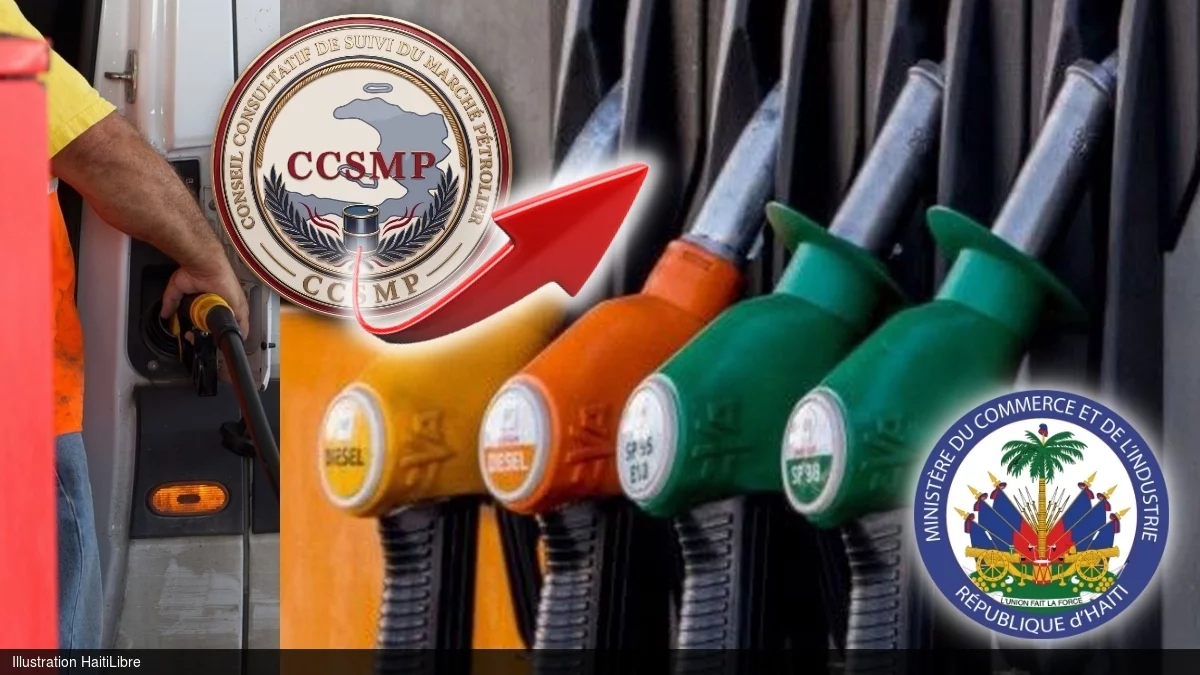
In an official announcement dated September 8, 2026, Haiti’s Ministry of Economy and Finance and Ministry of Commerce and Industry have rolled out updated pump prices for petroleum products across the country, following a formal recommendation from the country’s Petroleum Market Monitoring Advisory Council (CCSMP).
The new price schedule marks a controlled upward adjustment for all three major fuel categories. Gasoline, previously sold at 650 Gourdes per gallon, will now cost 700 Gourdes, a 50 Gourde increase. Diesel sees a 70 Gourde rise from 700 to 770 Gourdes per gallon, while kerosene gains 75 Gourdes, climbing from 690 to 765 Gourdes per gallon.
This incremental adjustment is not a full pass-through of global market costs to consumers, the CCSMP emphasized in its accompanying explanatory note. The advisory body calculated the full real cost of fuel at 879.22 Gourdes per gallon of gasoline, 861.39 Gourdes for diesel, and 788.87 Gourdes for kerosene — far higher than the new regulated prices. The decision to phase in increases comes after a full review of July 2026 fuel shipments, and is rooted in a framework of transparency, institutional accountability, and sensitivity to Haiti’s ongoing socio-economic crisis.
The CCSMP stressed that fuel pricing cannot be determined solely by budgetary and accounting needs, as every price shift ripples through every layer of daily life for Haitian citizens. Higher fuel costs directly raise transportation fees, push up grocery prices, raise operating costs for small businesses, disrupt agricultural production and domestic commerce, and make essential public services less accessible to vulnerable groups.
Against the current backdrop of widespread insecurity, mass population displacement, plummeting household incomes, soaring unemployment, and already eroded purchasing power, the Council warned that implementing the full calculated market price immediately would only deepen the economic and social vulnerability of Haitian families. The gradual adjustment is therefore framed as a deliberate compromise: it works to gradually close the revenue gap that the Haitian state currently carries for fuel subsidies, while avoiding the immediate shock of passing the entire cost difference on to consumers.
“The need to preserve public finances must go hand in hand with protecting purchasing power and preserving social cohesion,” the CCSMP stated, outlining its guiding principle for the recommendation.
Separately, Haiti’s Northeast Departmental Directorate of Commerce and Industry issued a public warning cracking down on unregulated illegal price gouging, a practice that has become alarmingly widespread in the region. The directorate emphasized that illegal overcharging does not only harm motorists — it sends inflationary shockwaves through transportation, food supplies, all goods and services, and undermines the entire national economy.
“We should never have reached a point where an illegal practice has become so widespread that the population has begun to consider it normal, right under the noses of the relevant authorities,” the directorate’s memo noted, adding that when the state sets a formal regulated price, that price is legally binding for all operators. Any vendor charging prices above the official schedule must provide verifiable legal justification for the markup, the agency said, noting that all claims of extraordinary expenses, security-related costs, or distribution chain disruptions will be subject to rigorous official investigation.
The department has made clear it will not tolerate exploitative price gouging that preys on the public or abuses consumer rights. It has issued a call to action for local communities, urging Haitian residents not to normalize illegal pricing practices, and to file formal official complaints whenever price violations are documented. To enforce the new price schedule, the directorate announced it will resume routine and targeted inspections at all service stations across the Northeast department, and will apply all relevant legal penalties for violations. The agency also requested coordinated cooperation from all other relevant government bodies to ensure consumer protections are upheld across the region.