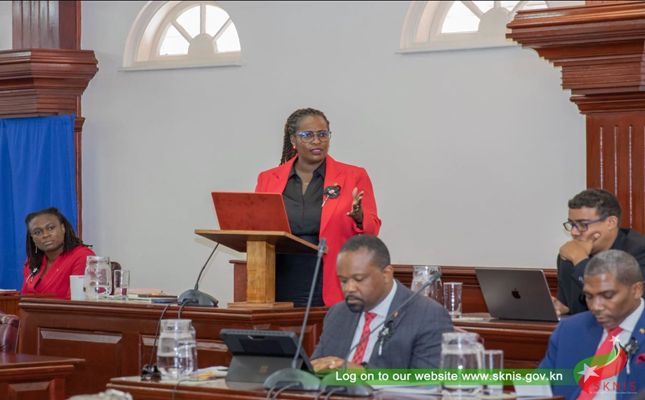
BASSETERRE, Saint Kitts – July 30, 2026 – As lawmakers in Saint Kitts and Nevis consider updates to the country’s extradition rules, Senator Dr. Joyelle Clarke has emerged as a prominent backer of the Extradition (Amendment) Bill 2026, framing the proposed legislation as a critical, long-overdue update to the federation’s ability to tackle transnational crime without compromising fundamental citizen protections.
Clarke threw her full support behind the bill while seconding it during a July 30 sitting of the country’s National Assembly, noting that the amendments are crafted to reinforce the federation’s legal infrastructure at a time of unprecedented global interconnectedness. Today, criminal suspects routinely cross international boundaries to escape prosecution, Clarke explained, and outdated national laws have not kept pace with this shifting landscape.
“Crime no longer respects borders. Persons who commit serious offences move between countries with an ease that our laws must be able to match,” Clarke told the assembly. “When such a person comes to our shores, this Federation must be able to answer the request of a country with which we have entered into a treaty. And when a person commits a serious offence here, against our people, our communities, and then flees, we must be able to bring that person back to face our own courts.”
At its core, the bill is a technical update that modernizes how evidence from countries requesting extradition can be submitted to Saint Kitts and Nevis’ domestic courts. Clarke emphasized that the change only adjusts procedural rules for evidence presentation, not the rigorous legal standard that courts must apply to approve any extradition request. Under the new framework, requesting countries will be permitted to submit evidence as certified official records authenticated by their relevant competent authorities – a format aligned with standard practice across most of the globe.
“It changes the form in which evidence may be presented. It does not change the standard our courts must apply,” Clarke clarified.
To address public concerns about potential overreach, Clarke explicitly reassured citizens that the amendments do not erode judicial oversight or weaken existing constitutional safeguards. All final extradition decisions will remain the exclusive purview of the country’s independent judiciary, she confirmed, with no executive branch minister or government official granted the power to order an extradition without formal judicial approval.
Beyond improving crime-fighting capacity, Clarke argued that a modern, functional extradition framework is key to upholding Saint Kitts and Nevis’ standing as a responsible global actor. Honoring existing extradition treaty commitments, she noted, strengthens the federation’s international credibility, protects its vital financial sector, supports long-term economic stability, and reinforces public confidence in the country’s justice system.
Clarke described the proposed changes as a modest but meaningful technical adjustment, one that preserves judicial control of extradition processes while allowing the federation to meet its binding international obligations in the global fight against transnational crime. She closed by commending Attorney General Hon. Garth Wilkin and his entire legal team for developing and advancing the legislation, and reaffirmed her full endorsement of the bill.