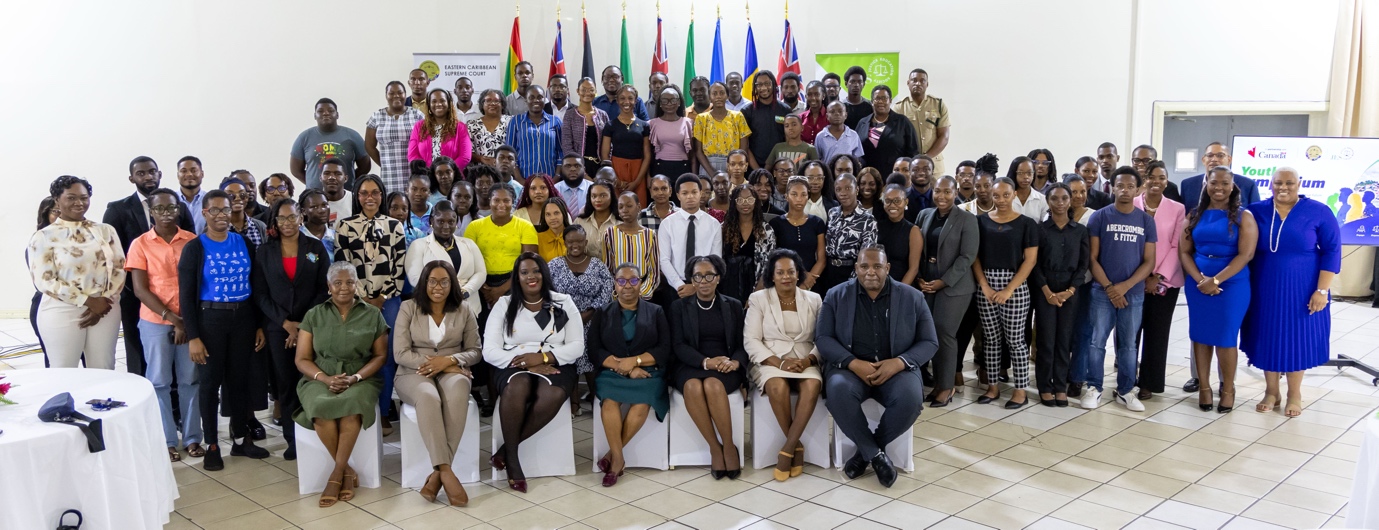
On July 10, the Grenada Trade Centre Annex played host to a landmark regional youth event that brought legal education directly to the next generation of Caribbean leaders. More than 100 young people based in Grenada gathered in person for the Eastern Caribbean Supreme Court (ECSC) and Justice Education Society (JES) Youth Symposium, with additional participants from across the Eastern Caribbean joining virtually to take part in the day of learning and dialogue.
Funded by the Government of Canada through the five-year, $4.5 million Judicial Strengthening for the Eastern Caribbean (JES-EC) Project administered by Global Affairs Canada, the symposium forms part of an expanding regional Public Legal Education and Information (PLEI) initiative. The project, which operates across Dominica, Grenada, St Lucia, and St Vincent and the Grenadines, aims to strengthen access to justice, boost legal empowerment, and build institutional capacity across the Eastern Caribbean, with a specific focus on expanding legal literacy for marginalized groups including women, youth, and vulnerable communities. This Grenada event follows on the success of a 2025 youth symposium held in St Lucia, with additional planned gatherings in Dominica and St Vincent and the Grenadines in the coming months.
The event opened with a welcome from Her Ladyship the Honourable Justice Paula Gilford, Senior Resident Judge for Grenada, followed by a keynote address from Her Ladyship the Honourable Margaret Price-Findlay, Chief Justice of the Eastern Caribbean Supreme Court. Price-Findlay’s presentation centered on the core role of the judiciary and the critical function of a robust justice system in upholding and protecting the fundamental rights of all citizens.
Throughout the day, participants engaged in hands-on interactive sessions led by sitting judges, practicing attorneys, youth advocates, law enforcement officials, and justice sector practitioners. The sessions covered a wide range of practical legal topics that directly impact young people in the region, including business and entrepreneurship law, property rights and estate planning, alternative dispute resolution through mediation, addressing cyberbullying, community policing frameworks, prevention of gender-based violence, and strategies for making informed positive life choices. The agenda also integrated spoken-word performances, open networking sessions, and facilitated group discussions that created space for young attendees to share their own perspectives and lived experiences, while reinforcing the core values of active citizenship and respect for the rule of law.
In remarks following the event, Chief Justice Price-Findlay emphasized that youth outreach is a foundational investment in the future of regional governance. “Youth outreach is essential to the effectiveness of this public education programme, as these young people will go on to become the future leaders of our countries — leaders who will influence every sector, whether economic, social or political. It is our intention to better educate young people about the judiciary and the court system as a whole, as a crucial element in the governance of their countries. We also hope that they, in turn, will play a part in educating others, including family members, friends, schoolmates and other persons with whom they interact,” she said.
Michele Gibson, Senior International Assistance Officer at Global Affairs Canada, highlighted Canada’s long-standing commitment to advancing the rule of law and democratic governance across the Caribbean. “Canada believes that young people are essential partners in advancing the rule of law, strengthening democratic values, and preventing violence in their communities. Through our support for the JES-EC Project, we are investing in opportunities that equip youth with legal knowledge, leadership skills and the confidence to become agents of positive change. When young people understand their rights and responsibilities and have a voice in shaping their communities, they help build safer, more inclusive and more resilient societies,” Gibson explained.
Lyndel Archibald, Project Director for the JES-EC Project, credited the cross-sector partnership for the event’s success, noting that collaborative investment in youth legal education builds a durable foundation for fair governance across the region. “We are pleased to collaborate with the ECSC and grateful to the Government of Canada for investing in our youth. This partnership ensures that young people across the region gain the tools to understand the justice system, and receive the knowledge and values to lead with fairness and justice. Together, we are building a foundation for informed citizens and stronger communities,” Archibald said.
Many youth attendees left the symposium feeling inspired and equipped to drive change in their own communities. One participant shared their takeaway from the event: “The highlight of the Youth Symposium for me was the opportunity to engage with passionate young leaders, exchange ideas, and learn from experienced facilitators and speakers. I especially appreciated the discussions on youth leadership, regional collaboration, and creating innovative solutions to challenges affecting young people. The networking opportunities and the sense of unity among participants were truly inspiring and motivated me to continue making a positive impact in my community and country.”
For the ECSC, the symposium reflects a growing institutional commitment to expanding access to justice beyond the walls of the courtroom, through intentional outreach, education, and open dialogue with regional communities. By creating direct pathways for young people to engage with justice sector professionals, the initiative fosters greater public trust and understanding of the judicial system, while empowering the next generation to take on active roles as informed citizens and community advocates. The initiative also advances Canada’s broader strategic goal of strengthening regional security and stability, as legal literacy is recognized as a core pillar of just and resilient societies. With the Grenada event completed, organizing partners are now preparing to bring the same model of interactive legal education to youth in Dominica and St Vincent and the Grenadines in the months ahead, advancing their shared vision of a more legally empowered, engaged, and equitable Eastern Caribbean.