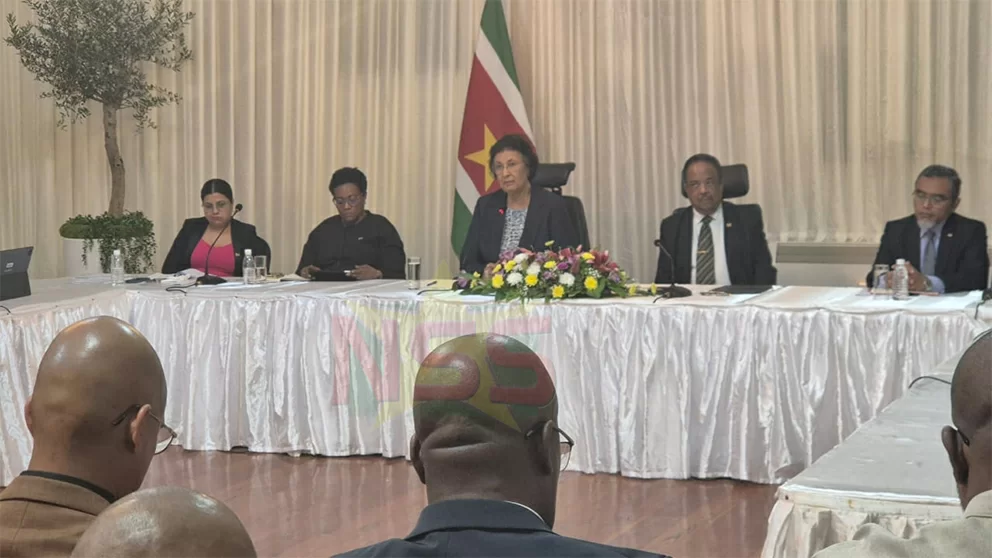
One year after taking office, Suriname’s President Jenny Simons delivered a frank progress update to reporters during a Monday press conference, acknowledging the slow pace of national recovery while outlining upcoming policy changes to tackle long-running systemic challenges.
Addressing public expectations for rapid change, Simons noted that repairing decades of damage accumulated over five years cannot be completed in just 12 months. She emphasized that at least a two-year transition period is required to put the country on a stable path, but added that the government cannot indefinitely claim limited financial resources as a barrier to action.
A core priority of the Simons administration remains reforming the country’s tax system, with five major tax reform bills currently under review by the National Assembly. Simons singled out unregulated gold mining, both legal and illegal, as a key area where the nation has failed to capture fair economic benefits. She admitted that fixing issues in the gold sector is far from straightforward, and the existing Gold Sector Ordering Commission has not delivered the results the government expected. To address this gap, the administration plans to establish a dedicated national gold authority, with draft enabling legislation expected to be submitted to parliament by the fourth quarter of the year.
Simons also drew attention to the severe environmental and public health harms caused by unregulated gold extraction, pointing out that toxic chemicals including cyanide and mercury have flowed into the country’s ecosystems unimpeded for years, with the problem growing progressively worse. She stressed that a turning point is urgently needed, and the government is drafting new legislation to push the sector toward less harmful, more sustainable extraction methods. “This is a path we will pursue with full seriousness,” Simons said.
The president highlighted an ongoing acute environmental crisis in the community of Pikin Saron and surrounding areas, where toxic pollutants have contaminated the Saramacca River. Initial investigations point to a leak from a local gold mining operation, possibly linked to local miner Grassalco or a Chinese mining firm operating in the region. Simons confirmed that investigative agencies have been ordered to deliver a full report with clear findings within two weeks.
Looking back on the first year of her administration, Simons said the national recovery phase is now underway. More than 50 corruption and misconduct cases have been submitted to the Public Prosecution Service, and state-owned enterprises have now been restructured with new executive boards tasked with stabilizing operations and driving long-term growth.
The president did not shy away from acknowledging setbacks. “Not everything we set out to do has been accomplished,” she said, noting that not all missing state vehicles have been recovered to date. Despite these challenges, public works and green space agencies have made progress on infrastructure repairs, the education sector has launched school renovation projects, and policymakers are working to address systemic flaws in the education system, including the persistent national shortage of qualified teachers.
Looking ahead, Simons announced that the government’s temporary fuel price cap, implemented to protect households from rising energy costs, cannot remain in place indefinitely. The measure currently costs the government 350 million Surinamese dollars per month to maintain, and will be phased out in the coming period. Simons did not provide a specific timeline or details on how the phase-out will be implemented, but confirmed that the government plans to introduce a moderate increase in civil servants’ salaries to offset upcoming cost of living adjustments.