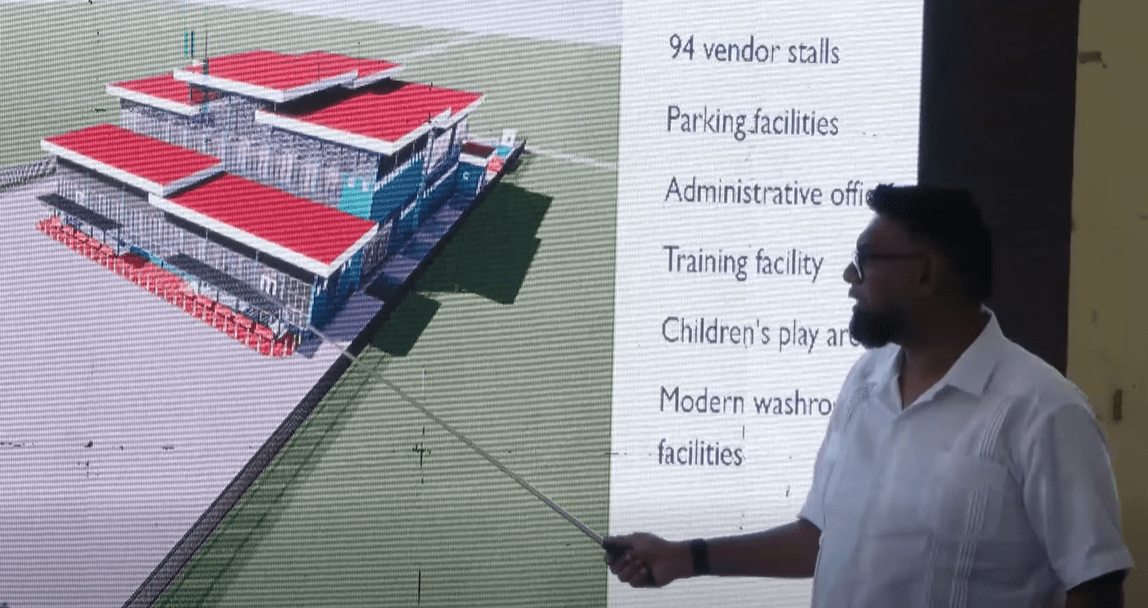
On Monday, August 3, 2026, Guyana’s President Irfaan Ali outlined sweeping community improvement plans under the government’s new model villages initiative during two public consultations held in Zeelugt, West Coast Demerara and Tuschen, East Bank Essequibo, promising transformative upgrades to quality of life for residents across Region Three.
During a meeting at Zeelugt Primary School, President Ali confirmed that the village’s popular but hazardous roadside snackettes – small food vendors that currently operate directly along the main public thoroughfare – will be relocated to a purpose-built new public market. The new facility will feature a dedicated section for these vendors, alongside a clean, safe, hygienic, and visitor-friendly food court designed to draw local patrons and tourists alike. Complementing the market development, the government has a large-scale waterfront regeneration project in the works that will add a public park and dedicated event spaces designed to host community gatherings without disrupting residential areas. Beyond food vendors, the plan also calls for consolidating spray-painting workshops, mechanic garages and other similar businesses into a single zoned location that minimizes noise, traffic and pollution impacts on nearby residential neighborhoods.
For Tuschen, located across the Essequibo River on the East Bank, the government plans to build a dedicated centralized logistics hub that will serve as a large-scale truck parking lot to remove heavy commercial vehicles from residential streets. Minister of Public Utilities and Aviation Deodat Indar, a Tuschen resident himself, detailed the breadth of infrastructure upgrades planned for the community: 89 kilometers of newly expanded, deep concrete drains that will double as water reservoirs to address flooding and water storage needs; reinforced road shoulders for all two-lane routes; pre-installed ducts for future utility service expansions; and a new bypass road connecting Tuschen to Windsor Forest that will redirect through traffic away from the village’s crowded residential core.
A centerpiece of the Tuschen upgrade is a GY$1.5 billion, 32,000 square-foot modern public market to be constructed at the rear of the village. Indar emphasized that the new facility will replace the informal, makeshift pallet-built stalls that currently serve vendors, raising community living and commercial standards long-term. Additional public safety and infrastructure upgrades include 168 new security cameras to support local law enforcement in crime reduction, the installation of new fire hydrants for improved emergency response, and 1,500 new street lights to boost nighttime safety and visibility. Maintenance of the upgraded community spaces will fall jointly to the Region Three administration and the Ministry of Local Government, Indar confirmed.
Housing Minister Collin Croal added clear expectations for community standards under the model villages initiative, stating that the government will not allow ongoing issues including derelict vehicles abandoned on public land, unregulated improper garbage disposal, long-term open storage of construction materials on public rights-of-way, and poorly maintained drainage systems that contribute to flooding. President Ali framed the model villages project as a holistic effort to improve resident quality of life, addressing not just physical infrastructure but also social cohesion, environmental cleanliness, and noise pollution reduction. “The quality of life that we experience in the community depends on the quality of our values, our culture, the way we treat the environment, the way we dump our garbage and the way in which we look out for each other,” he told attendees.