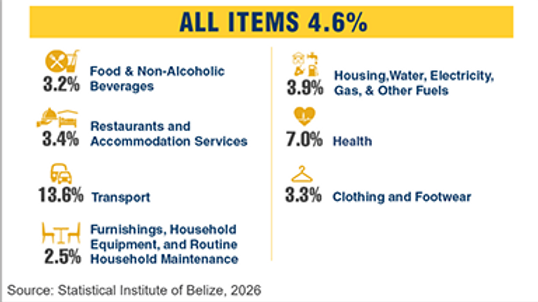
For the fourth straight month, skyrocketing transport costs have emerged as the dominant force pushing up inflation across Belize, new official data confirms. In June 2026, annual inflation for the transport sector hit 13.6% year-over-year, driving the country’s overall headline inflation rate to 4.6%, according to the latest Consumer Price Index (CPI) report published by the Statistical Institute of Belize.
The steep upward trajectory of transport costs traces directly to surging global and domestic fuel prices, which have put consistent pressure on consumer budgets throughout 2026. Diesel prices saw the most dramatic jump, soaring 34.3% from an average of $11.42 per gallon in June 2025 to $15.33 per gallon a year later. Regular gasoline rose 19.2% to hit $13.78 per gallon, while premium gasoline climbed 17.7% to $15.55 per gallon. Beyond fuel, passenger transport services also grew 15.5% more expensive, as providers of bus, taxi and international air travel passed increased fuel costs onto consumers through higher fares.
When combined with two other key spending categories — Food and Non-Alcoholic Beverages, and Housing, Water, Electricity, Gas and Other Fuels — transport accounted for more than three-quarters of the total increase in national consumer prices between June 2025 and June 2026. Across all consumer goods and services, the national All-Items CPI rose from 119.7 in June 2025 to 125.3 in June 2026, cementing the 4.6% annual inflation figure.
Breaking down inflation across other core sectors, Food and Non-Alcoholic Beverages posted a 3.2% annual increase, led by higher prices for fresh meats, sugar, fruit-bearing vegetables and baked goods. The housing and utilities category saw a 3.9% rise, driven by upward adjustments to electricity and water tariffs, higher liquefied petroleum gas prices, and growing residential rental costs. Health care costs jumped 7% year-over-year, while restaurants and accommodation services recorded a 3.4% increase.
Inflation rates varied across Belize’s municipal regions. The twin towns of San Ignacio and Santa Elena recorded the highest annual inflation rate among all municipalities at 6%, with broad-based price hikes hitting every major spending category from transport and groceries to utilities, medical care, dining and clothing. Meanwhile, the island tourism hub of San Pedro posted the lowest regional inflation rate at 3.4%.
Despite the strong annual uptick in prices, consumer costs held remarkably steady between May and June 2026. Month-over-month inflation clocked in at just 0.1%, as a 0.8% rise in food prices was almost entirely offset by a 0.5% drop in transport costs, triggered by a temporary reduction in regular gasoline prices during the month.
Looking at cumulative inflation for the first half of 2026, Belize’s year-to-date inflation rate stands at 2.5%. Transport has retained its position as the top contributor to price growth over this period, with cumulative price increases hitting 5.3% since January. Food and Non-Alcoholic Beverages and the housing and utilities category followed, both posting 2.1% cumulative price growth through the end of June.