For decades, Suriname has grappled with a persistent, well-documented crisis in its gold mining industry that has yet to see meaningful resolution. The scope of the problem is no secret to policymakers, regulators, and the public alike:
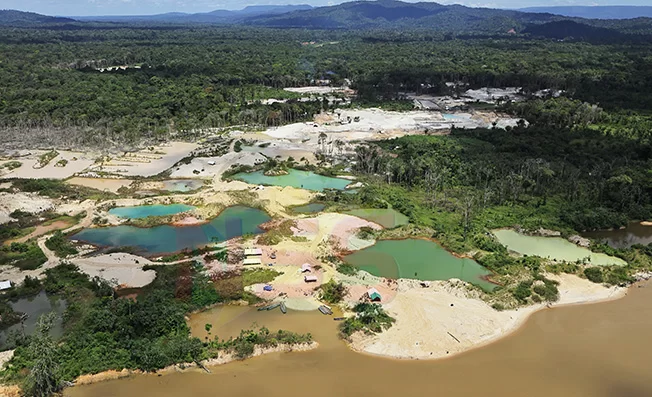
Authorities know exactly where unregulated, illegal gold extraction operations are located across the country. They are fully aware that artisanal and illegal mining has poisoned rivers with toxic mercury, cleared vast swathes of old-growth forest, and encroached on protected natural reserves that are critical to biodiversity conservation. They can calculate with reasonable accuracy the hundreds of millions in lost state revenue that illegal mining siphons away from national budgets every year. They also acknowledge the rampant human rights abuses plaguing informal mining camps, including child labor, systemic worker exploitation, and human trafficking.
Yet despite decades of public discussion, official commissions, draft reform plans, and repeated promises of new enforcement measures, almost no tangible progress has been made to fix the broken sector. This is the defining paradox of Suriname’s gold industry: the problems are not hidden, they have been widely recognized and discussed for generations, but action has consistently failed to follow recognition.
Even political leaders now openly admit that the barrier to reform is not a lack of solutions or regulatory tools. Ronny Asabina, chair of the Basic Party for Renewal and Democracy (BEP), correctly points out that the national government already possesses all the necessary legislation and legal authority to bring the sector under effective regulation. The failure, he argues, lies not in weak rules, but in weak enforcement of existing laws.
In a notable, high-stakes remark during parliamentary budget debates, Natural Resources Minister David Abiamofo pulled back the curtain on the root of this enforcement failure, revealing that top political figures from every major party hold direct or indirect financial stakes in the mining sector. This revelation cuts to the heart of the crisis: when influential leaders across the political spectrum have personal financial interests in the very industry the government is tasked with regulating, serious questions about the independence and effectiveness of any policy reform become unavoidable. This is not an unfounded accusation—it is an open reality that demands full, unflinching transparency from the country’s political class.
While political leaders delay action, the damage of inaction continues to pile up across the country. Ecological destruction grows more visible by the day: illegal mining operations continue to operate unimpeded along the Marowijne River, which forms the border between Suriname and French Guiana. A 2021 border protocol aimed at curbing cross-border illegal activity has sat unratified for years, though Suriname’s parliament, the National Assembly (DNA), is finally set to revisit the agreement this week.
Recent observations from National Assembly President Jennifer Simons further highlight the deep flaws in the current regulatory framework. Simons noted that nearly 40 companies hold active gold mining concessions, yet only a tiny fraction of these permit holders actually export gold legally. This fact alone demands a fundamental reckoning with how the country’s permitting system works, raising urgent unanswered questions: What is the true scale of gold smuggling out of Suriname? How much tax revenue does the state forfeit each year to unregulated extraction? How many concessions are actually put to active mining use, and how many exist only as tradable assets for speculative profit? Most critically, how much of the wealth extracted from Suriname’s soil actually benefits the broader Surinamese public?
These are not simple questions to answer, but they must be addressed to build a sustainable, transparent gold sector that serves the national interest. This debate has long outgrown being just about gold: it is now a test of governance, government credibility, and commitment to transparency. Ultimately, it is a test of whether Suriname’s rule of law can consistently enforce its own regulations, regardless of who holds influence. The stakes extend far beyond ecology: unregulated mining is a disaster for public health, erodes the quality of life for indigenous and local communities in the interior, and undermines the country’s already strained public finances.
No one can claim that Suriname’s authorities do not know what needs to be done to fix the sector. But for decades, a stubborn gap has persisted between acknowledging the problem and implementing solutions. This gap costs the country critical revenue, irreparably damages vital ecosystems, erodes public trust in government, and undermines the legitimacy of the rule of law. As one of Suriname’s core economic pillars, the gold sector deserves far more than the endless cycle of new plans, new commissions, and unfulfilled promises that has defined reform efforts to date.
President Simons has made a public promise to finally bring order to the gold sector. History will judge this promise not on words, but on tangible action—and that is where the greatest challenge lies. If the government is truly serious about reforming the sector, it will have to make difficult, unpopular choices that cut against the interests of powerful players. It will have to enforce the law against illegal activity, no matter who is involved or what political or financial interests stand to be harmed. That will almost certainly mean making choices that are unpopular within ruling party ranks and across the governing coalition.
History will not judge the current government on its pledge to reform the gold sector. It will judge it on whether the government was willing to apply the law equally, to all parties, without exception or favor. The laws to regulate the sector already exist. The only remaining question is whether Suriname’s political leadership has the will to finally put them into practice.