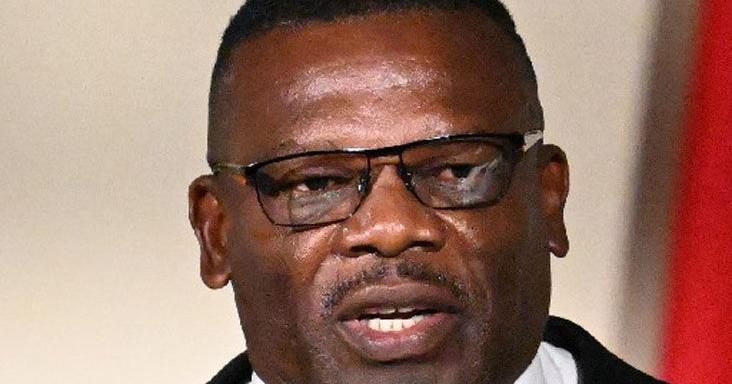
A political firestorm has erupted in Trinidad and Tobago after a leaked intercepted telephone conversation pulled the ruling government into accusations of unlawful surveillance and abuse of state power, prompting a sharp rebuttal from the country’s Minister of Homeland Security Roger Alexander.
At the center of the controversy is a 15-minute audio recording purported to capture a private chat between Genevieve Hadeed and her relative Star Sabga, during which Sabga reportedly made critical remarks targeting Prime Minister Kamla Persad-Bissessar, Attorney General John Jeremie and other senior government officials. The recording surfaced shortly after Genevieve and her husband Dominic, owner of Blue Waters, were released from police custody this past Thursday. Sabga, by contrast, remains in detention without formal charges and is currently waiting for a constitutional challenge hearing that aims to secure her release.
Opposition figures have rapidly condemned the incident, with former prime minister Stuart Young leading the scrutiny. Young has raised two urgent, unresolved questions: whether the communication interception was properly authorized under the country’s existing Interception of Communications Act, and how a confidential recording tied to an active police investigation was leaked to the public. Multiple other Opposition lawmakers have taken to social media to amplify their criticism of the disclosure, arguing it represents a troubling overreach of state surveillance authority.
In an official response to questions from local media outlet the Express on Monday, Alexander pushed back forcefully against all accusations, dismissing the Opposition’s claims as unfounded and politically motivated. The homeland security chief emphasized that the legal framework governing communication interceptions has long been in place, rejecting any suggestion that the current government introduced new, unregulated surveillance powers.
Addressing the People’s National Movement (PNM), the country’s main opposition party, Alexander noted that interception powers have been used in previous cases, with one ongoing court case already relying on intercepted materials as evidence. “The PNM must read and understand that this new generation of people is not the people of the past who only saw life through the PNM matrix,” Alexander said in his statement.
Alexander went further to turn criticism back on the Opposition, highlighting recent high-profile actions that he argues demonstrate the PNM’s own disregard for the rule of law. He pointed specifically to an incident Thursday night, where PNM chairman Marvin Gonzales publicly burned a court order served to the party related to financing arrangements for its Balisier House headquarters. Gonzales had claimed at the time that the party would not be intimidated by the legal action, but Alexander framed the act as a deliberate insult to legal process. “That is how the PNM is teaching society how to treat lawful documents,” he said.
The homeland security chief also called out the Opposition for previous questioning of decisions by the Director of Public Prosecutions (DPP) and members of the national judiciary. “So right now, all laws, all decisions, all statements are an abuse only when it was not made or done by them,” Alexander argued, accusing the PNM of holding a inconsistent, partisan double standard when it comes to evaluating state action.
Alexander added that Opposition figures have demonstrated a fundamental misunderstanding of the legal basis for public disclosure orders (PDOs) in the country, saying their criticism lacks logical foundation. He compared the PNM’s objections to PDOs to demanding authorities not file criminal charges for offenses like kidnapping or larceny, calling the Opposition’s position nonsensical. “It is quite clear that Opposition members do not understand the procedure,” he said. “They do not understand the reasoning behind the PDOs. They don’t want to acknowledge the rule of law because if they are making those statements, it is quite obvious that it is in fact law in Trinidad and Tobago.”
Closing his response, Alexander urged all critics to review the country’s existing surveillance and legal frameworks before issuing public statements, adding a pointed jab at legally trained Opposition members: “It seems not all persons who study law understand law.”