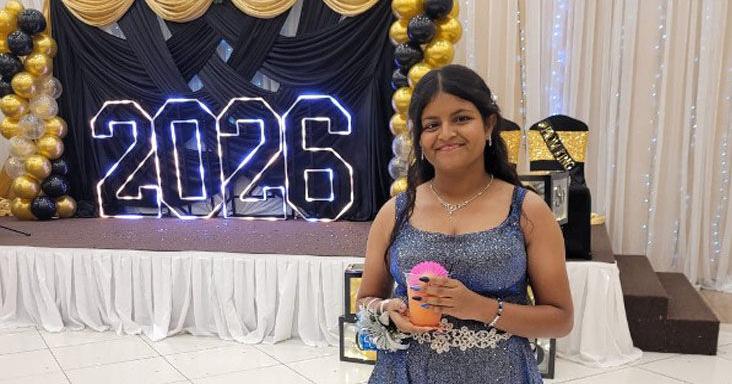
Eighteen years ago, a newborn named Hannah Bhagwandeen from Claxton Bay, Trinidad and Tobago, captured the compassion of communities near and far after being diagnosed with a life-threatening rare liver disease as an infant. Today, she stands as a global symbol of unbreakable resilience, celebrating a milestone many once thought impossible: graduating from secondary school.
Hannah’s story of struggle and perseverance began just weeks after her birth in December 2007. When she was born, doctors gave her a clean bill of health, and her parents Joshua and Thalia Bhagwandeen brought their first child home expecting a healthy new beginning. But just six weeks in, Hannah was diagnosed with biliary atresia, a rare condition that impacts just one in 20,000 infants worldwide. By the time she celebrated her first birthday, Hannah had already survived a life-saving Kasai procedure, followed by two liver transplants: the first used a portion of her father Joshua’s liver, and a second transplant from an anonymous deceased donor just three months later. All of her early complex surgeries were performed at Johns Hopkins Medicine International in Baltimore, Maryland, with millions in medical costs covered by generous donations from local and international readers after the Trinidad Express first shared her story.
By age five, Hannah had endured nine major surgeries, and faced additional long-term health complications: lifelong anti-rejection medication to protect her transplanted liver left her completely hearing impaired. In 2010, she received a cochlear implant in her left ear at Toronto’s Hospital for Sick Children, but the disability has remained a persistent barrier through her years of schooling. Despite this, Hannah never allowed her health challenges to limit her ambition.
Like all secondary students in Trinidad and Tobago, Hannah navigated the enormous disruption of the COVID-19 pandemic while preparing for her critical Secondary Entrance Assessment (SEA) exam. For Hannah, the shift to online learning created unique barriers: without in-person support from her classroom aide, she often struggled to follow instruction and keep up with coursework. With tailored support from her family—who adapted learning tools including custom charts, flashcards, and educational videos to suit her needs—and patience from her teachers, Hannah pushed through five years of secondary school, ultimately completing her Caribbean Secondary Education Certificate (CSEC) exams and walking the graduation stage in June.
Outside the classroom, Hannah has thrived in extracurricular pursuits, recently winning two medals at the Pan-Caribbean Martial Arts Tournament. She is an avid crafter, specializing in handmade stretch beaded bracelets, and shares a uniquely close bond with her younger sister Leah, who trains alongside Hannah in martial arts and consistently steps in to support her elder sister. The pair encourage one another’s goals, share a love of sport, and built their relationship on mutual care and respect.
For Hannah’s family, her graduation is far more than an academic milestone—it is a testament to the power of resilience and unconditional love. “Watching her walk across the stage to receive her certificate was a moment that represented years of hope, faith, and perseverance,” Joshua Bhagwandeen shared. “It was not just the end of secondary school—it was a celebration of overcoming extraordinary challenges. It brought tears to my eyes, seeing how much she has struggled, but made it through. We are very proud of Hannah.”
Hannah, who spoke to the Express after her graduation, said she feels immense pride in her achievement, crediting her family’s unwavering support for her success. “Being disabled doesn’t means you can’t do things you want to do, there are ways you can enjoy life,” she said. After graduation, she plans to take time to enjoy her favorite activities—crafting bracelets and training in martial arts—before pursuing her next goal, with her family fully committed to supporting whatever path she chooses.
Hannah still requires ongoing specialist care, including daily anti-rejection medication and regular blood tests to monitor the function of her transplanted liver. Because her medication suppresses her immune system, she must take extra precautions to avoid infection, but she is able to enjoy most of the same activities as any other young adult.
Sharing advice for other families raising children with disabilities and chronic health conditions, Thalia Bhagwandeen urged parents to hold onto hope even in the hardest moments. “There will be difficult days, moments of uncertainty, and times when you feel overwhelmed, but don’t give up,” she said. “Ask questions, advocate for your child, and celebrate every small victory. Hannah’s journey has taught us that resilience, love, determination, and hope can carry a family through even the most challenging circumstances.”