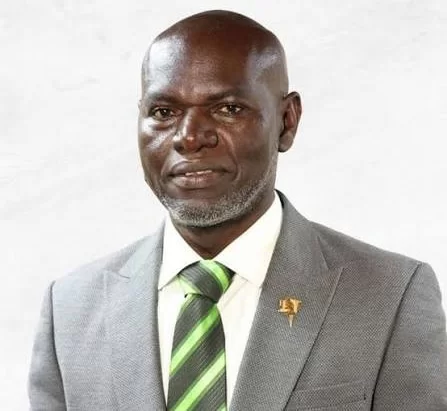
A senior leader of Suriname’s ruling coalition has exposed deep-rooted systemic failures plaguing the country’s critical gold mining sector, blaming entrenched overlapping political and economic interests for the consistent failure to enforce existing regulations. Ronny Asabina, chairman of the BEP political party, parliamentary faction leader, and a long-time resident of Brokopondo’s Marshallkreek district, made the allegations in an exclusive interview with local outlet Starnieuws, contradicting common narratives that weak regulation stems from insufficient existing laws.
Asabina emphasized that the national government already holds all necessary legal frameworks, data, and authority to bring order to the gold sector – the only missing element is genuine political will to act. Clear agreements on good governance and sector reform were reached within the ruling coalition when it took office, but tangible progress on the ground remains non-existent, he said. “The government knows exactly who holds every concession. The first step is simple: strictly enforce the terms of every active mining permit,” Asabina argued.
The BEP leader called out large-scale illegal subletting of mining concessions as one of the sector’s most pressing flaws. Under current permit rules, subletting is explicitly prohibited, yet the practice has become widespread. Many individuals who qualify for concessions do not engage in actual mining operations; instead, they treat the rights as speculative assets, subletting them to third parties or profiting from selling shares in the concession. Asabina noted that some concession holders do not even know the exact location of their own mining claims.
Alarmingly, this speculative practice extends far beyond professional mining operators, according to Asabina. Professionals from entirely unrelated sectors – including sitting politicians, lawyers, notaries, and even members of the clergy – hold concessions solely to trade them for profit, he claimed.
A further contributing factor to chaos in gold-producing regions is the systematic withdrawal of state presence from mining areas over recent years, Asabina explained. The mining inspection service, which once enforced regulations and oversaw activity in the country’s interior, has effectively ceased to function. As a result, private mining operators and equipment owners are left to provide their own security for staff, machinery, and gold stockpiles – a vacuum that has been filled by private security firms and armed groups that now exercise de facto control over large swathes of mining territory. “The state no longer provides security. Every operator has to figure out how to protect their own assets,” Asabina said. “That is how armed non-state actors gained so much power on the ground.”
Fixing the broken sector will require unprecedented political courage, Asabina stressed, pointing to recent public comments from Natural Resources Minister David Abiamofo, who acknowledged during national budget debates that high-profile figures from nearly all major political parties maintain direct ties to gold industry interests. “That tells you just how deep this problem goes,” Asabina said. “The government must be willing to act without fear or favor, regardless of who is involved. We need a firm, no-nonsense policy to cut through the rot.”
Recent tensions in the Sarakreek gold region serve as a perfect illustration of years of unresolved systemic issues, according to Asabina. He rejected official claims that the unrest stemmed from grassroots discontent among local communities, arguing that far larger political and economic interests were the actual driving force. Ronnie Brunswijk, chairman of coalition partner ABOP and a former vice president, has long been a prominent player in the gold sector, and Asabina says that widespread use of political influence to protect private economic interests has left the government unable to act independently and consistently. This interwoven power structure has eroded legal certainty and led to increasingly frequent violent escalations of concession disputes, he added.
Despite the sector’s many flaws, Asabina acknowledged that small-scale gold mining is one of the foundational pillars of Suriname’s national economy. Along with supporting connected industries including transport, equipment maintenance, supply, and retail, the sector is the second largest employer in the country – trailing only the public sector – providing livelihoods for thousands of Surinamese workers. However, a large share of gold production operates outside the formal economy, costing the state hundreds of millions in lost tax revenue annually.
The damage from unregulated mining extends far beyond lost government income, Asabina warned. The lack of effective governance in gold regions has spawned a cascade of interconnected social crises, including widespread environmental pollution, mass fish die-offs in local waterways, rampant illegal weapons possession, expanded sex work, child labor, rising school dropout rates, drug trafficking, and growing incursion by foreign criminal groups into Suriname’s mining interior. He also questioned the capacity of the country’s security services, noting that major drug seizures and enforcement actions almost always rely on intelligence from foreign partners or third-party tips rather than independent domestic investigative work.
“The problem is not that we don’t know what needs to be fixed – we’ve known for decades,” Asabina concluded. “The problem is that we refuse to do it. We promised the Surinamese people we would reorganize this sector and bring full transparency, and we have not delivered on that promise.”