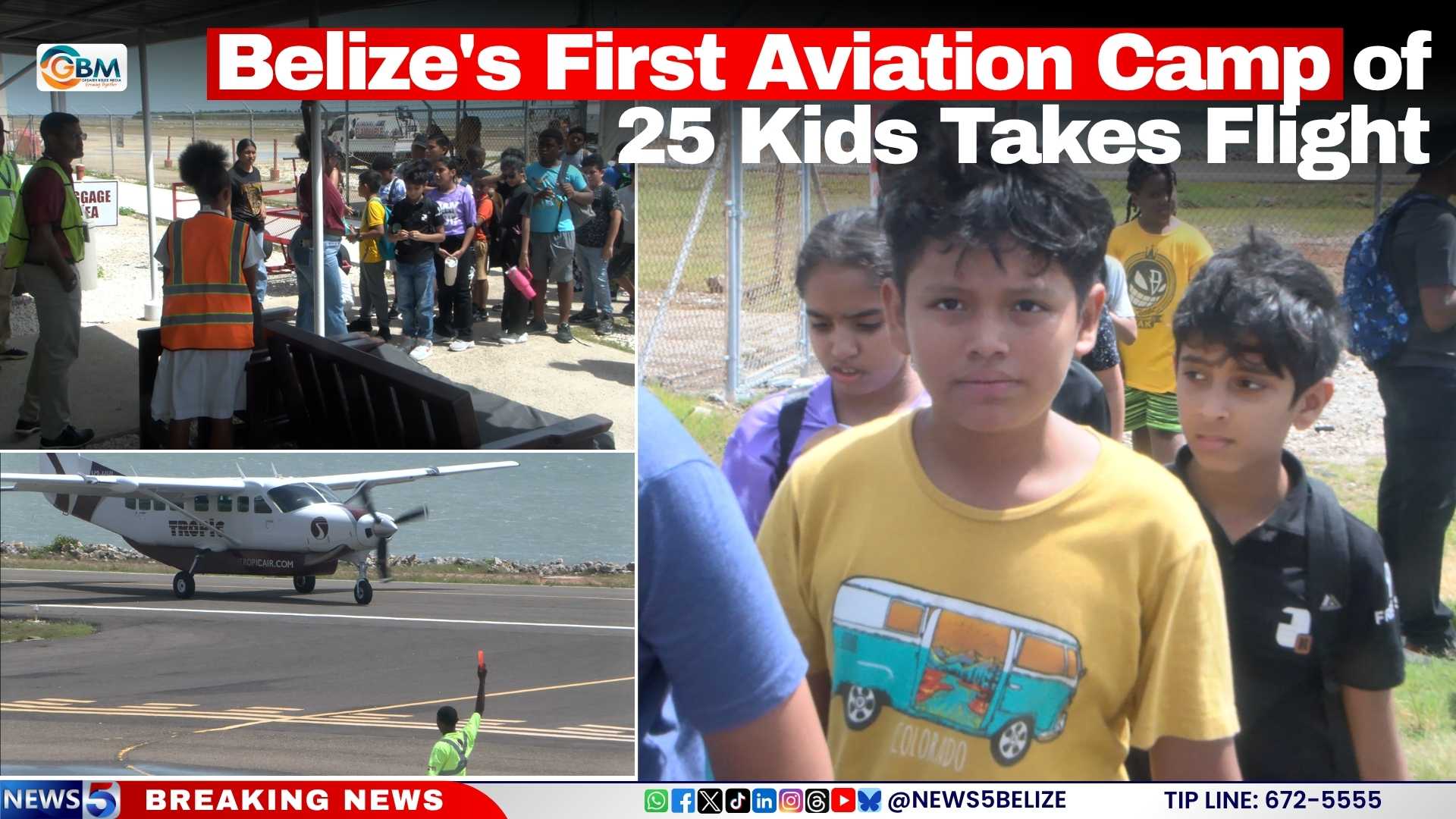
In a bustling hangar at Belize’s Sir Barry Bowen Municipal Airport, 25 curious young minds stepped beyond the passenger cabin this week to dive into the multi-faceted world of aviation at Belize’s first ever STEM Aviation Camp. Running for five full days, the week-long immersive initiative is designed to introduce local teens to the wide range of rewarding careers aviation has to offer, connecting classroom-based STEM learning to hands-on, real-world industry experience.
The trailblazing program is a collaborative effort between the cross-border non-profit STEMU Foundation, Saint Catherine Academy, Deep Blue Avionics, regional carrier Tropic Air, the Belize Defence Force (BDF) Air Wing, and the Belize Civil Aviation Authority, with sponsorship support from RF&G Insurance Ltd. Interest in the inaugural camp far outpaced organizers’ initial projections, with selected participants traveling daily from across the country — including Belize City, Belmopan, Orange Walk, and Corozal — to take part in the activities.
Jamie Usher, Vice-Principal of Student Affairs at Saint Catherine Academy and President of the Belize Robotics Federation, framed the camp as a new approach to making STEM education tangible for young learners. “As an educator and a female leader in STEM-focused careers, we are thrilled to create this space where hands-on, real-life experiences tie together science, technology, engineering, and math, while also building critical teamwork and problem-solving skills,” Usher explained. “It turns abstract textbook concepts into something dynamic and alive that young people can see themselves working in one day.”
The camp curriculum is structured to move students from foundational knowledge to on-site industry exploration. After the first two days spent covering core aviation theory, core industry vocabulary, and the standard international phonetic alphabet, participants moved to on-site visits, starting with the Sir Barry Bowen Municipal Airport hangar. The week’s schedule also includes guided tours of the BDF Air Wing facilities and the Belize Civil Aviation Department headquarters at the Philip S.W. Goldson International Airport, with planned time on the active flight line by the end of the week.
To date, organizers have introduced students to at least eight distinct aviation career paths, ranging from aircraft engineering and maintenance to airport firefighting, flight operations, and ground support services. Jarrus Mitchell, founder of the STEMU Foundation — a Belize-U.S. non-profit launched in 2023 to expand equitable access to high-quality STEM education across Belize — said an aviation-focused camp was a natural expansion of the organization’s mission. “This is our first annual STEM aviation camp, and our core goal is to give kids hands-on exposure to the full range of careers available in aviation that many have never heard of,” Mitchell said. He added that the foundation’s long-term vision for Belize includes expanding access to vocational training and professional development across a range of high-demand sectors, including engineering, agriculture, healthcare, and information technology.
For many of the young participants, the experience has already upended long-held assumptions about who can work in aviation and what careers the industry offers. After meeting Terry Folsom, an aviation engineer with Deep Blue Avionics, 14-year-old participant Damariel Aguilar said the experience changed her perspective on gender roles in the field. “I learned that both boys and girls can be pilots and engineers,” Aguilar said. “Miss Terry taught me that women can work in these roles just like men, just like she does.”
Fellow camper Abigail Rivero noted that the camp fills a critical gap in youth career preparation, giving young people early exposure to fields they would not otherwise encounter in standard school curricula. “This summer camp introduces kids to so many different fields that we don’t learn about in regular class,” Rivero said. “When it’s time to pick a career path, we’ll already have experience with these options, so we don’t have to wonder if we missed out on something we might love.”
Each student has taken away unique new skills aligned with their interests: For Skye Williams, the most memorable takeaway was a concrete lesson in applied physics, learning about the four core forces that enable flight: lift, thrust, drag, and weight. For Yuvan Lalwani, the week brought both a new understanding of industry communication and practical applied math. “I learned the phonetic alphabet: Y for Yankee, A for Alpha, B for Bravo,” Lalwani said. “I also learned how to calculate flight speed, and now I can figure out how long a trip will take before I even get on a plane.”
By the end of the week on Friday, participants will have completed a full journey from classroom theory to standing on the flight line of Belize’s busiest international airport, laying the groundwork for a new generation of Belizean aviation professionals.