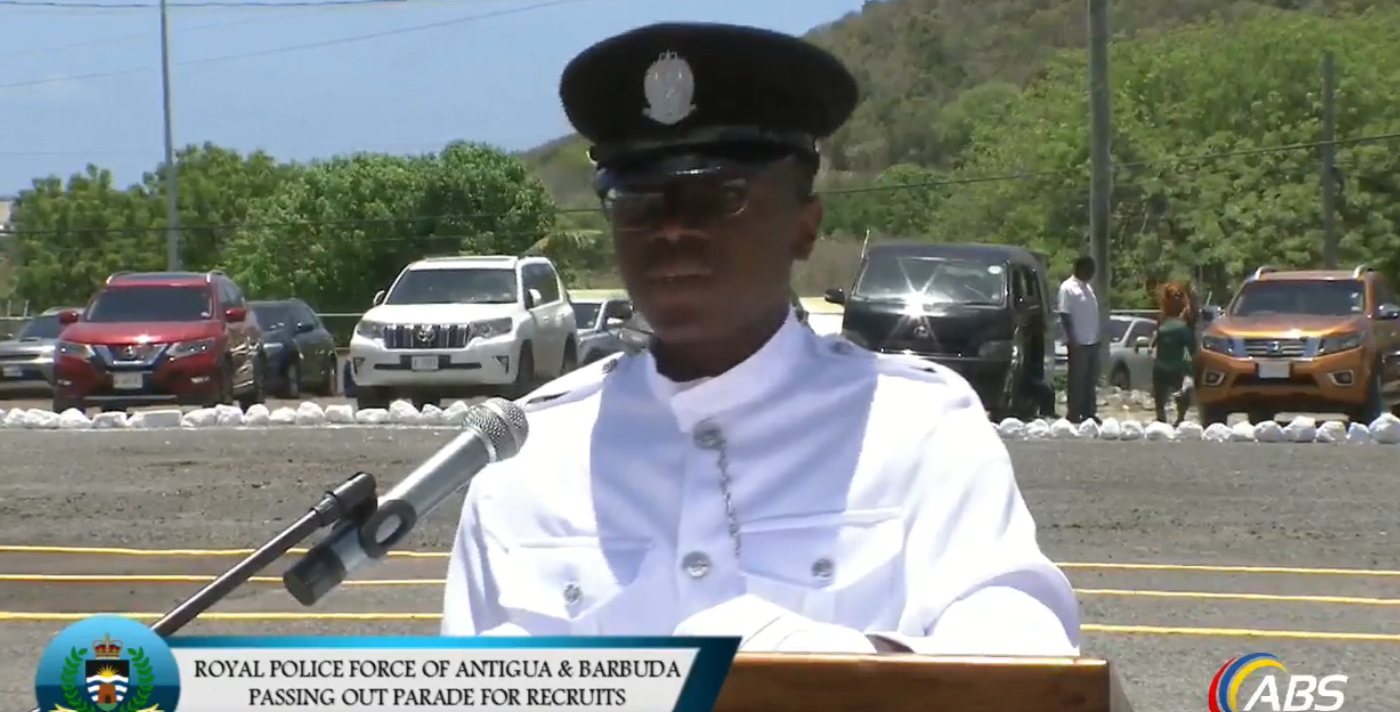
On a celebratory Thursday at the Sir Wright F. George Police Academy, 43 newly minted officers of the Royal Police Force of Antigua and Barbuda crossed the graduation stage to cap off six months of grueling recruit training, with their class valedictorian issuing a powerful reminder that policing is first and foremost a commitment to public service, not just authority.
Special Constable Dante Browne, the top-performing graduate of the force’s 50th Recruit Training Course, delivered the keynote address to his fellow graduates, guests, and police leadership, reflecting on the rigorous journey that turned a group of 54 aspiring trainees into 43 sworn officers ready to serve their communities.
Browne opened his address by walking the audience through the humble and humbling start of the cohort’s training. When the group first arrived at the academy, most arrived confident they understood the demands of a policing career, he recalled. That illusion shattered quickly, with the first harsh command from training instructors pushing recruits into unexpected physical exertion that left many questioning their choice to join the force. He quipped that many recruits experienced the physical strain in unflattering, unforgettable ways that drew laughter from the assembled crowd.
That early adversity, Browne emphasized, was intentional: it taught the class humility from day one and forced every trainee to confront their core motivations for pursuing a career in law enforcement. Of the 54 recruits who started the program, only 43 completed it — a attrition rate that Browne framed as a story of sacrifice, pain, and relentless perseverance. “That number tells a story — a story of pain, sacrifice and perseverance, a story of mental fortitude, of pushing forward when the body had stopped and the mind whispered doubts,” he said. “But more importantly, it is a story of purpose.”
Over the six months of training, Browne explained, the cohort built core foundational values that extend far beyond learning to enforce the law. On the parade square, they learned precision and unwavering discipline. Through grueling daily physical training, they built resilience and learned that excuses have no place in public service. In the classroom, they developed the professional judgment needed to serve and protect communities, with instructors emphasizing that policing is at its core a people-centered profession.
Browne specifically thanked the academy’s training team, singling out Chief Magistrate Nyoh Emmanuel and Senior Sergeant Donald Shackle for reinforcing the academy’s most critical lesson: that law enforcement work is rooted in serving people, not just writing citations or making arrests. He also extended gratitude to Commissioner of Police Everton Jeffers, the entire command staff, academy instructors, and the family members who supported the recruits through the demanding training period, noting that the graduates’ success would not have been possible without the collective sacrifice and encouragement of those around them.
In his closing challenge to his fellow graduates, Browne reminded the cohort that the badge they now wear carries a meaning far greater than symbolic authority. “As we stand here today, we must remember that the badge we now wear is more than just a symbol of authority. It is a symbol of public trust,” he said.
While Thursday was reserved for celebration, Browne noted that the real work of serving Antigua and Barbuda begins the moment graduates leave the academy. He urged his classmates to lead with courage when facing difficult situations, hold fast to integrity when their values are tested, and lead with compassion whenever communities need it most. He called on the new officers to support one another, hold each other accountable to the high standards of the force, and serve with unwavering honor.
“Service is not about convenience, it is about commitment,” he said. Closing with a rallying cry for public service, Browne emphasized that nations are built not by those who take the easy path, but by those who answer the call to serve even when it requires great personal sacrifice. “When duty calls, it is not comfort that responds. It is courage, discipline and an unshakable commitment to protect and serve,” he said.