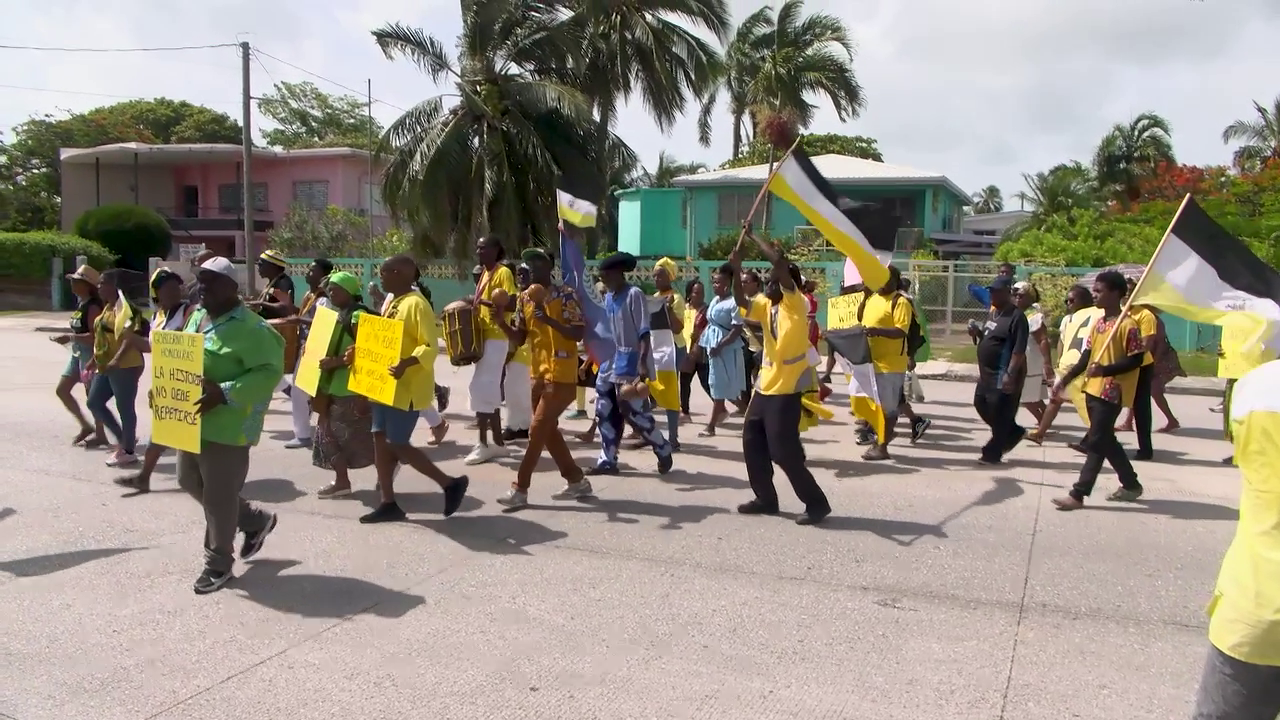
On July 14, 2026, more than 200 Garifuna community members and their allies filled the streets of Belize City, rallying in peaceful demonstration to stand with dozens of Garinagu families facing forced displacement from their centuries-old ancestral lands in San Juan, Atlántida, Honduras. The protest, organized by the National Garifuna Council (NGC), shines a global spotlight on a long-running land conflict that carries deep historical trauma for the transnational Garifuna people.
Under a banner of shared identity and kinship, the march echoed with the rhythmic beat of traditional drums and unified chants, as protesters made clear that the struggle in Honduras is not merely a dispute over territory—it is a fight for cultural survival, collective identity, and the fundamental human right to ancestral lands. According to accounts from displaced families in San Juan, Honduran military personnel have deployed armed forces to the area, using intimidation tactics to force 150 multi-generational Garinagu households off land they have stewarded since the late 18th century, to clear space for a government-approved large-scale tourism development project.
Jose Armando Guzman, a San Juan resident who has joined the resistance to the displacement, described the fear that gripped the community when armed troops first arrived. “At the beginning, we were scared because they were armed with rifles and guns as if they were going to war. But they are just trying to rob 150 families of their land. So we said, ‘No way. We are staying here,’” Guzman said in remarks shared at the Belize protest.
For Garifuna people in Belize, the crisis hits exceptionally close to home. Beyond shared cultural roots and a collective history, many Belizean Garifuna families have direct blood and community ties to the San Juan area, stretching back to a 1937 massacre that killed more than a dozen Garinagu in the same community and forced hundreds of survivors to flee across the border into Belize. Ifasina Efunyemi, Assistant Treasurer of the NGC, emphasized that collective solidarity is a core value of the Garifuna people.
“What happens to any one of us happens to all of us essentially. That is our fundamental principle as a people, and so we are joining with them to show that they are not alone. And these are our relatives. These are people that we are connected to by DNA. We had many Garinagu who fled from that very community back in 1937 as a result of a massacre by the government, right? And so this threat, when we saw the videos coming out of San Juan last week, you saw military strong, very strong and aggressive military presence in San Juan. And all our people could do was lift up their phones,” Efunyemi told reporters at the rally.
Following the peaceful march through Belize City, NGC leadership met directly with Carmen Scarleth Ayon Neda, the Honduran Ambassador to Belize, to deliver an official letter of protest addressed to Honduran President Nasry Asfura. The letter outlines the Garifuna community’s deep discontent with the displacement, urges the Honduran government to honor international conventions protecting Indigenous ancestral land rights, and warns that both the Belizean public and the global Garifuna community are closely monitoring the situation.
“That’s a letter that we wrote to the ambassador to present to the president of Honduras, expressing our discontent with what is taking place, reminding him that we do not want history to repeat itself, and also imploring on him to respect the rule of law, to respect the conventions that have been passed that protect our rights, our traditional spaces, and to alert him that Belize is paying attention and the international community is paying attention. So, it is in their best interest to do what is proper,” explained NGC President Alex Nolberto.
In response, Ambassador Ayon Neda confirmed that the letter would be delivered directly to President Asfura, and assured the council that the Honduran government would be made aware of the Garifuna community’s concerns. “Rest assured, I will present this document to the president of Honduras, Nasry Asfura, for him to do his work and for him to also recognize what is happening in Honduras. We, as Hondurans represented here in this country, we receive this document with regards to your Garifuna community, as our friends, as our colleagues, also as Hondurans,” she said during the meeting.
The protest is part of a growing global outcry from Garifuna communities across North and Central America, who have rallied to condemn the forced displacement and call for a peaceful, legal resolution that protects the San Juan communities’ right to their ancestral homeland. The NGC is continuing to push the Government of Belize to formally raise the issue with Honduran federal authorities, to elevate the crisis to regional diplomatic bodies if needed.