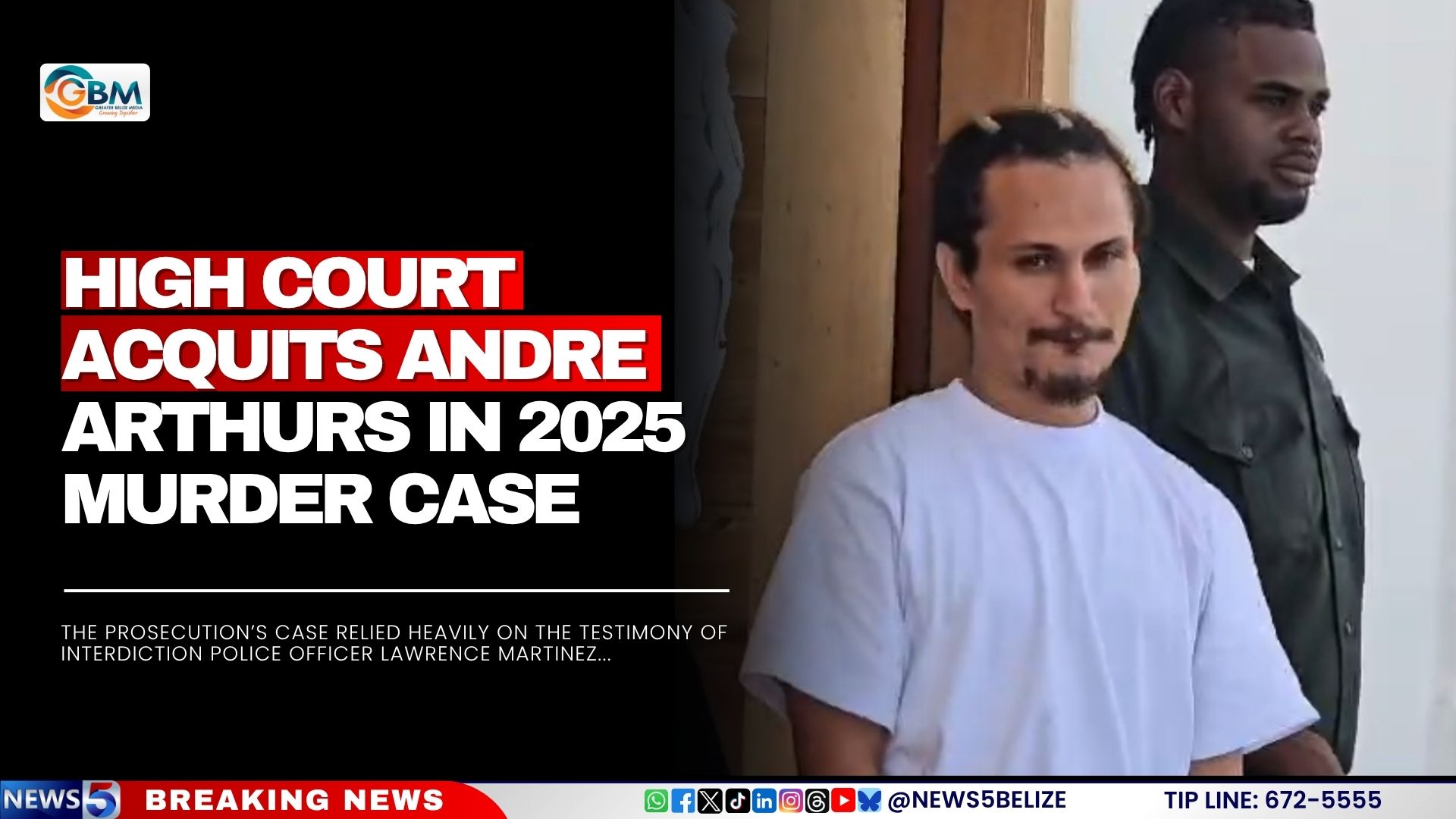
On a Tuesday session in July 2026, a dramatic conclusion unfolded at the Belize High Court: 28-year-old construction worker Andre Arthurs walked free after being acquitted of the 2025 murder of 33-year-old Mark Usher Jr. in Belize City.
Usher was killed in a public shooting at the intersection of Jabiru Street and Fabers Road in March 2025, a case that has dragged on for more than a year. Arthurs, a resident of the Fabers Road area, had been held in pre-trial detention after being formally charged with the fatal shooting. But the prosecution’s case quickly unraveled in court over a series of critical evidential gaps that the Crown could not resolve.
Presiding over the case, Justice Nigel Pilgrim delivered the not-guilty verdict after ruling that the prosecution failed to meet the required legal standard of proving guilt beyond a reasonable doubt. The entire prosecution’s argument rested almost entirely on the identification testimony of Interdiction Police Officer Lawrence Martinez. Martinez told the court that moments after the shooting, he observed a man in a blue shirt riding a bicycle away from the crime scene. He later picked Arthurs out during a group identification procedure.
While Justice Pilgrim acknowledged that Martinez appeared to be a sincere and credible witness on the stand, major procedural flaws in the identification process created unavoidable doubt. The court learned that the prosecution never provided evidence confirming that other participants in the identification lineup matched Arthurs’ core physical characteristics, including height, skin tone, age, and general build. Without that critical alignment, the court could not confirm that the identification was not a result of improper suggestion or chance.
The evidential deficiencies extended far beyond the flawed identification process. Investigators never tested Arthurs’ hands for gunshot residue, a standard step in most shooting investigations that could have tied him to the weapon. The prosecution also failed to produce any DNA evidence linking Arthurs to the crime, never recovered the alleged firearm used in the shooting, and never obtained a search warrant to connect the reported blue shirt to Arthurs. Even the suspect’s abandoned bicycle, a key piece of physical evidence described by the officer, was never properly accounted for in the investigation, leaving a host of unanswered questions about its connection to the case.
Justice Pilgrim emphasized in his ruling that the Crown bears the legal burden of proving every element of a criminal charge beyond a reasonable doubt. In this case, that meant confirming beyond question that the identification evidence was reliable enough to conclude Arthurs was the shooter. Without that certainty, any guilty conviction would be legally unsound.
Throughout the entire trial, Arthurs repeatedly maintained his innocence. He told the court that at the time of the shooting, he was at his home hosting a barbecue with friends, placing him far from the crime scene. After the verdict was read, Arthurs left the courthouse surrounded by supporting relatives, a free man after more than a year of legal uncertainty. Mark Usher Jr.’s mother, who attended the ruling to hear the outcome, left the courthouse shortly after the verdict was announced. Andre Arthurs was represented throughout the proceedings by defense attorney Simeon Sampson.